
Cults3D Review: A Free STL Files Repository Tested

Our hands-on Cults3D review digs into this independent STL marketplace: file quality, free versus paid models, payouts, and the quirks nobody warns you about. Read on before you download.
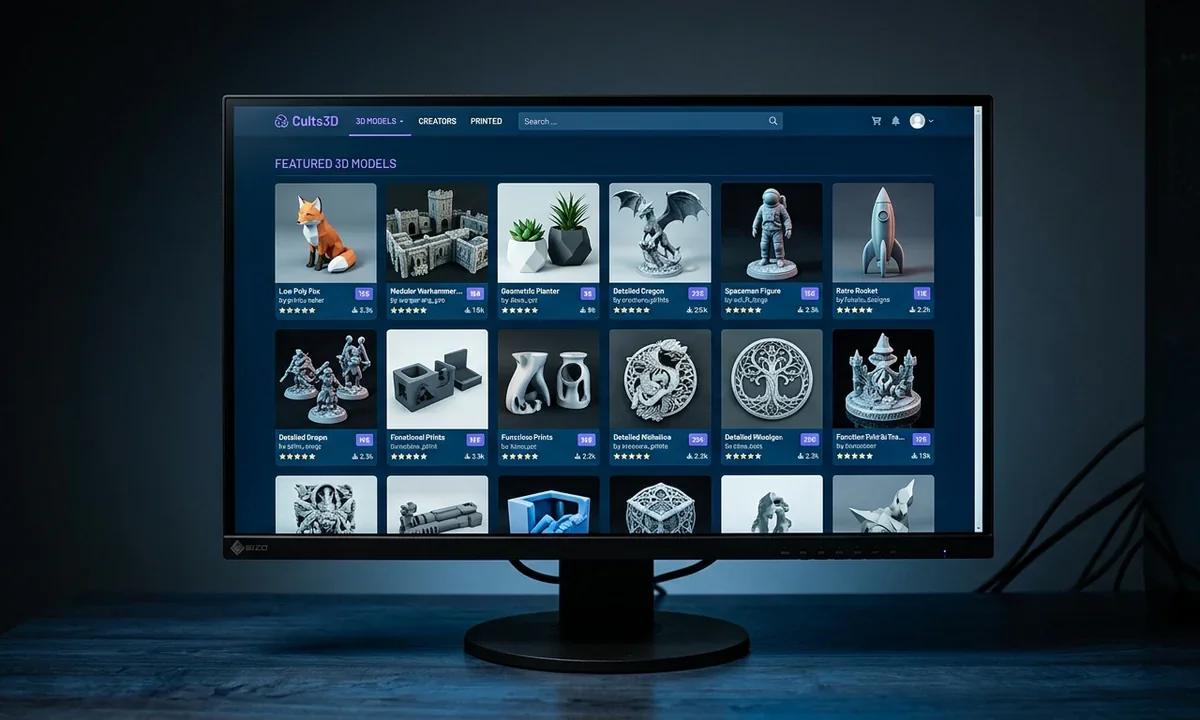
Few 3D model libraries split opinion as sharply as Cults3D. After several weeks of testing it across daily FDM printing projects, commercial design sourcing, and designer account evaluation, the short answer is yes: Cults3D is worth using, but not for exactly the reasons its homepage suggests. Its biggest strength isn't the size of the catalog alone. It's the balance between discoverability, paid creator incentives, and licensing clarity that many free repositories still struggle to match.
Launched in France during 2014, Cults3D has grown into an independent marketplace hosting roughly 3.4 million free and premium models from about 243,000 designers. That scale matters, yet volume alone never guarantees printable files. We tested downloads ranging from mechanical brackets and CAD accessories to tabletop miniatures, cosplay props, and replacement appliance parts, paying close attention to print quality, documentation, and licensing consistency.
This review targets two audiences. Makers deciding where to download reliable files will learn whether the platform deserves a permanent bookmark. Designers wondering where to sell their own work will see how its marketplace compares with larger ecosystems.
Our view is straightforward. Cults3D succeeds because it rewards creators while remaining useful for everyday hobbyists, although a few operational frustrations prevent it from becoming an automatic first choice for everyone.
Cults3D reviewWhat Cults3D Actually Is
Unlike repositories backed by printer manufacturers, Cults3D operates as an independent marketplace. That independence shapes nearly every decision the platform makes. Instead of pushing hardware sales or locking users into a branded ecosystem, the business earns revenue through a 20% commission on paid model sales. Designers keep the remaining 80 %, which creates a straightforward incentive structure without subscription requirements.
The catalog extends well beyond standard STL downloads. During testing we found listings containing OBJ, 3MF, STEP, and SCAD files alongside DXF and SVG resources intended for CNC routers and laser cutters. That wider format support makes the marketplace attractive to users working with Polygon Modeling, Surface Modeling, Solid Modeling, or Parametric design workflows. Engineers refining NURBS geometry and hobbyists exporting optimized meshes can often find source files that fit their preferred pipeline rather than relying on a single tessellated STL.
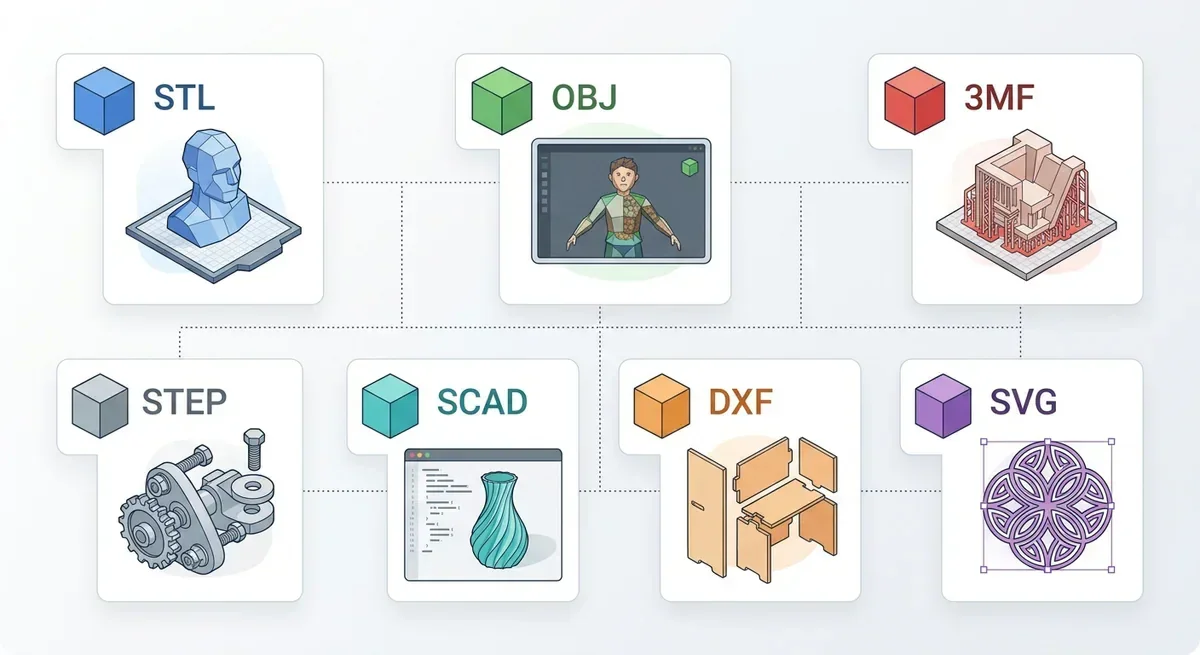
This image highlights the diverse file formats available on Cults3D, including STL, OBJ, 3MF, STEP, SCAD, DXF, and SVG, catering to various 3D modeling and CNC workflows.
One policy deserves genuine credit. Cults3D asks designers to include photographs of completed prints instead of relying entirely on polished renderings. We found that requirement reduced unrealistic expectations because buyers could compare digital previews with physical results. It doesn't eliminate poor uploads, but it raises the average standard.
The platform also mixes free and paid content naturally. Functional replacement parts, jewelry patterns, cosplay accessories, tabletop miniatures, decorative home objects, and educational models appear side by side. Filtering between free and premium listings takes only a few clicks.
Behind that enormous catalog sits a surprisingly small team. In practice, the lean operation explains both the platform's agility and some of its occasional moderation delays. The honest assessment is that Cults3D feels more like a specialized marketplace built by people who understand digital fabrication than a massive corporate repository.
Cults3D reviewInside the STL Library
1Search Experience and Discovery
Breadth defines the library almost immediately. Searches for practical repair components returned hundreds of printable options, while more specialized topics such as articulated creatures, jewelry masters, cosplay armor, and decorative organizers also produced extensive results. Filtering by free downloads, popularity, publication date, category, and file type kept exploration manageable, although broader searches occasionally surfaced duplicate imports and near-identical remixes.
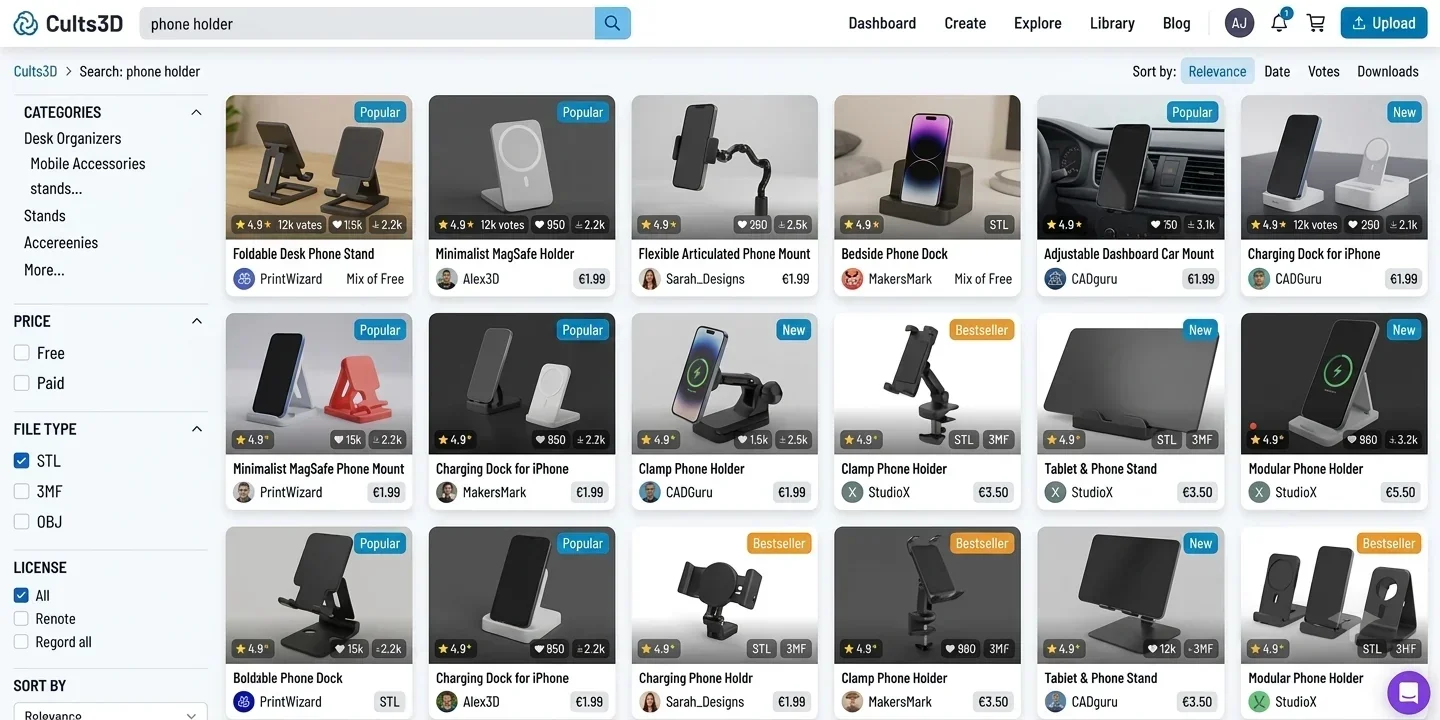
The Cults3D platform offers a diverse range of phone holder designs, showcasing the breadth of its STL file repository. Users can filter by popularity, price, and file type to find suitable 3D printable models.
During hands-on testing, I searched for replacement appliance clips, camera mounts, calibration tools, and tabletop terrain. Functional parts generally ranked well, and many included detailed photographs showing successful prints instead of computer renders. That visual evidence proved more valuable than download counts alone.
2Print Quality
No marketplace can guarantee perfect files. Even so, Cults3D performs better than many open repositories because contributors must demonstrate that a model has actually reached the printer.
We downloaded models representing different modeling techniques, including Topology-heavy character sculpts, Mesh Optimization examples, Decimation workflows, Retopology practice files, and highly detailed Tessellation exports. Most sliced cleanly without requiring manifold repairs. A handful still contained non-Manifold geometry or unnecessary mesh density, especially among older uploads, so experienced users should inspect geometry before committing expensive filament or resin.
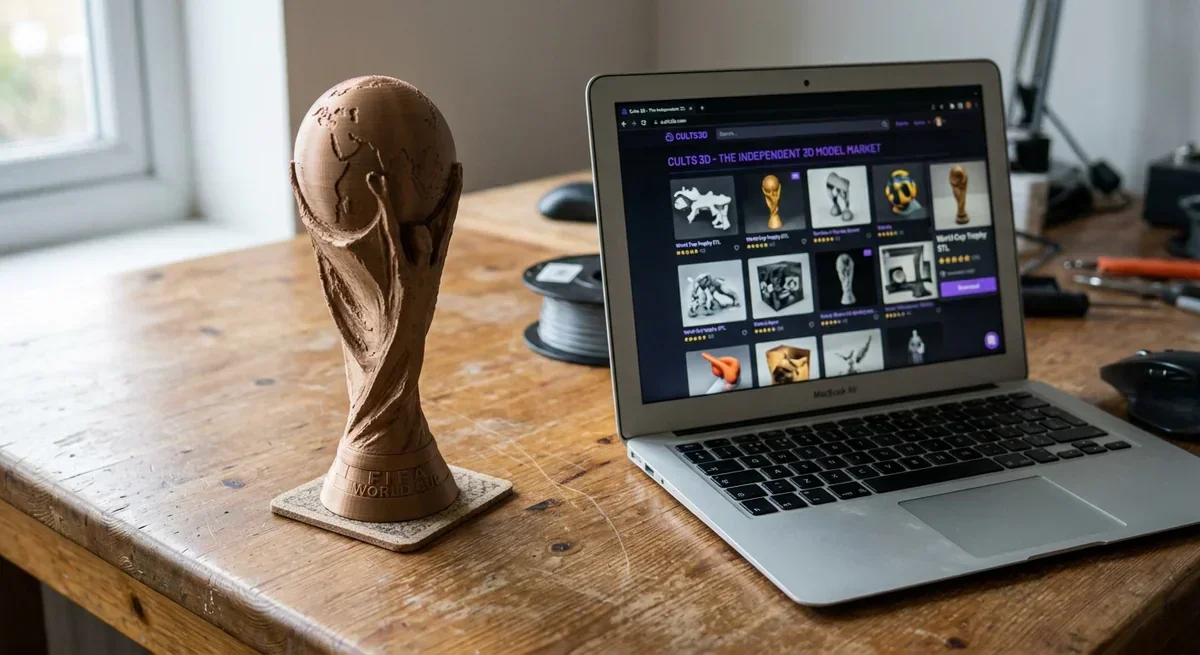
A 3D printed World Cup trophy sits beside a laptop showcasing Cults3D's STL file repository, highlighting the platform's diverse modeling options.
Community engagement adds another layer of quality control. Weekly featured collections, themed contests, user comments, favorites, and designer profiles help surface reliable creators instead of isolated uploads.
Key strengths became obvious after repeated use:
- Strong category coverage across hobby and professional niches
- Reliable filters for free and paid content
- Physical print photos improve buyer confidence
- Active creator community with recurring contests
- Clear designer portfolios that reward consistent quality
The library feels curated enough to save time without becoming restrictive. It still contains clutter, but finding genuinely printable models required noticeably less trial and error than several competing repositories we tested.
Cults3D reviewPricing, Payouts and Fine Print
For buyers, pricing stays refreshingly simple. You create a free account, browse both paid and free listings, then purchase individual models when something justifies the asking price. During testing, premium files ranged from roughly one dollar for small accessories to well over one hundred dollars for highly detailed cosplay kits, engineering assemblies, or commercial design collections. Most quality functional models clustered between three and fifteen dollars, which felt reasonable considering the time saved over designing them from scratch.
Designers work under an equally straightforward revenue model. Cults3D keeps a 20 percent commission from each sale while creators receive the remaining 80 percent. There are no monthly subscription charges, listing fees, or premium seller accounts.
The financial structure looks like this:
| Item | Buyer | Designer |
|---|---|---|
| Account creation | Free | Free |
| Listing fee | None | None |
| Platform commission | N/A | 20% |
| Creator revenue | N/A | 80% |
| Payout method | N/A | Hyperwallet |
Hyperwallet handles creator payouts. That works well for many sellers because it supports multiple withdrawal methods across different countries. Still, community discussions consistently reveal one recurring complaint: payout verification and transfers occasionally take longer than expected. We didn't experience a payout problem during our evaluation, but enough experienced designers have reported delays that prospective sellers should know about them before relying on the platform as a primary income source.
Licensing represents one of Cults3D's stronger areas. Listings clearly distinguish personal-use and commercial-use permissions, reducing the uncertainty that often surrounds free repositories. That matters if you sell printed products through Etsy or operate a small print farm. Reading each license still matters because permissions vary by designer, but the platform presents those differences clearly.
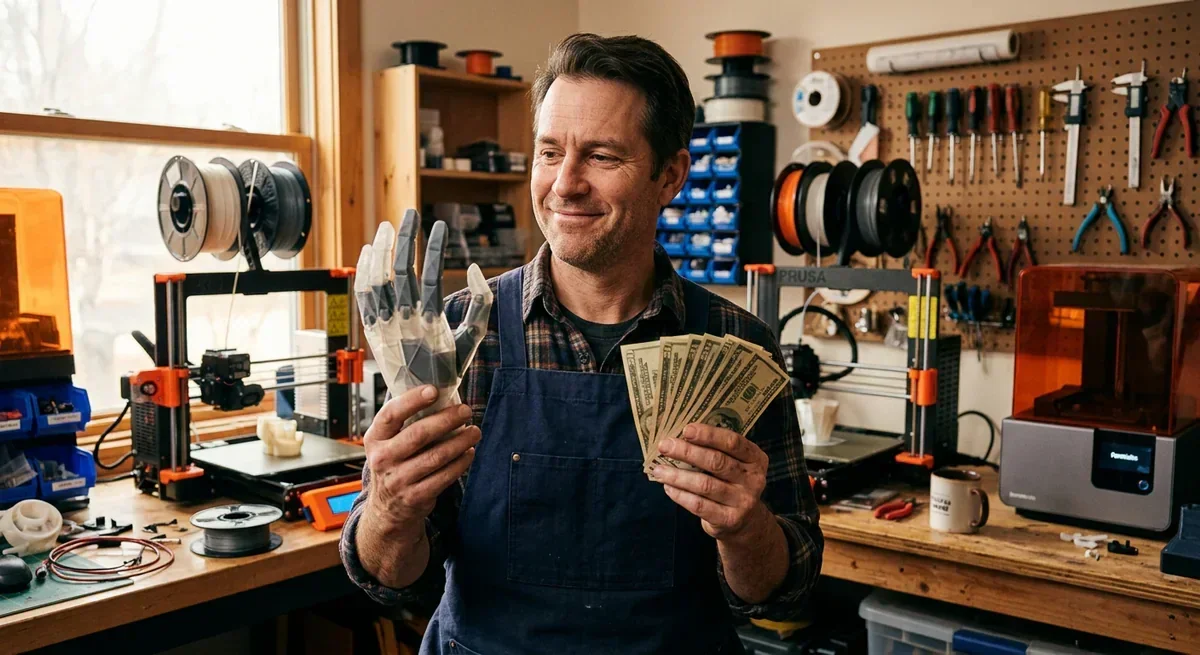
A maker showcases a 3D printed prosthetic hand alongside cash, highlighting the potential profitability of selling 3D printed products using STL files from repositories like Cults3D.
Discounts also appear throughout the year. Seasonal promotions, particularly summer sales, regularly reduce prices across selected collections, making premium downloads easier to justify if your wish list can wait a few weeks.
Cults3D reviewHow It Stacks Against Rivals
No repository dominates every workflow. Each platform reflects different priorities, and choosing the right one depends more on your goals than the raw number of available models.
The comparison below summarizes where each major competitor stands after practical testing.
| Platform | Cost | Quality Control | Creator Income | Independence | Best For |
|---|---|---|---|---|---|
| Cults3D | Free and paid | Good | Excellent | Independent | Buyers and sellers |
| Thingiverse | Mostly free | Variable | Limited | Corporate owned | Casual hobbyists |
| Printables | Free | Very good | Limited monetization | Printer brand | Reliable functional prints |
| MakerWorld | Free | Very good | Brand rewards | Printer brand | Bambu Lab users |
| MyMiniFactory | Mostly paid | Excellent | Strong | Independent | Premium miniatures |
Thingiverse still wins on sheer familiarity and free content. Unfortunately, inconsistent moderation means duplicate uploads, abandoned projects, and incomplete descriptions appear more often than they should. We found ourselves verifying printability much more frequently there.
Printables offers a cleaner browsing experience and consistently strong functional models. If your projects revolve around calibration tools, replacement parts, fixtures, or workshop accessories, Printables often reaches the finish line faster. Its community also rewards contributors through contests and ecosystem incentives, although direct sales remain less central than on Cults3D.
MakerWorld performs exceptionally well for owners of Bambu Lab printers. Integration with printer profiles simplifies the printing process, but that convenience comes with tighter ties to a hardware ecosystem. Users outside that environment gain fewer advantages.
MyMiniFactory targets premium collectible creators. Detailed miniatures generally surpass equivalent listings elsewhere, though buyers pay accordingly.
Our view is that Cults3D occupies the middle ground better than anyone else. It combines marketplace economics with a broad searchable catalog and reasonable quality expectations. Free repositories still win if budget outweighs everything else. Designers hoping to monetize original work, however, will probably find Cults3D's balanced approach more attractive.
Cults3D reviewThe Good, Bad and Frustrating
Cults3D inspires unusually strong reactions, and after spending time on both sides of the platform, that polarization makes sense. Buyers who find reliable designers often become loyal customers because the marketplace saves hours of searching across multiple repositories. Sellers who build an audience appreciate the straightforward commission structure and the visibility that featured collections and contests can provide.
The strongest advantage remains creator support. Unlike repositories that focus almost entirely on free sharing, Cults3D gives designers a realistic path to earning income from quality work. That incentive attracts skilled modelers producing well-optimized files instead of quick uploads assembled with little attention to print success.
The weaknesses become noticeable during longer sessions. Search results occasionally contain duplicate listings or older models that no longer match current design standards. Site performance also fluctuated during our testing. Pages sometimes loaded more slowly than expected, particularly when browsing image-heavy categories.
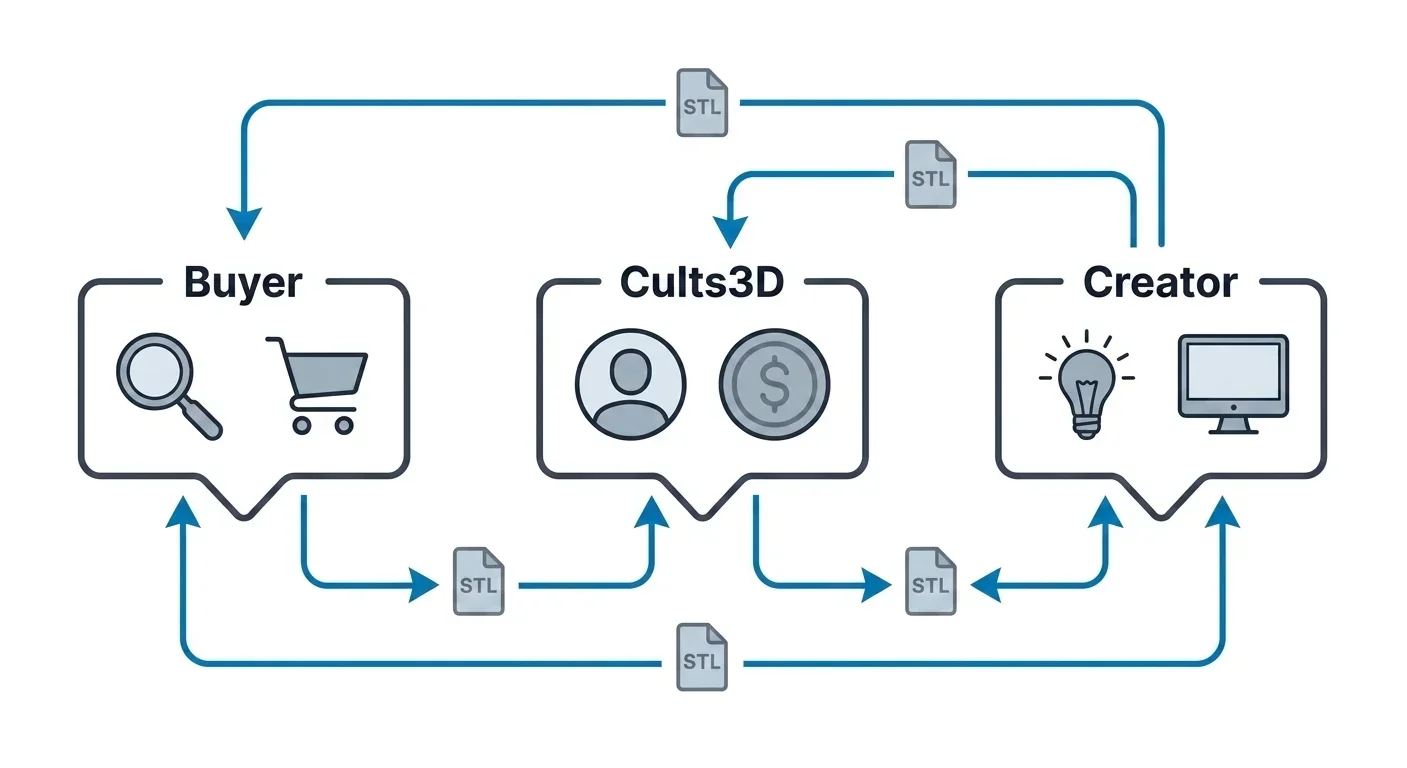
This diagram illustrates the STL file exchange process on Cults3D, highlighting interactions between buyers and creators.
Community feedback reveals another recurring concern. While many designers report smooth experiences with Hyperwallet, others describe delayed payouts or lengthy verification processes. Those reports do not represent every seller, but they appear often enough across user discussions that they deserve consideration before depending on marketplace income.
1What Works Well
- Excellent balance of free and premium models with broad category coverage.
- Clear licensing reduces confusion for commercial printing businesses.
- Print photographs improve confidence before downloading.
- Strong incentives encourage experienced designers to publish quality work.
2Where It Falls Short
- Duplicate or outdated listings occasionally clutter search results.
- Site responsiveness varies during busy periods.
- Some creators report payout delays that can disrupt cash flow.
The honest assessment is simple. None of these drawbacks qualifies as a deal-breaker for most buyers. Professional sellers, however, should treat payout timing as a business consideration rather than an afterthought.
Cults3D reviewOur Verdict on Cults3D
After several weeks of downloading, printing, comparing, and evaluating files across multiple workflows, our rating lands at 4.5 out of 5. Cults3D succeeds because it balances creator compensation with a library large enough to solve real printing problems. Few competing platforms manage both equally well.
 Cults3D
Visit Website →
Cults3D
Visit Website →
Perfect for:
- Casual makers who want access to both free and premium printable models.
- Serious hobbyists looking for specialized designs that rarely appear elsewhere.
- Independent designers who want to sell files without paying subscription fees.
Skip it if:
- You only download free models and never intend to purchase premium files.
- You need guaranteed instant seller payouts as your primary source of business income.
- You prefer repositories tightly integrated with a specific printer ecosystem such as MakerWorld.
Our view is that Cults3D has earned a permanent place alongside Printables rather than replacing it outright. Each platform excels in different situations, but Cults3D offers the strongest overall balance between marketplace flexibility, creator opportunity, and printable content quality.
Start your search here if you value choice, licensing clarity, and access to talented independent designers. If every dollar matters and free downloads satisfy your needs, Printables or Thingiverse may still serve you better. For everyone else, especially creators hoping to monetize their work, Cults3D remains one of the most compelling destinations in today's 3D printing community.
Industrial designer and consultant specialising in 3D scanning and 3D modeling for product development. Produces comprehensive guides and in-depth reviews to help professionals choose the right digital capture and design tools.