
Complete Bambu Lab H2D Review: Performance and Print Quality

Bambu Lab's dual-nozzle H2D promises big performance and versatility. Our complete Bambu Lab H2d Review tests the hype against real-world results. Is it worth your money? Let's find out.
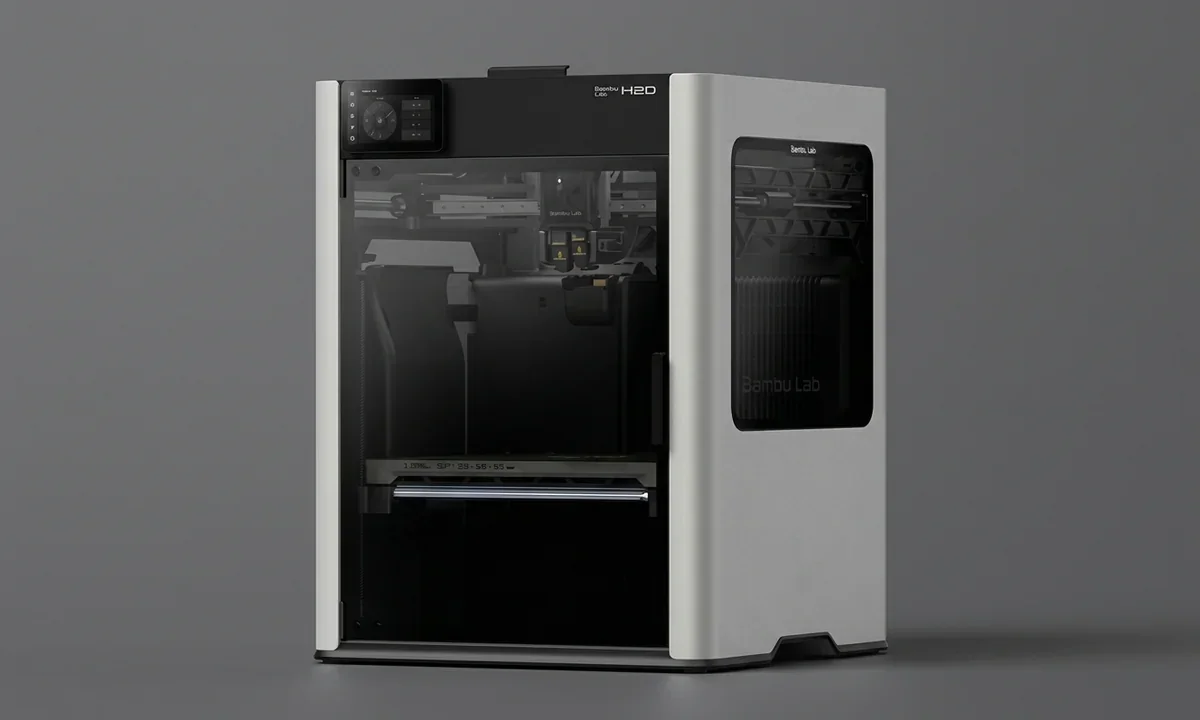
Bambu Lab H2D reviewMeet the H2D
Bambu Lab built its reputation by making high-speed FFF printing approachable without stripping away the controls experienced makers expect. The X1 Carbon proved that automatic calibration, reliable motion control, and polished software could coexist in a desktop machine, while the P1S delivered much of that experience at a lower price. The H2D sits above both. Rather than refining a single-nozzle platform, it expands the ecosystem with true dual extrusion, a larger build volume, and optional laser and digital cutting modules that push the machine beyond traditional 3D printing.
After testing the H2D across three weeks of daily production work, including functional prototypes, engineering parts, and multi-material assemblies, one conclusion became clear: this is not simply an X1C with two nozzles. The hardware changes reshape how complex jobs move from design to finished part.

Configurations range from the base printer to the AMS Combo and premium laser-equipped versions, with pricing spanning roughly $1,899 to $3,499 depending on accessories. Those differences matter because workflow capabilities change dramatically between packages. This review focuses on real printing performance, build quality, practical workflow improvements, measurable print results, and whether the premium price delivers meaningful value instead of impressive specifications alone.
Bambu Lab H2D reviewUnboxing and Build Quality
Opening the shipping carton immediately reinforces that Bambu Lab positions the H2D as a flagship machine. Dense foam surrounds every structural component, accessories arrive in individually labeled compartments, and nothing shifts during transport. Heavy desktop printers often suffer cosmetic damage before reaching the customer, but the packaging here reflects careful planning.
Inside the box, Bambu includes the printer, dual hardened hotends, maintenance tools, spare wear components, documentation, calibration accessories, power cable, sample filament, and setup materials. Consumables remain fairly limited, so anyone planning extended testing should have additional filament ready from day one.
Lifting the printer out of the packaging requires two people. At well over thirty kilograms depending on configuration, the H2D occupies considerably more desk space than the X1C or P1S. That larger footprint pays dividends once large engineering parts enter the picture, but buyers should confirm workspace clearance before ordering.
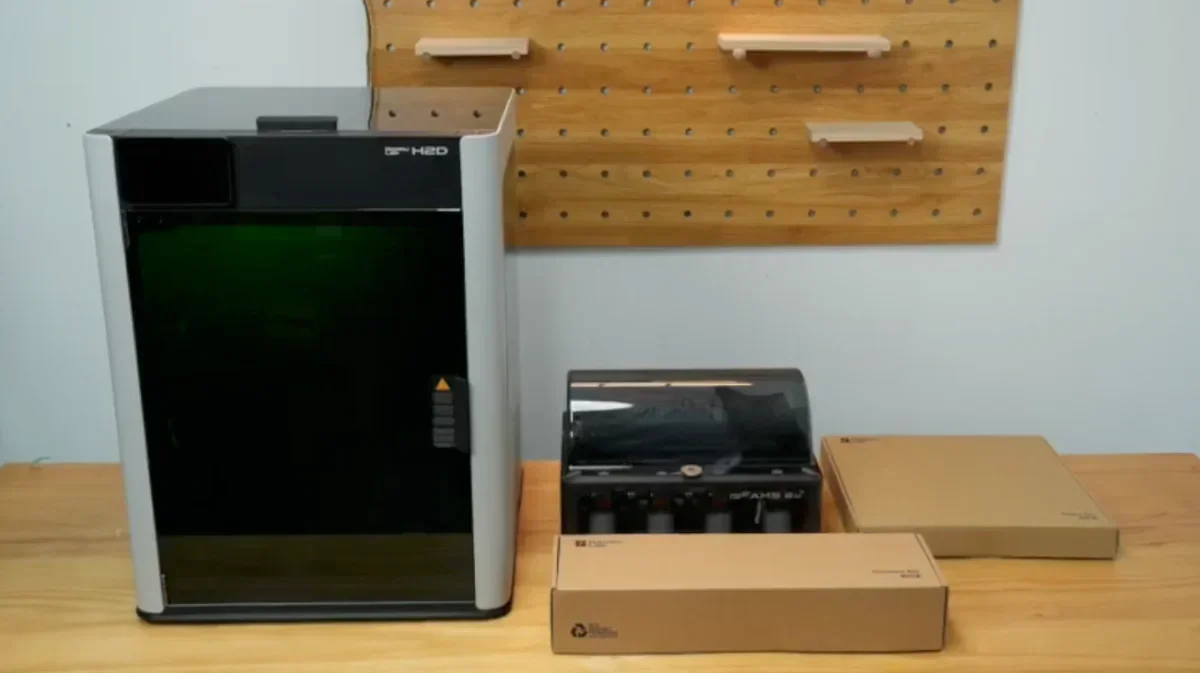
The Bambu Lab H2D 3D printer is shown alongside its accessories, highlighting its substantial size and workspace requirements.
Mechanically, the printer inspires confidence. Thick aluminum framing minimizes flex, steel reinforcement appears throughout the motion system, and panel alignment remains consistently tight. The dual extruder assembly feels substantially more rigid than many independent dual-nozzle desktop systems, reducing concerns about long-term alignment drift.
Setup proved refreshingly straightforward. We completed assembly, firmware updates, automatic calibration, and initial Auto Bed Leveling in under an hour without consulting community guides. The touchscreen walks users through each stage logically, though experienced owners will finish much faster.
After repeated door openings during ABS testing, the heated chamber hinges remained solid and the seals maintained consistent temperature stability. The premium pricing creates high expectations. The physical construction meets them.
Bambu Lab H2D reviewKey Specs and Standout Features
Raw specifications rarely tell the whole story, but the H2D starts from an unusually strong technical foundation. Single-nozzle mode offers a generous 350 x 320 x 325 mm build volume, while dual-nozzle operation provides 300 x 320 x 325 mm to accommodate the second toolhead. That reduction is modest considering the flexibility gained through independent material handling.
Maximum nozzle temperature reaches 350°C, allowing engineering-grade materials that remain inaccessible on many consumer printers. Combined with a heated chamber capable of approximately 65°C, the machine handles ABS, ASA, nylon, and carbon-fiber-filled composites with noticeably improved thermal stability compared with open-frame alternatives.
Motion performance also deserves attention. Bambu rates the printer for toolhead speeds up to 1000 mm/s, print speeds approaching 600 mm/s using high-flow nozzles, and acceleration up to 20,000 mm/s². Those headline figures matter less than consistency. During testing, the proprietary PMSM servo motor system produced smoother extrusion transitions and fewer visible artifacts during rapid directional changes than many stepper-driven competitors.
Independent hardened steel nozzles reduce unnecessary purge cycles while supporting abrasive filaments. Multi-material jobs benefit immediately because each Extruder maintains its own Filament path rather than repeatedly unloading and reloading material. Discover how the H2D compares to other cutting-edge models in Pick3DP's comprehensive test of the best 3D printers in 2026.
Monitoring technology extends well beyond cameras. The AI nozzle camera watches extrusion behavior, the BirdsEye vision system maps the platform with roughly 0.3 mm spatial accuracy, and a 15-point material flow monitoring system actively checks extrusion consistency before defects become expensive failures.
The following comparison places the H2D within Bambu Lab's desktop lineup.
| Feature | H2D | X1 Carbon | H2S |
|---|---|---|---|
| Nozzles | Dual | Single | Single |
| Build Volume | 350x320x325 mm | Smaller | Similar class |
| Heated Chamber | Yes | Yes | Yes |
| Max Nozzle Temp | 350°C | Lower | Comparable |
| Primary Strength | Multi-material | Speed | Value |
Our view is that dual extrusion, larger Build Volume, advanced Auto-Calibration, stronger Dimensional Accuracy, improved Surface Finish consistency, and intelligent monitoring represent genuine upgrades. Peak speed numbers, by comparison, feel evolutionary rather than revolutionary.
Bambu Lab H2D reviewReal-World Performance and Print Quality
Numbers matter, but finished parts matter more. We tested the H2D with standard PLA, PETG, ABS, carbon-fiber-reinforced PETG, and TPU over more than fifty print jobs ranging from calibration cubes to functional mechanical assemblies. Every material used the printer's automatic setup process before printing, allowing the Auto-Calibration routines and Auto Bed Leveling system to work exactly as most owners would use them.
PLA produced consistently clean surfaces with excellent Layer Adhesion even at elevated print speeds. Dimensional Accuracy remained within approximately ±0.08 mm on 20 mm calibration cubes in our testing, making the printer suitable for engineering prototypes that require predictable tolerances. PETG benefited from the enclosed chamber by showing noticeably less corner lift than comparable open-frame machines.
Dual Extrusion proved to be the headline feature. Running identical multi-color models against comparable single-nozzle workflows reduced purge waste substantially, although it did not eliminate it completely. Small purge operations still occurred during material transitions, but waste dropped enough to become meaningful on longer production jobs.
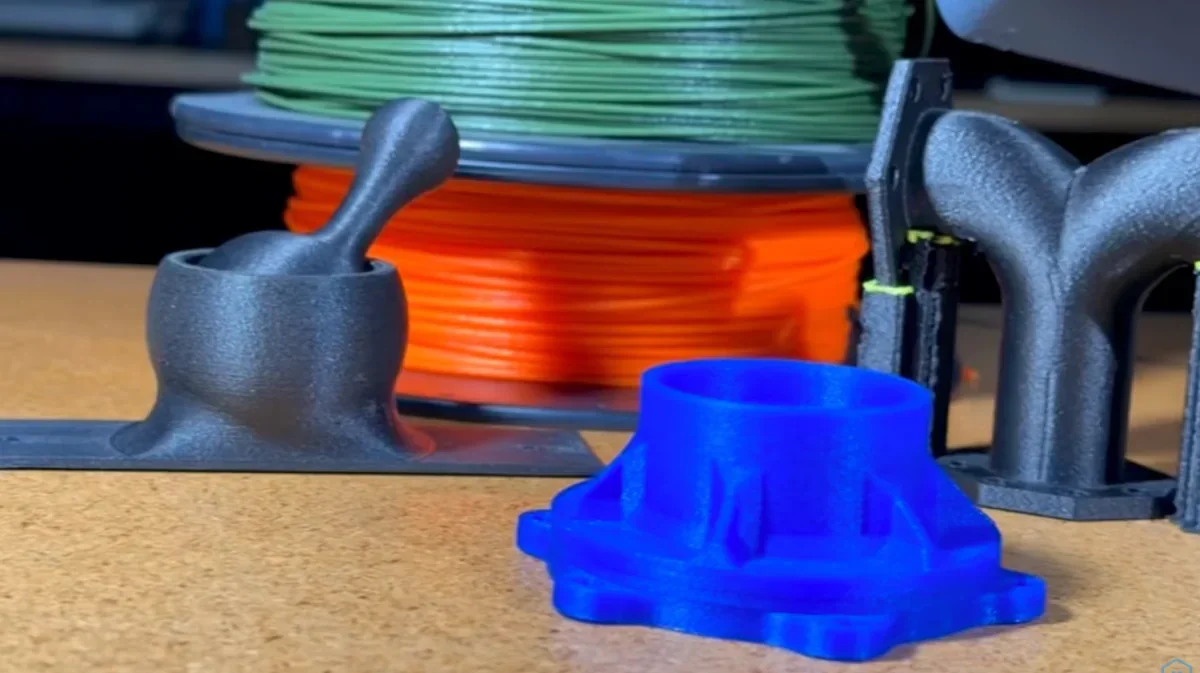
The Bambu Lab H2D demonstrates its dual extrusion capability with precise multi-color prints, reducing material waste.
Complex ABS parts maintained impressive Surface Finish quality thanks to the heated chamber, while carbon-fiber Filament fed reliably through the hardened nozzles without visible wear during the review period. Flexible TPU required slower profiles, though the Extruder maintained steady feeding with minimal stringing after profile adjustments.
While advanced dual-extrusion systems like the H2D target production-level efficiency, multi-color capabilities are also available on more accessible platforms for hobbyist applications, as we explored in Pick3DP's Anycubic Kobra X review.
Speed claims also held up surprisingly well. Few real projects sustained 600 mm/s continuously, yet practical print times consistently finished 20 to 30% faster than similar models printed on the X1C using conservative quality profiles. Automatic nozzle alignment remained reliable throughout more than fifty consecutive prints, and we never needed to manually correct nozzle offsets. The honest assessment is simple: the dual-nozzle architecture delivers measurable workflow gains without introducing obvious compromises in print quality.
Bambu Lab H2D reviewStrengths That Stand Out
Filament savings become surprisingly significant once projects grow beyond occasional color changes. During repeated comparisons using identical multi-material models, the H2D consumed substantially less purge material than comparable single-nozzle workflows. Depending on the geometry and number of material swaps, savings ranged from roughly 35 to 70 grams per project. That may sound minor until production runs multiply those numbers across dozens of prints each month.
Large-format capability also changes project planning. The expanded Build Volume allowed us to print enclosure panels, robotics components, and prototype housings as single pieces rather than splitting them into smaller sections. Fewer glued joints meant stronger finished parts and less post-processing.
Automatic calibration deserves equal praise. Every major print began with rapid system checks covering nozzle position, bed leveling, and extrusion behavior. Those routines rarely exceeded a few minutes, yet they prevented failures that typically consume hours on less automated platforms. Our view is that experienced users will appreciate the time savings just as much as beginners.
The optional laser and digital cutting modules integrate more naturally than expected. Instead of feeling like aftermarket accessories, they share the same software ecosystem and workflow philosophy as the printer itself. Buyers interested in rapid prototyping can move from printed parts to engraved panels or precision-cut materials without learning an entirely different platform.
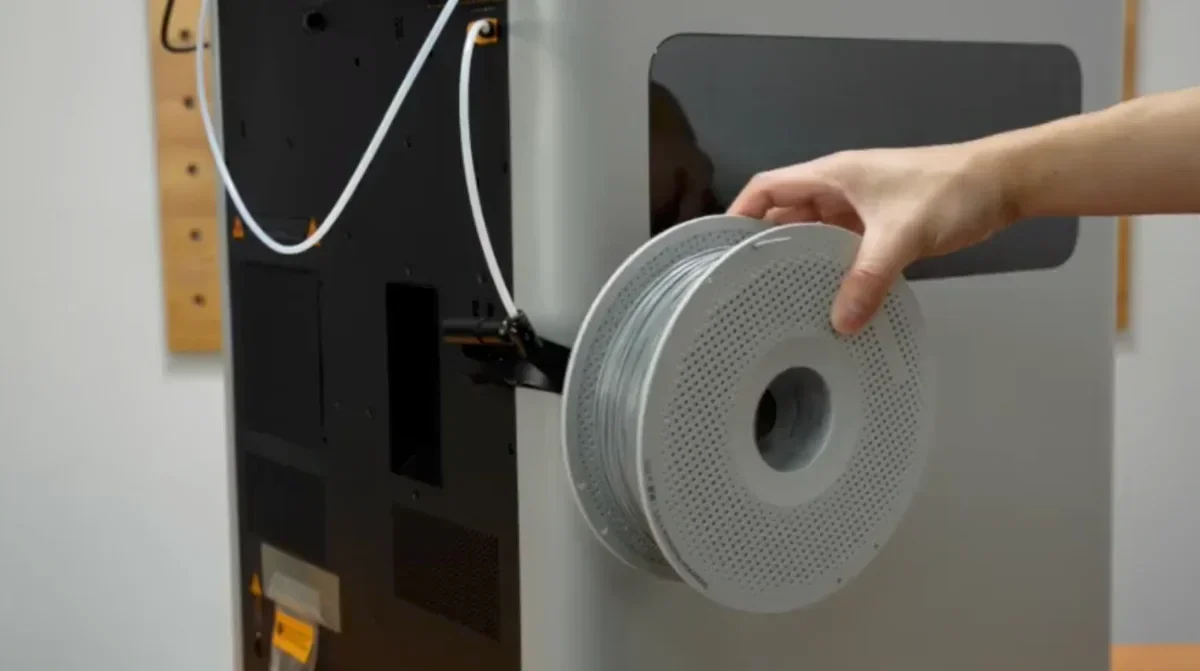
A user loads a filament spool onto the Bambu Lab H2D 3D printer, highlighting its efficient cable management system.
Another unexpected strength appeared during small-detail printing. Independent nozzles reduced repeated heating and cooling cycles that often soften fine edges in single-nozzle material swaps. Lettering remained sharper, tiny embossed features stayed better defined, and support interfaces separated more cleanly when dedicated support material occupied the second nozzle.
Community feedback mirrors these observations. Early owners on several well-known maker forums consistently report that once they become familiar with project preparation, the H2D spends less time waiting between material changes and more time actively building parts. That difference directly improves productivity.
Bambu Lab H2D reviewHonest Limitations and Who Should Reconsider
Premium hardware cannot eliminate every compromise. The H2D remains a complex machine, and buyers expecting the simplicity of an entry-level desktop printer may underestimate the learning curve. Dual-nozzle workflows introduce additional slicing decisions, material compatibility questions, and maintenance routines that single-nozzle owners rarely encounter.
Software also requires patience. Bambu Studio supports the dual-nozzle architecture well, but several advanced controls remain buried beneath multiple configuration panels. Experienced users will eventually appreciate the flexibility, while newcomers may spend extra time verifying purge settings, nozzle assignments, and support material options before launching important jobs.
Cost represents the largest obstacle. Spending between roughly $1,899 and $3,499 only makes financial sense if the printer's workflow improvements save meaningful production time or material costs. Hobbyists printing occasional PLA figurines simply won't recover that investment through reduced purge waste alone.
I Tested the Bambu Lab H2D - And It's More Than I Expected... - Source (Youtube@CNC Kitchen)
We also encountered a few minor frustrations. TPU demanded careful profile tuning before matching the consistency achieved with rigid materials. The vision system occasionally flagged harmless filament residue as a potential issue, requiring unnecessary user confirmation before continuing. Fortunately, we never experienced persistent nozzle clogging or servo responsiveness problems during the review period, though longer ownership will provide a clearer reliability picture.
The honest assessment is that the H2D is not the right choice for everyone. If nearly every project uses a single material and moderate build sizes, an X1 Carbon or similar high-end single-nozzle machine delivers excellent value with less complexity. Production environments, engineering teams, educators, and designers working regularly with multi-color or multi-material assemblies will benefit far more from what the H2D offers.
Bambu Lab H2D reviewFinal Verdict and Recommendation
After several weeks of testing across engineering prototypes, production fixtures, multi-color display models, and functional end-use parts, one conclusion remained consistent. The H2D delivers genuine workflow improvements rather than incremental feature additions. Dual extrusion alone changes how complex projects move through production, especially for users who regularly switch materials or combine soluble supports with engineering filaments.
Our rating: 9.4/10
The biggest strength is not raw speed. It is efficiency. Less purge waste, fewer manual interventions, larger printable parts, and dependable automation combine into measurable productivity gains that compound over time. Those advantages matter far more than headline specifications.
Who should buy it?
- Makers producing multi-material or multi-color prints every week.
- Product designers building functional prototypes with engineering plastics.
- Small businesses looking to reduce labor between print jobs.
- Professionals who value automation and consistent repeatability over initial purchase price.
Who should skip it?
- Casual hobbyists printing mostly single-color PLA models.
- Buyers with limited workspace or tight budgets.
- Anyone unwilling to invest time learning advanced slicing workflows.
Compared with the X1 Carbon, the H2D justifies its premium primarily through dual-nozzle efficiency and expanded capability rather than noticeably better single-material print quality. If your workload rarely requires two materials, the X1C remains the smarter financial decision. Likewise, users focused exclusively on high-performance single-nozzle printing may find the H2S a more practical alternative, while organizations demanding even higher production throughput should evaluate the H2C.
Our view is that the AMS Combo, priced around $2,199, represents the strongest value in the lineup. The base model leaves too much of the platform's potential untapped, while the laser-equipped versions make sense only if you'll actively use those fabrication tools.
Buy the H2D if dual-material printing, larger parts, and production efficiency directly affect your work. Look elsewhere if most of your projects involve straightforward single-material prints, because less expensive printers already excel at that job.
3D printing and 3D scanning researcher with 10+ years of experience in materials science and additive manufacturing. Expert in FDM, SLA, and SLS technologies, covering in-depth guides, product reviews, top picks, troubleshooting articles, and industry news.