Understanding Material Jetting vs Binder Jetting: A Complete Overview

Binder Jetting vs Material Jetting confuses almost everyone. One glues powder, the other cures droplets. Here's what separates them on cost, detail and strength - dig in.
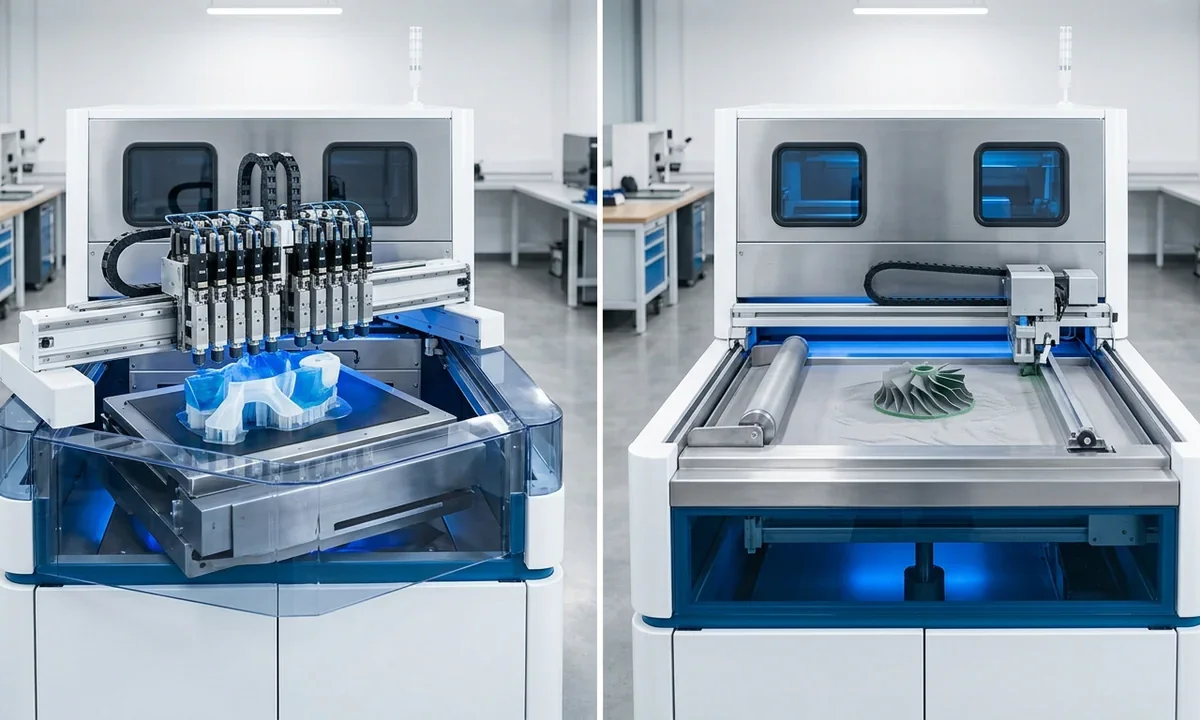
Two industrial 3D printing systems carry the word jetting in their names, yet they solve fundamentally different manufacturing problems. Material Jetting deposits tiny droplets of build material directly onto the part before curing each layer with ultraviolet light, while Binder Jetting sprays a liquid binder onto a powder bed to bond loose particles that later require thermal processing. Choosing between them depends less on the printhead and far more on the material, mechanical requirements, production volume, and downstream workflow.
The shared terminology causes understandable confusion because both technologies borrow concepts from conventional inkjet printing. Their similarities largely end there. Material Jetting prioritizes exceptional surface finish, dimensional accuracy, and multi-material realism. Binder Jetting focuses on high-throughput production, broad material compatibility, and economical manufacturing of complex metal, ceramic, and sand components after post-processing.
That distinction reflects the broader evolution of additive deposition methods, where similar deposition mechanisms have produced manufacturing platforms with completely different engineering goals. Rather than asking which technology is better, design engineers usually benefit from asking which production constraints matter most. Surface quality, structural strength, shrinkage, production speed, machine investment, material availability, and finishing requirements all influence the final decision far more than the shared word "jetting.This comparison evaluates both processes across those practical criteria so you can match the technology to your application instead of relying on marketing terminology.
How Material Jetting Builds Parts
Imagine an industrial inkjet printer replacing colored ink with engineering photopolymers. Material Jetting follows that principle by ejecting microscopic droplets through hundreds or thousands of printhead nozzles onto a precisely controlled build platform. Ultraviolet lamps mounted beside the printhead cure each deposited layer almost instantly, allowing the machine to repeat the cycle until the complete geometry emerges.
Commercial systems such as PolyJet from Stratasys dominate this category, although NanoParticle Jetting extends the concept by depositing suspensions containing metal or ceramic nanoparticles instead of conventional photopolymers. Despite their different feedstocks, both processes rely on controlled droplet placement rather than melting filament or selectively fusing powder.
Layer heights commonly fall between 14 and 32 microns, allowing remarkably smooth surfaces and crisp feature definition. Designers frequently choose Material Jetting for cosmetic prototypes because printed parts often require little sanding before painting or evaluation. Transparent materials, simulated rubber, rigid plastics, and multi-material combinations can even appear within the same build, something few competing additive processes accomplish as effectively.
Support structures also differ from many other printing methods. The printer deposits a dedicated support material alongside the model, then operators dissolve or wash it away after printing. That approach protects delicate overhangs and enclosed channels while reducing the manual labor associated with mechanically removing supports.
Mechanical performance remains the technology's primary compromise. Most photopolymers reproduce appearance exceptionally well but lack the long-term toughness, thermal stability, and fatigue resistance expected from production engineering plastics. Parts exposed to prolonged ultraviolet light or elevated temperatures may degrade faster than injection-molded equivalents.
Industrial Material Jetting systems typically cost $100,000 to more than $500,000, while specialized NanoParticle Jetting platforms can exceed that range substantially. Material costs generally range from $300 to over $1,000 per liter, depending on resin chemistry and application. Those economics position Material Jetting primarily within professional design studios, medical research, dental laboratories, and manufacturing organizations that value appearance and precision over structural durability.
Industrial designers seeking realistic cosmetic prototypes frequently look at PolyJet vs SLA to achieve ultra-smooth surfaces and unmatched color fidelity.
Binder Jetting: Powder Meets Glue
A fresh layer of powder spreads across the build platform before the first droplet ever lands. Instead of depositing the part material itself, Binder Jetting selectively sprays a liquid binder onto carefully defined regions of the powder bed. Wherever the binder wets the particles, they adhere together and gradually form the component layer by layer.
Fresh powder covers the completed layer, the printhead deposits more binder, and the cycle repeats until the entire build finishes. Unbound powder naturally supports every overhang throughout the process, eliminating the dedicated support structures that Material Jetting requires for complex geometries.
Immediately after printing, the component exists only as a green part. Although the geometry has formed successfully, mechanical strength remains extremely limited. Operators first remove excess powder during depowdering, then perform debinding when necessary to eliminate residual binder before transferring the parts into a high-temperature furnace for sintering.
Sintering permanently bonds the particles into a dense solid component but introduces one of the process's defining engineering challenges: shrinkage. Metal Binder Jetting parts often shrink by approximately 20 percent during sintering, although the exact value depends on material composition, packing density, and furnace parameters. Machine software compensates by scaling the original CAD model, yet engineers must still validate critical tolerances through process qualification.
Material flexibility distinguishes Binder Jetting from many competing additive technologies. Manufacturers routinely process stainless steels, tool steels, copper, ceramics, silica sand for foundry molds, and gypsum-based powders capable of producing full-color concept models. That diversity makes the technology attractive across industries ranging from aerospace and automotive to casting and architecture.
Production speed also favors Binder Jetting because the printhead scans across the entire build area instead of tracing each contour with a laser. Multiple components can occupy the same powder bed without dramatically increasing print time, improving throughput for batch manufacturing.
Industrial Binder Jetting systems generally start around $200,000 and can exceed $1 million, depending on build volume and automation. Material costs vary widely because powder chemistry differs substantially between metals, ceramics, and foundry applications. Finished part economics therefore depend as much on furnace utilization, shrinkage compensation, and post-processing labor as on printing itself.

Binder Jetting vs Material JettingHead-to-Head: Detail, Strength, Cost
The table below compares the characteristics that most strongly influence purchasing decisions. Individual machines vary, but these ranges represent what engineers typically encounter when evaluating commercial Material Jetting and Binder Jetting platforms.
| Technology | Pros | Cons | Best Use Case | Typical Cost |
|---|---|---|---|---|
| Material Jetting | Exceptional surface finish, multi-material capability, full-color parts, excellent dimensional accuracy | Expensive photopolymers, limited mechanical durability, UV-sensitive materials | Cosmetic prototypes, medical models, dental applications, design validation | Machine: $100,000-$500,000+; Material: $300-$1,000+/L |
| Binder Jetting | High throughput, wide material selection, support-free printing, scalable batch production | Requires depowdering, debinding, sintering, shrinkage compensation | Metal production parts, foundry molds, ceramic components | Machine: $200,000-$1M+; Material costs vary by powder |
Resolution often becomes the first comparison point because both technologies create fine details through jetting. Material Jetting generally delivers sharper edges and smoother external surfaces thanks to thin 14 to 32 micron layers and precise droplet placement. Binder Jetting can reproduce intricate geometry, but loose powder particles and subsequent sintering usually soften extremely fine surface features.
Mechanical performance tells a very different story. Material Jetting produces highly accurate photopolymer components that excel during design reviews, ergonomic studies, and visual validation. Long-term structural loading, elevated temperatures, and continuous outdoor exposure expose the limitations of most photopolymer materials. Binder Jetting reverses that equation. Once metal parts complete sintering, they achieve mechanical properties that can approach wrought materials for many alloys, though density and performance vary between systems and processing parameters.
Surface finish also favors Material Jetting immediately after printing. Most parts emerge with smooth, presentation-ready surfaces requiring minimal finishing once support material dissolves. Binder Jetting components rarely reach that standard directly from the furnace. Machining, polishing, bead blasting, or surface treatments frequently become part of the production workflow, especially for customer-facing products. While Material Jetting delivers smooth out-of-the-machine finishes Binder Jetting parts almost always require advanced post-processing techniques like polishing 3D prints to achieve industrial quality.
Throughput deserves careful interpretation. A single Material Jetting machine can produce multiple prototypes efficiently, particularly when every part demands different materials or colors. Binder Jetting becomes more competitive as production volumes increase because filling unused build volume with additional parts adds relatively little print time. Furnace capacity, rather than printer speed, often becomes the production bottleneck.
Cost comparisons extend beyond machine price. Material Jetting carries high consumable costs but relatively predictable workflows after printing. Binder Jetting usually offers lower raw material costs for many metals, yet depowdering equipment, thermal furnaces, quality inspection, shrinkage validation, and labor all contribute to the final cost per part. For production environments, those downstream operations often determine overall profitability more than printer purchase price alone.
Both technologies also share one genuine advantage. Neither relies on high-powered lasers during printing, allowing multiple printheads to process broad areas simultaneously and making future productivity improvements largely dependent on printhead development rather than scanning speed alone.
Engineers focused on high throughput and structural density rather than intricate aesthetics often pivot to MJF vs SLS for functional end-use parts. Likewise, when evaluating droplet-based precision against powder bed systems, engineering teams often compare PolyJet vs SLS technologies to determine structural integrity versus crisp fine features.

Binder Jetting vs Material JettingMatching the Process to Applications
Selecting the right jetting technology becomes much easier once the application defines the requirements instead of the technology defining the project. Material Jetting excels whenever appearance, dimensional precision, or multiple materials carry more value than ultimate mechanical strength. Binder Jetting becomes the stronger candidate when production volume, engineering materials, or complex metal geometries drive the purchasing decision.
Material Jetting has become a standard tool across industrial design studios, healthcare, and product development because it produces presentation-quality models directly from the printer. Designers can validate ergonomics, assembly clearances, transparent features, and color variations before committing to tooling. Medical teams also rely on patient-specific anatomical models for surgical planning, while dental laboratories routinely fabricate highly detailed guides and mock-ups.
Common Material Jetting applications include:
- Anatomical models with realistic color differentiation
- Dental models and surgical guides
- Transparent fluid flow prototypes
- Consumer product appearance models
- Overmolded prototypes combining rigid and rubber-like materials
- Marketing samples and trade-show display models
- Precision concept models requiring excellent surface finish
Binder Jetting addresses a completely different manufacturing challenge. Instead of producing visually realistic prototypes, it focuses on creating functional components in engineering materials that undergo thermal processing after printing. Foundries frequently print complex sand molds and cores that eliminate expensive tooling, while manufacturers increasingly produce stainless steel, tool steel, and copper components in production batches.
Several industries have adopted Binder Jetting because the printer fills an entire build volume with dozens or even hundreds of parts before sending them through a shared sintering cycle. That workflow improves machine utilization and lowers production cost for suitable geometries.
Typical Binder Jetting applications include:
- Sand casting molds and cores
- Stainless steel production parts
- Copper heat exchangers
- Complex internal cooling channels
- Ceramic industrial components
- Mid-volume replacement parts
- Architectural full-color gypsum models
Neither technology replaces every manufacturing process. For industrial teams evaluating alternative metal fabrication methods Pick3DP's comprehensive comparison of DMLS vs SLM explains how laser powder bed systems stack up against traditional binder methods. Manufacturing professionals transitioning from liquid jetting to high-strength metal production can consult our in-depth SLM 3D printing guide to understand laser powder bed fusion mechanics. Likewise, for heavy-duty metal parts that require direct thermal fusion instead of liquid bonding agents, a detailed comparison of DMLS vs EBM outlines alternative paths for manufacturing high-strength aerospace components.
Binder Jetting vs Material JettingThe Verdict, Plus Other Routes
No single jetting technology wins every comparison because each addresses a different manufacturing objective. Material Jetting serves organizations that prioritize appearance, dimensional accuracy, and multi-material realism. Binder Jetting rewards manufacturers seeking scalable production in metals, ceramics, or foundry materials, even if the workflow extends well beyond the printer itself.
For industrial designers, medical researchers, and product development teams, Material Jetting usually provides the fastest path from CAD model to presentation-ready prototype. The ability to combine transparent, rigid, flexible, and colored materials within one build remains one of its strongest competitive advantages.
Production engineers evaluating functional metal parts should examine Binder Jetting first whenever batch production and complex geometries outweigh the added thermal processing steps. Shrinkage calibration, furnace capacity, and quality control become part of the manufacturing strategy rather than secondary considerations.
Alternative additive technologies also deserve consideration. SLA often delivers excellent surface quality at a substantially lower equipment cost than Material Jetting, although it lacks true multi-material capability. Laser Powder Bed Fusion technologies produce exceptionally dense metal parts but generally sacrifice throughput and increase operating costs. Multi Jet Fusion occupies a middle ground for polymer production, combining speed with stronger end-use mechanical properties than photopolymers.
Industrial designers seeking realistic cosmetic prototypes frequently look at PolyJet vs SLA to evaluate whether Material Jetting justifies its higher investment. Engineers comparing production polymers frequently analyze machine selection variables before choosing between jetting, extrusion, or powder bed technologies.
Organizations purchasing their first industrial additive manufacturing platform should also consider outsourcing initial projects to an experienced service bureau. Production data collected from real jobs often reveals whether machine utilization, material consumption, and post-processing costs justify an in-house investment far better than vendor demonstrations alone.
Binder Jetting vs Material JettingKey Differences Worth Remembering
Choosing between these technologies becomes straightforward once you separate the shared printing mechanism from the very different manufacturing outcomes. Material Jetting deposits and cures the build material itself, while Binder Jetting creates a temporary bonded shape inside a powder bed before transforming it into a finished part through thermal processing. That distinction influences nearly every engineering decision that follows.
Three practical differences matter most:
- Material and final properties: Material Jetting produces highly accurate photopolymer parts optimized for visualization, medical modeling, and design validation. Binder Jetting processes metals, ceramics, sand, and gypsum, producing functional engineering components after sintering.
- Surface quality versus production strength: Material Jetting delivers some of the smoothest surfaces available in additive manufacturing with minimal finishing. Binder Jetting typically requires depowdering and additional finishing but produces components with far greater structural capability once post-processing is complete.
- Workflow and production economics: Material Jetting offers a relatively direct print-to-part workflow but carries high resin costs. Binder Jetting introduces additional manufacturing stages, including depowdering, debinding, and sintering, yet it scales efficiently for batch production and complex metal geometries.
For most product designers evaluating concepts, ergonomic studies, or presentation models, Material Jetting remains the stronger option. Manufacturers producing end-use metal parts, casting tooling, or medium-volume production components will generally gain greater long-term value from Binder Jetting despite its more demanding workflow.
A simple rule captures the difference well: Material Jetting prints the final material directly, while Binder Jetting prints a temporary shape that becomes the final part only after thermal processing.
Industry analyst with a PhD in Materials Engineering and 12+ years tracking the global digital fabrication market. Covers 3D printing, 3D scanning, CNC machining, laser machining, and 3D modeling through data-driven guides and market news.