
FDM vs SLS 3D Printing: Filament Mechanics vs Powder Bed Freedom

FDM vs SLS is one of 3D printing's most debated matchups. Filament extrusion or powder bed fusion - the right call depends on more than price. Find out which wins for your work.
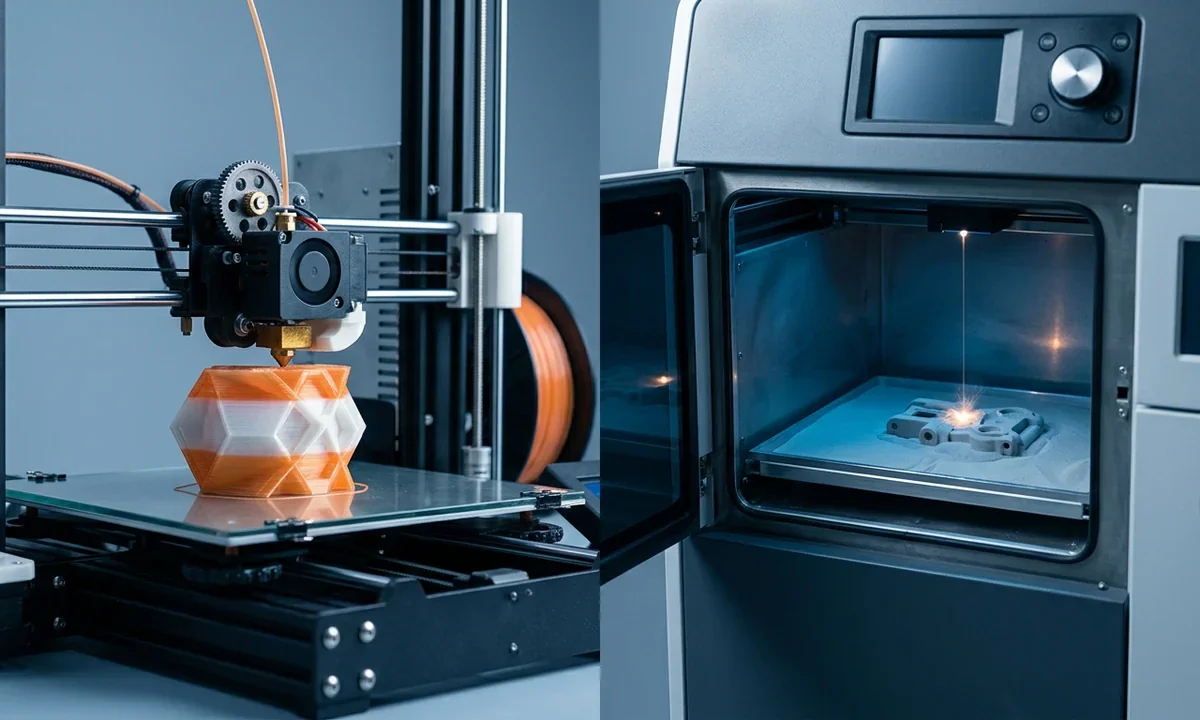
FDM and SLS both produce functional plastic parts, yet they solve manufacturing problems in completely different ways. FDM builds components by depositing molten filament through a heated nozzle, while SLS fuses powdered polymer with a laser inside a powder bed. The result is that two parts may look similar on a workbench while differing substantially in strength, design freedom, production cost, and scalability.
That overlap creates confusion because entry-level comparisons often reduce the decision to print quality or machine price. Engineers rarely choose between these technologies for those reasons alone. They evaluate mechanical performance, production volume, material behavior, geometric complexity, and the total cost of delivering a finished part.
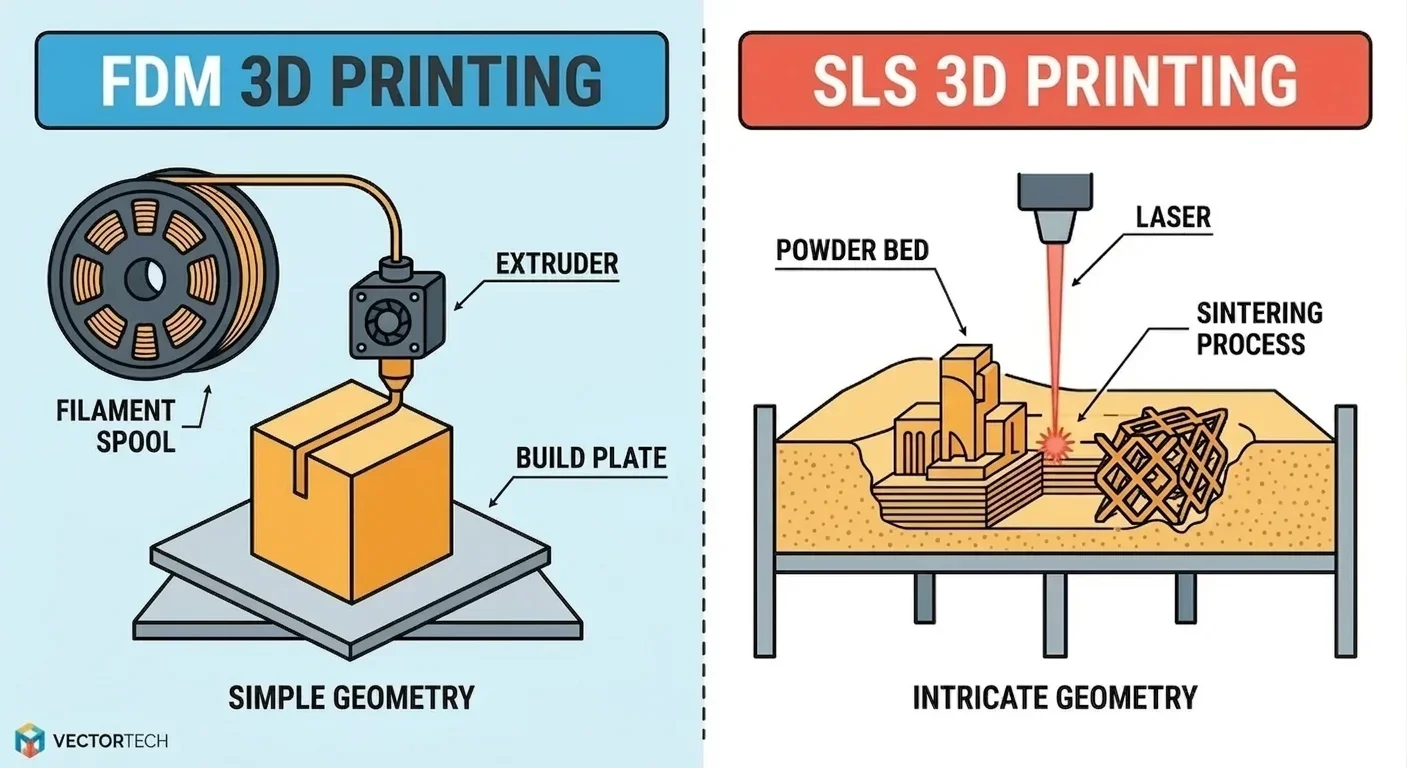
Illustration comparing FDM and SLS 3D printing, highlighting filament mechanics versus powder bed freedom for different geometries.
A hobbyist printing replacement brackets has very different priorities from a product team validating a production-ready enclosure. The same technology will not serve both equally well. Context matters.
By the end of this comparison, you should know whether FDM or SLS better matches your project, budget, manufacturing goals, and expected production volume. More importantly, you'll understand why one technology becomes the stronger choice instead of relying on oversimplified recommendations.
FDM vs SLSHow FDM Actually Works
A spool of thermoplastic filament feeds into a heated extruder where drive gears push the material toward a metal hotend. As the filament reaches its melting temperature, the nozzle deposits a narrow bead onto the build plate following toolpaths generated by slicing software. Once a layer finishes, the printer moves upward by a predetermined layer height, commonly between 0.1 and 0.3 mm, and repeats the process until the model is complete.
Every deposited strand bonds to the layer beneath while cooling almost immediately. That thermal bonding creates one of FDM's defining characteristics: anisotropy. Parts generally resist forces better within the XY plane than across the Z axis because interlayer adhesion remains weaker than the strength of the continuous extruded filament. Print orientation therefore becomes a mechanical design decision rather than simply a way to fit a model on the build plate.
Material selection represents one of FDM's biggest strengths. Basic materials such as PLA and PETG dominate desktop printing, while engineering users frequently choose ABS, ASA, nylon, polycarbonate, TPU, carbon fiber reinforced composites, or high-temperature polymers such as PEEK on specialized systems. The growing filament ecosystem gives engineers flexibility that few additive manufacturing processes can match.
 Credit © Pick3DP
This diagram illustrates the mechanics of an FDM 3D printer, highlighting key components like the filament spool, extruder, and heated build plate. Understanding these elements is crucial for optimizing material selection and print quality.
Build volume also favors FDM. Desktop printers commonly offer capacities around 220 x 220 x 250 mm, while large-format machines comfortably exceed one cubic meter. Producing oversized fixtures, architectural models, or manufacturing jigs often becomes practical without splitting the design into multiple sections.
Surface quality depends heavily on print settings. Fine layer heights reduce visible stepping but increase print time, while thicker layers accelerate production at the expense of appearance. Curved surfaces almost always reveal layer lines, and unsupported overhangs generally require support structures that must be removed after printing. Those supports frequently leave cosmetic marks or rough surfaces wherever they contact the part.
FDM vs SLSHow SLS Actually Works
A Selective Laser Sintering printer begins each layer by spreading a thin, uniform coating of polymer powder across the build chamber. Most production systems use nylon powders such as PA12 or PA11, although flexible TPU and specialty engineering blends are also available. A CO₂ laser then scans the cross-section of every part, heating individual powder particles until they fuse together without fully melting into a liquid state.
Once the laser finishes the layer, the build platform lowers by roughly 80 to 120 microns and a recoater applies fresh powder across the surface. The process repeats hundreds or thousands of times until the entire build completes. Unlike FDM, the surrounding unsintered powder naturally supports every overhang, cavity, lattice, and internal channel throughout the job. Designers therefore gain far greater geometric freedom because they do not need to generate removable support structures.
 Credit © Pick3DP
This diagram illustrates the Selective Laser Sintering (SLS) process, highlighting key components like the laser source and powder deposition system. It demonstrates how SLS uses a CO2 laser to fuse powder particles, offering design freedom in 3D printing.
Mechanical performance reflects that different manufacturing approach. SLS parts generally exhibit much more consistent strength across multiple directions than FDM components because the fused powder matrix reduces the pronounced layer-to-layer weakness associated with extruded filament. Complete isotropy still depends on machine calibration, laser parameters, and powder quality, but functional parts usually behave more predictably under multidirectional loading.
Surface finish differs from filament printing as well. Fresh SLS parts have a slightly matte, granular texture rather than visible extrusion lines. Small details, snap fits, living hinges, and complex assemblies often print successfully in a single build, making the technology especially attractive for functional prototyping and low-volume manufacturing.
Printing does not end when the laser stops scanning. Operators typically allow the powder cake to cool for several hours before unpacking the build because rapid cooling can introduce distortion. Finished components then undergo depowdering with compressed air or bead blasting, while recovered powder is screened and blended with fresh material for future jobs according to the manufacturer's recommended refresh ratio.
Nylon PA 12 - 3D Printing Materials Explained - Source (Youtube@Protolabs)
Machine accessibility remains the biggest limitation. Industrial SLS systems typically cost between $150,000 and $500,000 before powder handling equipment, ventilation, and facility requirements enter the budget. Material prices also exceed common FDM filaments, yet the economics improve as build density increases because dozens or even hundreds of unrelated parts can occupy the same Powder Bed during a single production cycle. For functional prototypes, complex assemblies, and small manufacturing runs, that advantage often outweighs the higher initial investment.
FDM vs SLSHead-to-Head on Every Dimension
Looking at finished parts alone rarely tells the full story. FDM and SLS can both produce accurate, functional components, but they arrive there through fundamentally different manufacturing methods. The better choice depends less on appearance than on production volume, mechanical requirements, and the complexity of the geometry you need to manufacture.
The table below compares the criteria that most influence a purchasing or manufacturing decision.
| Category | FDM | SLS | Practical Winner |
|---|---|---|---|
| Manufacturing method | Extrudes molten filament through a nozzle | Fuses polymer powder with a laser | Tie, different approaches |
| Machine cost | $200 to $20,000+ | $150,000 to $500,000+ | FDM |
| Material cost | $20 to $100/kg for common filaments | $70 to $150/kg for nylon powders | FDM |
| Mechanical strength | Strong within layers, weaker between layers | More uniform strength in multiple directions | SLS |
| Geometric freedom | Supports required for many overhangs | No supports required | SLS |
| Surface finish | Visible layer lines | Fine matte texture | SLS |
| Dimensional Accuracy | Typically ±0.2 mm or ±0.5% depending on calibration | Often ±0.2 mm or better across production builds | Slight edge to SLS |
| Material variety | Extremely broad | Focused mainly on engineering nylons and TPU | FDM |
| Post-processing | Support removal, sanding, filling if needed | Depowdering, bead blasting, optional dyeing | Depends on application |
| Production efficiency | Excellent for one-off parts | Excellent for nested production batches | Depends on volume |
Cost creates the largest gap between the two technologies. A capable desktop FDM printer costs less than a single maintenance contract for many industrial SLS systems. That difference explains why FDM dominates maker spaces, engineering labs, schools, and small businesses.
Geometry tells a different story. Every support structure printed on an FDM machine consumes material, increases print time, and leaves marks after removal. SLS avoids those compromises because loose powder supports every feature automatically. Internal channels, enclosed mechanisms, lattice structures, and nested assemblies often print as complete parts without any design modifications.
Mechanical behavior follows the manufacturing process. FDM parts frequently fail along layer boundaries when loaded in the weakest orientation, especially with brittle materials such as PLA. SLS components generally distribute stress more evenly because the laser fuses surrounding powder into a more homogeneous structure. For functional hinges, snap fits, and production components, that consistency often matters more than ultimate tensile strength.
Material selection swings back toward FDM. Hundreds of commercial filaments exist, including flexible elastomers, carbon fiber composites, high-temperature engineering plastics, electrically conductive blends, and biodegradable materials. SLS concentrates on a smaller ecosystem centered around nylon because those materials consistently process well inside a powder bed.
Production volume ultimately shifts the balance. Printing ten unrelated prototypes generally favors FDM because each machine starts quickly with minimal setup. Printing one hundred compact functional parts often favors SLS because operators can densely pack components throughout the build volume, allowing one job to manufacture dozens of finished pieces simultaneously.
Neither technology dominates every category. FDM minimizes investment and maximizes material flexibility. SLS maximizes design freedom, mechanical consistency, and manufacturing efficiency once production volume justifies the higher operating costs.
When to Use FDM vs SLS
Matching the technology to the application almost always produces better results than chasing the highest specifications. An inexpensive FDM printer can outperform an industrial SLS system if the project values large build volume, rapid iteration, and low operating costs. Likewise, a complex mechanical assembly may become impractical on FDM while printing effortlessly in SLS.
Choose FDM when cost and flexibility matter most. Engineers developing an early prototype often expect to revise the design several times before reaching a final version. Printing a new iteration with inexpensive PLA or PETG keeps development costs low while allowing changes within hours instead of days. Large manufacturing jigs, assembly fixtures, architectural models, educational projects, and replacement household parts also fit naturally within FDM's strengths because machine availability and material costs remain favorable.
Material diversity provides another reason to select FDM. If your project requires carbon fiber reinforced nylon, flexible TPU, high-temperature polycarbonate, or experimental composite filaments, filament extrusion offers substantially more options than today's commercial SLS material ecosystem. Multi-material desktop printers also simplify producing prototypes with soluble supports or multiple colors.
Choose SLS when mechanical performance and geometric complexity outweigh acquisition cost. Functional end-use components, lightweight lattice structures, living hinges, enclosed mechanisms, and snap-fit assemblies benefit from support-free manufacturing. Designers can consolidate multiple parts into one printed assembly without worrying about inaccessible support material trapped inside the model.
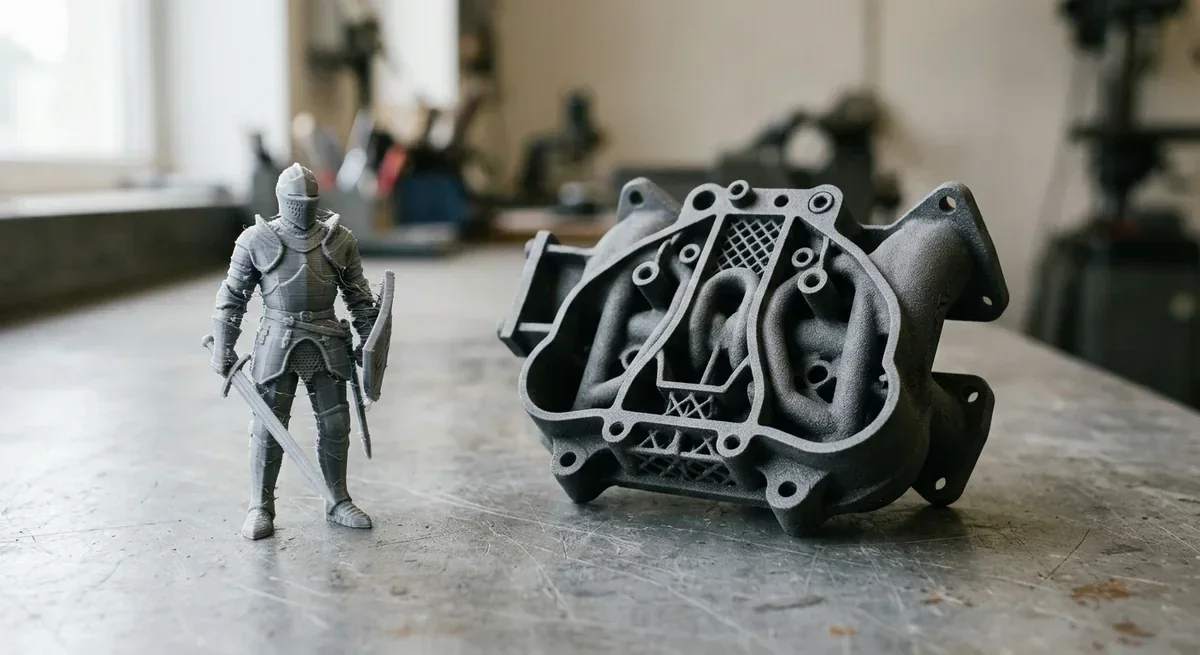
A complex SLS 3D printed mechanical part showcases geometric freedom, compared to a detailed FDM printed knight figurine, highlighting the strengths of each technology.
Small production runs frequently shift toward SLS as well. Rather than printing one part after another, operators densely pack dozens of unrelated components throughout the Powder Bed. The laser builds every layer across the entire job regardless of whether the chamber contains one large enclosure or one hundred small brackets. That improves production efficiency considerably once batch sizes increase.
Some projects genuinely fall between the two technologies. Imagine a custom drone frame requiring excellent stiffness, moderate production volume, and limited budget. Both processes could succeed. The deciding factor becomes production scale. Manufacturing five frames generally favors FDM because machine and material costs remain low. Producing two hundred identical frames often justifies SLS because the improved mechanical consistency and support-free nesting reduce labor per finished part.
Neither technology replaces the other. Most engineering teams continue using both because each solves a different manufacturing problem more efficiently.
Cost Reality: FDM vs SLS
Machine price represents only one part of the financial equation. Material costs, labor, post-processing, machine utilization, and production volume ultimately determine which technology delivers the lower cost per finished part.
A capable desktop FDM printer typically costs between $200 and $2,000, while professional systems range from $5,000 to over $20,000. Standard PLA and PETG filaments generally sell for $20 to $35 per kilogram, with engineering materials reaching $80 to $200 per kilogram depending on composition.
SLS operates in a different investment category. Industrial systems usually begin around $150,000 and may exceed $500,000 once powder handling equipment, cooling stations, and facility requirements are included. Nylon powder commonly costs $70 to $150 per kilogram, although actual material consumption depends on powder refresh ratios and recycling practices.
The economics change as production volume grows.
| Production Quantity | Typical FDM Cost per Part | Typical SLS Cost per Part | Better Value |
|---|---|---|---|
| 1 part | $3 to $20 | $40 to $120 | FDM |
| 10 parts | $3 to $15 | $12 to $35 | FDM |
| 100 parts | $3 to $12 | $4 to $10 | SLS for complex parts |
Labor also deserves attention. FDM often requires support removal, occasional sanding, and repeated machine supervision across multiple print jobs. SLS demands depowdering after each build but allows operators to manufacture many parts simultaneously. Once production reaches several dozen complex components per batch, SLS frequently becomes the more economical process despite its higher machine and material costs.
FDM vs SLSPros and Cons: Both Options
No additive manufacturing process dominates every application. FDM and SLS each solve problems the other struggles with, which explains why many engineering organizations operate both technologies rather than replacing one with the other. The best choice depends on what limits your project first: budget, geometry, production volume, or mechanical performance.
1FDM Pros
- Lower entry cost than SLS. Desktop printers are affordable for hobbyists, schools, startups, and engineering teams.
- Extensive material selection. Hundreds of filaments are available, including PLA, PETG, ABS, ASA, TPU, nylon, carbon fiber composites, and high-temperature engineering plastics.
- Large build volumes. Many FDM systems produce parts that would not fit inside most polymer SLS machines.
- Simple material handling. Filament storage and loading require far less equipment than powder management.
- Excellent for rapid design iteration. Engineers can modify a CAD model, slice it, and begin another print within minutes.
2FDM Cons
- Weaker interlayer bonding than SLS. Part orientation significantly affects mechanical performance because anisotropy remains an inherent characteristic of filament deposition.
- Support structures increase labor. Removing supports consumes time and often leaves visible marks on finished surfaces.
- Surface finish usually requires additional work. Layer lines remain visible unless sanding, filling, or chemical smoothing is performed.
- Complex internal geometry has practical limits. Fully enclosed channels and intricate lattice structures often become impossible or inefficient to manufacture.
3SLS Pros
- More consistent mechanical properties than FDM. Functional parts generally perform more predictably under loads applied from multiple directions.
- Support-free manufacturing. The surrounding Powder Bed supports every feature automatically, allowing engineers to design without considering removable supports.
- Ideal for complex assemblies. Interlocking mechanisms, snap fits, lattice structures, and enclosed components frequently print as complete assemblies.
- Efficient batch production. Multiple unrelated parts can occupy the same build chamber without extending build height significantly.
- Professional surface quality. Finished parts display a uniform matte appearance without visible extrusion lines.
4SLS Cons
- Far higher acquisition cost than FDM. Machine prices place SLS outside the budget of most hobbyists and many small businesses.
- Limited material ecosystem. Most commercial systems concentrate on nylon-based materials rather than the broad polymer selection available to FDM users.
- Powder handling requires dedicated equipment. Safe storage, recycling, ventilation, and cleanup increase operational complexity.
- Longer turnaround for individual parts. Cooling, depowdering, and post-processing often add several hours after printing completes.
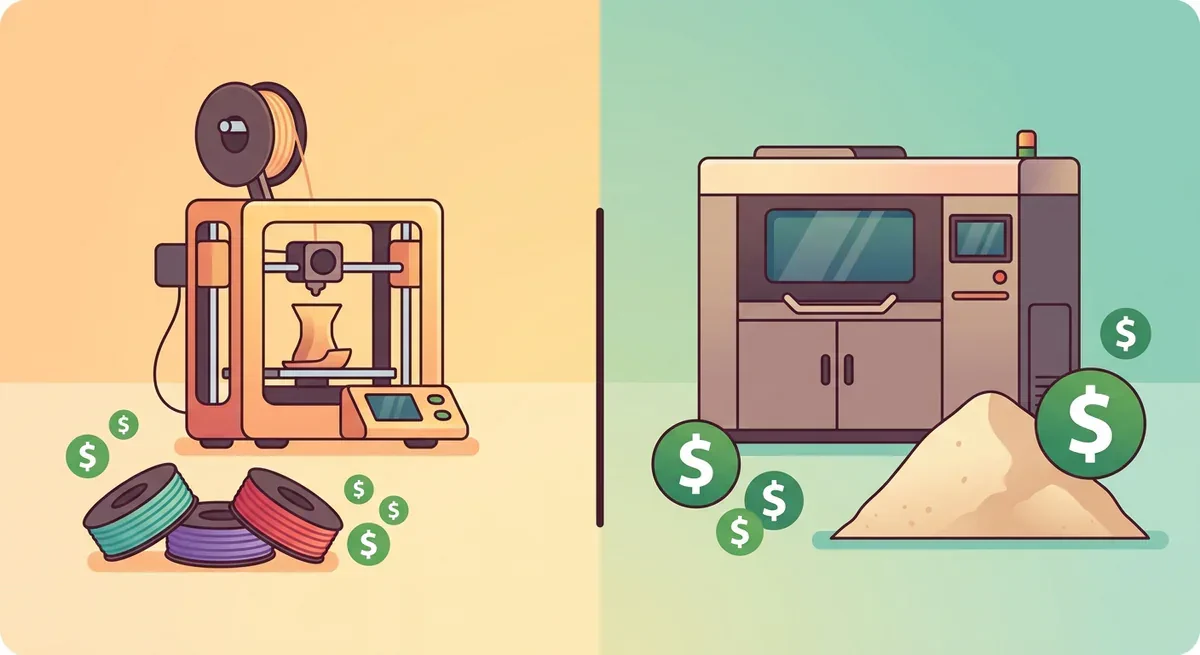
Overall, neither technology clearly wins across every category. FDM offers unmatched accessibility, exceptional material flexibility, and the lowest operating costs for prototyping and low-volume work. SLS becomes the stronger choice when production requires complex geometries, consistent mechanical performance, or efficient manufacturing of functional parts in moderate quantities.
FDM vs SLSWhich Should You Choose?
The right decision rarely depends on print quality alone. Instead, identify the constraint that matters most in your project. Cost, geometry, production volume, material requirements, and mechanical performance usually narrow the answer quickly.
Choose FDM if any of the following describe your application:
- You need the lowest possible equipment and operating costs.
- Your design will change repeatedly during development.
- You require specialty filaments such as carbon fiber composites, flexible TPU, or high-temperature engineering polymers.
- Your project includes very large parts that exceed the build volume of most SLS systems.
- You print occasional prototypes rather than maintaining continuous production.
Choose SLS if these priorities better match your requirements:
- Your parts require nearly uniform strength regardless of loading direction.
- The design contains enclosed channels, lattice structures, snap fits, or moving assemblies that would require extensive supports on FDM.
- You manufacture dozens or hundreds of functional components in each production batch.
- Cosmetic consistency matters because customers will handle the finished product.
- You want to consolidate multiple assembled components into a single printed part.
Some projects remain difficult to classify. Imagine designing a custom robotic gripper for a pilot production run of fifty units. Both technologies can produce functional components. Ask one question: Will labor or machine cost dominate the budget? If labor associated with support removal, assembly, and repeated print setup exceeds the additional manufacturing cost of SLS, the powder-based process often becomes the better long-term investment. If equipment cost remains the limiting factor, FDM usually delivers greater value.
Neither option fits every manufacturing challenge. Multi Jet Fusion (MJF), another Powder Bed Fusion technology, frequently occupies the space between traditional SLS production and large-scale industrial manufacturing by offering faster build speeds and competitive mechanical properties. If your project demands production volumes beyond typical prototyping while still requiring complex nylon components, MJF deserves careful consideration alongside SLS rather than being treated as a separate category.
FDM vs SLSKey Differences, Summarized
The comparison becomes much simpler once you focus on the manufacturing objective instead of the printing technology. FDM and SLS both produce functional plastic parts, but they optimize for different priorities.
- Manufacturing process: FDM builds parts by extruding molten filament through a heated nozzle, while SLS uses a laser to fuse polymer powder inside a Powder Bed. That difference eliminates support structures in SLS and greatly expands geometric freedom.
- Cost and accessibility: FDM offers the lowest barrier to entry, with reliable desktop machines available for a few hundred dollars and inexpensive filament. SLS requires industrial-grade equipment, powder handling infrastructure, and a substantially larger investment, making it more common in professional manufacturing environments.
- Mechanical performance and production: FDM excels at rapid prototyping, large parts, and material flexibility. SLS produces stronger, more consistent functional components with complex geometries and becomes increasingly economical for small production runs where many parts can share the same build chamber.
Choose FDM if your priorities are affordability, rapid iteration, broad material compatibility, or large-format printing. Choose SLS if you need complex support-free geometries, consistent mechanical properties, or efficient production of functional nylon parts.
SLS vs. FDM - Which technology wins? | Test of a Hyperbolic planetary gearset - Source (Youtube@SINTRATEC)
If you're selecting hardware rather than comparing technologies, the next step is evaluating printers that match your workflow and budget. A dedicated buyer's guide can help narrow the options based on build volume, material compatibility, and production requirements.
The simplest way to explain the difference to a colleague is this: FDM builds parts by depositing melted filament layer by layer, while SLS builds parts by laser-fusing powder, allowing stronger, support-free components with far greater geometric freedom.
3D printing and 3D scanning researcher with 10+ years of experience in materials science and additive manufacturing. Expert in FDM, SLA, and SLS technologies, covering in-depth guides, product reviews, top picks, troubleshooting articles, and industry news.