
Polyjet vs SLA: Which Resin 3D Printing Process Is Right for You?

Polyjet vs SLA isn't just about print quality. Learn how speed, materials, costs, and workflow affect real projects, then discover which process actually fits your needs.
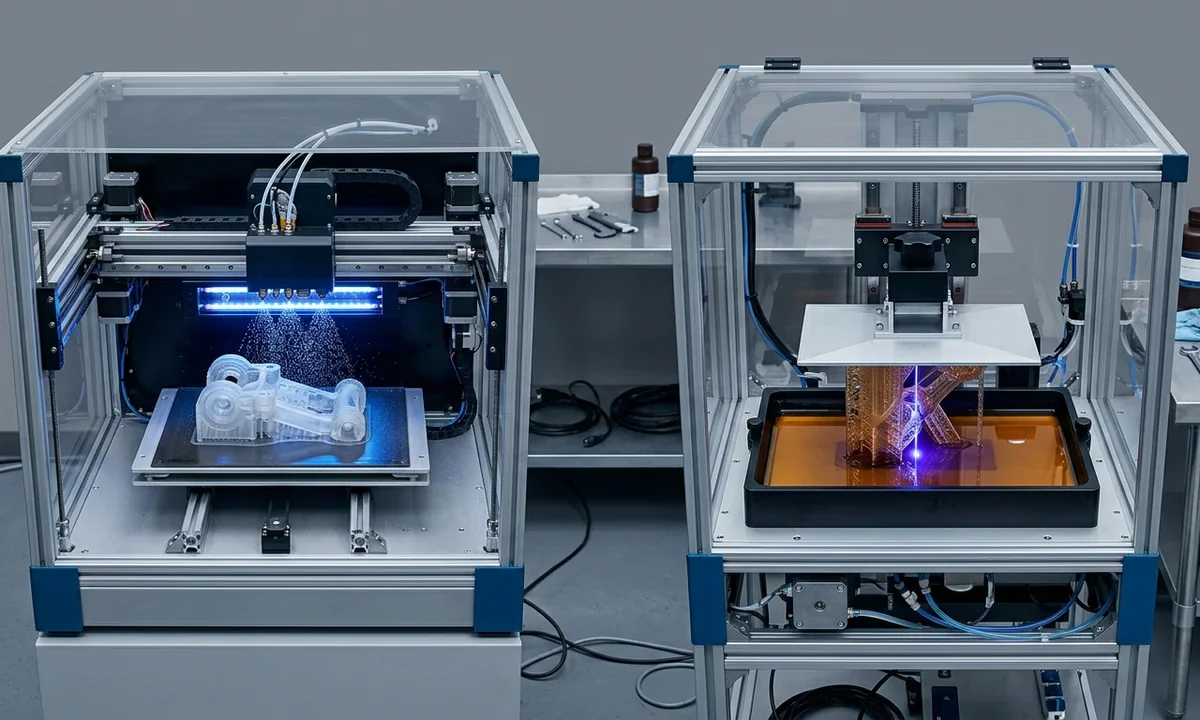
A glossy concept model and a dental surgical guide can emerge from machines that both cure liquid resin with ultraviolet energy, yet the workflows differ sharply. PolyJet systems spray microscopic droplets through print heads similar to Inkjet Printing hardware, while SLA printers trace each layer with a laser inside a Resin Vat.
Marketing language creates confusion. Vendors advertise "production-grade" parts without explaining how support removal or resin aging affect daily operation. Understanding the foundational differences in Filament vs Resin 3D Printing helps clarify the trade-offs in part strength and surface finish before you narrow the choice to these two resin workflows.
| Category | PolyJet | SLA |
|---|---|---|
| Mechanism | Jets UV Resin droplets | Laser cures resin vat |
| Strength | Multi-material realism | Lower operating cost |
| Support removal | Soluble or water jet | Manual washing and clipping |
| Entry pricing | Usually above $20,000 | Starts near $300 desktop |
Most buyers start with surface finish, but material flexibility and throughput usually matter more after production begins.

PolyJet Printing Explained
1How Material Jetting Works
Tiny resin droplets leave dozens or hundreds of nozzles during a PolyJet print pass. The machine spreads a thin layer of Thermoset Resin, flashes it with ultraviolet lamps, then repeats the cycle until the part reaches full height. PolyJet belongs to the broader PJP category of material jetting systems, though Stratasys remains the dominant commercial supplier.
Support material changes the workflow. Most machines print a gel-like secondary resin around overhangs and internal channels, then operators remove it with water jets or chemical baths after printing. Since Polyjet is a form of material jetting, a deeper dive into Material Jetting vs Binder Jetting provides valuable technical context if you want to compare other industrial deposition systems.
2Where PolyJet Excels
Surface quality drives most purchasing decisions. A J850 Prime or Objet30 can produce cosmetic prototypes with almost invisible layer transitions, transparent lenses, and rubber-like textures inside the same build. Industrial design teams often use PolyJet because clients can hold a prototype that resembles the final manufactured product before tooling begins.
Material blending also sets PolyJet apart. Some systems mix rigid and flexible photopolymers during printing, creating simulated overmolds or soft-touch grips in one part. Dental labs use that capability for gingiva masks and orthodontic planning models where multiple textures matter. Color matching also runs far ahead of most desktop resin platforms.
3PolyJet Limitations
Machine pricing stays high. Even older refurbished systems commonly cost $15,000 to $40,000, while current production units can exceed $250,000 before maintenance contracts and resin cartridges enter the equation. Material costs also climb quickly, with many proprietary resins selling between $300 and $500 per liter.
Maintenance demands attention every week. Print heads clog, UV lamps degrade, and unused resin can separate inside cartridges if operators leave the machine idle too long.

SLA Printing Explained
1How SLA Resin Printing Works
A narrow laser beam draws each cross-section inside a vat of liquid photopolymer during SLA printing. Every pass hardens selected resin areas, lowers the build platform, then exposes the next layer until the part finishes. Most desktop systems use bottom-up configurations, while industrial machines from 3D Systems and UnionTech often rely on larger top-down architectures for higher throughput.
Resin chemistry shapes the final result. Tough blends, castable dental materials, high-temperature formulations, and flexible elastomers now exist for machines that once handled only brittle prototype resin. Engineers deciding on the fundamental material choice should read our guide on FDM vs SLA for an overview of filament versus resin printing before comparing advanced resin systems.
2Why SLA Remains Popular
Desktop accessibility changed the market. A capable SLA machine now costs between $300 and $6,000, which places professional-quality resin printing within reach of small design studios and independent makers. Formlabs, HeyGears, Anycubic, and Phrozen all compete aggressively in this range. Resin selection keeps expanding every product cycle.
Dimensional accuracy also stays consistently strong. Well-calibrated SLA systems commonly achieve tolerances near ±0.1 mm on smaller components, especially when operators orient the model carefully and control post-curing temperatures. Dental aligner molds, hearing-aid shells, and engineering fit checks all benefit from that precision.
3Common SLA Trade-Offs
Uncured resin creates extra handling steps. Operators must wash printed parts in isopropyl alcohol or dedicated cleaning fluid, remove supports manually, then complete final Curing under ultraviolet light. Wear gloves. Liquid resin bonds to skin quickly.
Some SLA parts also remain brittle compared with nylon powder prints or machined thermoplastics, though modern engineering resins continue improving. To explore another key comparison, see our detailed SLA vs SLS comparison to understand the difference between liquid and powder-based technologies.

PolyJet vs SLA Compared
1Print Quality and Surface Finish
A polished consumer electronics mockup often reveals the difference immediately. PolyJet parts leave the printer with extremely smooth surfaces and nearly invisible layer transitions, especially on curved geometry and transparent sections. SLA prints also achieve high detail, but angled surfaces usually show faint stepping under direct light unless you sand or coat them afterward.
Support structures shape the user experience more than marketing brochures admit. PolyJet machines print dissolvable or water-removable supports that protect delicate features without leaving heavy contact marks. SLA supports attach directly to the model, so operators must clip them manually and sand visible touchpoints afterward. Fine jewelry masters and dental models still benefit from SLA precision, though cosmetic presentation usually favors PolyJet.
2Materials, Flexibility, and Durability
Material choice changes the recommendation quickly. PolyJet systems can combine rigid and flexible photopolymers in one build, which helps product teams simulate overmolded grips, hinges, or transparent housings before committing to tooling. SLA printers cannot blend multiple resin chemistries during a single print on most commercial platforms.
Durability remains complicated. PolyJet materials generally prioritize visual realism over long-term mechanical performance, and some become brittle after extended UV exposure. SLA engineering resins now perform better under heat and stress than earlier generations, especially formulations like Formlabs Tough 2000 or Loctite IND405. For manufacturing engineers prioritizing material properties, it's worth reviewing PolyJet vs SLS for a comprehensive technology assessment alongside resin-based systems.
The table below compares the major technical trade-offs.
| Technology | Pros | Cons | Best Use Case | Typical Cost |
|---|---|---|---|---|
| PolyJet | Multi-material, color realism, smooth finish | High machine cost, expensive resin | Product visualization | $20,000 to $250,000+ |
| SLA | Accurate, affordable entry cost, broad resin range | More cleanup, manual supports | Engineering prototypes | $300 to $15,000 |
3Speed, Build Volume, and Cost
PolyJet systems print entire layers in sweeping passes, so large batches of cosmetic prototypes finish quickly. SLA speed varies more because the laser traces every feature individually. Dense parts with intricate geometry often take longer on SLA hardware.
Build volume also separates industrial and desktop workflows. A Stratasys J850 handles much larger assemblies than most desktop SLA printers, though industrial SLA systems such as the 3D Systems SLA 750 compete effectively in aerospace and medical production environments.
Operating cost matters daily. PolyJet resin prices stay high, and maintenance contracts can exceed several thousand dollars annually. SLA ownership costs remain lower for small studios and prototype-focused teams.
4Workflow and Post-Processing
PolyJet workflows reduce manual finishing. Operators remove support gel, rinse the part, and move directly into evaluation or presentation in many cases. SLA demands more bench work because cleaning, drying, post-curing, and sanding all affect final quality.
That extra labor changes production economics. A single SLA print may cost less in material, but technician time can erase those savings during high-volume iteration cycles.
Best Uses for Each
1When PolyJet Makes More Sense
Color realism and mixed-material capability give PolyJet a clear advantage during client-facing prototype reviews. Automotive interiors, consumer electronics housings, medical visualization models, and packaging concepts benefit from surfaces that already resemble molded production parts. Product teams can print transparent sections beside rubber-like buttons in one build, which shortens evaluation cycles significantly.
Medical applications also favor PolyJet in several niches. Surgeons often request anatomical models with soft tissue differentiation before complex procedures. Dental labs use multi-material workflows for gingiva masks and implant planning because support removal stays gentle around delicate geometry.
Visual fidelity drives the decision here. If the prototype must look finished directly off the machine, PolyJet usually wins.
2When SLA Is the Better Choice
Engineering groups often choose SLA because the economics scale more comfortably. A Formlabs Form 4, Phrozen Sonic Mega, or UnionTech industrial system can produce accurate prototype parts without the six-figure investment common in advanced PolyJet installations. Resin variety also gives SLA broader reach for functional testing.
Dental manufacturing relies heavily on SLA. Labs print aligner molds, crown patterns, and surgical guides daily because validated biocompatible resins remain widely available. Small-batch production also works well when operators need repeatable tolerances and moderate throughput rather than cosmetic realism.
SLA handles rapid iteration efficiently. Designers can modify a CAD file in the morning, print a revised assembly overnight, then test fitment the next day without committing to expensive material cartridges.
3Choosing Based on Budget
Budget usually narrows the shortlist quickly.
- Hobbyists and independent makers generally fit inside the SLA market because desktop systems start below $500.
- Small engineering shops often combine SLA printing with outsourced PolyJet service bureau work for presentation models.
- Large corporations with dedicated prototype departments can justify PolyJet ownership if visual realism affects product approval cycles frequently.
If you need to refresh core terminology, our guide on What is 3D Printing offers a quick primer for all skill levels.
Beyond PolyJet and SLA
1Other Resin Printing Alternatives
DLP printers occupy the middle ground between affordability and production efficiency. Instead of tracing each layer with a laser, DLP systems project an entire image through a digital light engine, which speeds up smaller batch production considerably. EnvisionTEC and Asiga built strong dental ecosystems around this approach.
Carbon's CLIP process changes the oxygen environment near the resin surface to create near-continuous printing motion rather than discrete layer pauses. Speed improves dramatically for selected geometries, though machine and material costs remain high. For high-volume production analysis, our ultimate guide explaining MJF vs SLS 3D Printing is a crucial resource for comparative evaluation if your parts require stronger end-use thermoplastics rather than photopolymer resin.
Material jetting competitors continue evolving as well. Mimaki and Stratasys both push color realism further every product cycle, especially for medical visualization and consumer packaging applications.
2Outsourcing vs Buying Equipment
Buying hardware too early creates expensive downtime. A service bureau often makes more sense if your team prints fewer than 15 to 20 large prototype jobs monthly or requires occasional access to specialized materials. Outsourcing also shifts maintenance, calibration, and failed print risk onto the vendor.
Internal ownership becomes practical once iteration speed matters more than part cost. Product design firms that revise assemblies daily usually recover the investment faster because engineers stop waiting for external delivery schedules.
3Questions to Ask Before Investing
Ask direct operational questions before signing anything.
- Do you need cosmetic realism or functional testing first?
- Will the parts contact skin or require certified biocompatible resin?
- Can your workspace handle resin ventilation and cleaning stations safely?
- How much technician time can you dedicate to support removal and curing?
- Will production volumes justify annual maintenance costs?
Those answers narrow the technology choice quickly.
Final Takeaways That Matter
1The Biggest Performance Differences
Two machines can print smooth resin parts while serving completely different production goals. PolyJet focuses on presentation quality, multi-material realism, and minimal visible layering. SLA focuses on dimensional accuracy, resin flexibility, and lower ownership cost. Your workflow matters more than the headline specifications printed on a brochure.
PolyJet generally produces the best cosmetic finish directly from the printer. Product designers working on consumer-facing prototypes often prefer it because transparent surfaces, textured grips, and color transitions appear convincing without heavy post-processing. The downside appears quickly in operating costs. Proprietary cartridges, scheduled maintenance, and machine pricing place PolyJet firmly inside professional and industrial environments.
SLA remains easier to access. Desktop systems now deliver highly accurate parts for a fraction of the investment required by industrial material jetting platforms. Dental production, engineering validation, and low-volume manufacturing all benefit from that lower barrier to entry.
2Which Resin Workflow Wins?
Neither process wins universally. PolyJet makes more sense if visual realism, color matching, or mixed-material simulation drives the project. SLA fits better when you need accurate engineering prototypes, repeatable production workflows, or affordable resin experimentation.
Choose based on the part's job, not marketing language. That approach avoids expensive mistakes.
Technical communicator specialising in 3D printing workflows, covering the full content spectrum: foundational guides, step-by-step how-to tutorials, hands-on reviews, curated top picks, troubleshooting solutions, and industry news.