
SLM 3D Printing Guide: How Selective Laser Melting Works

Curious how slm 3d printing actually builds metal parts? This guide breaks down selective laser melting in plain terms - dive in and finally understand the process from start to finish.
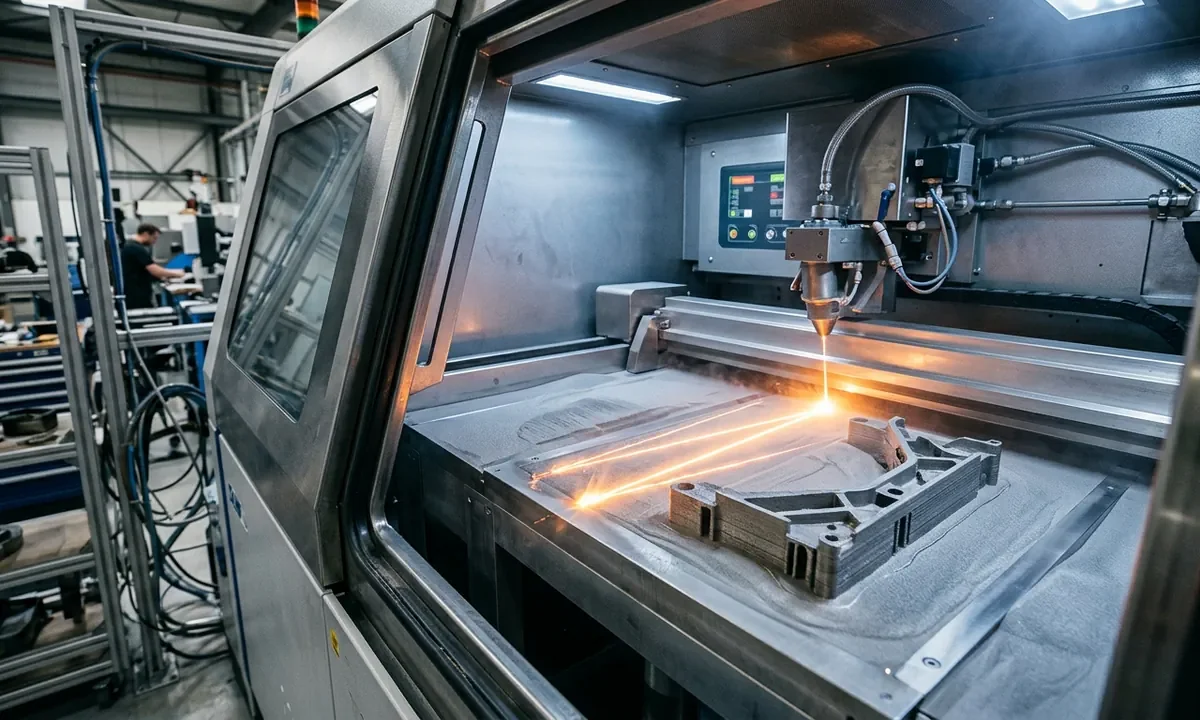
In a turbine blade factory in southern Germany, a single design revision once took six months to validate through casting and machining. Today, the same geometry can be produced overnight in dense metal, tested within days, and iterated within a week. That shift hinges on one process: selective laser melting.
Selective laser melting (SLM) is a metal additive manufacturing method where a high-powered laser fully melts fine metal powder layer by layer to create near fully dense parts. Unlike partial-sintering techniques, SLM produces components with mechanical properties approaching wrought material, making it suitable for functional, load-bearing applications.
Defining Selective Laser Melting
SLM 3D printing belongs to the powder bed fusion family, but its defining characteristic is complete melting. Each layer of powder is selectively fused into a solid cross-section, forming a metallurgical bond with the layer beneath.
Why Industries Are Adopting SLM
Aerospace firms report weight reductions of up to 40 percent in topology-optimized parts, while medical implant manufacturers rely on SLM for patient-specific geometries. The appeal is not just complexity, but performance. Parts exhibit high density, controlled microstructures, and, under optimized conditions, near-isotropic behavior, reducing the traditional gap between prototyping and production.
History and Evolution of Selective Laser Melting Technology
1Early Powder Bed Fusion Developments
The roots of SLM trace back to the late 1980s, when selective laser sintering (SLS) emerged as a method for fusing polymer powders. Early experiments with metals followed quickly, but the physics posed a problem. Metals require significantly higher energy input to transition from solid to liquid compared to polymers, and early systems lacked the laser power and process control to achieve consistent melting.
Initial metal systems relied on partial sintering. Particles bonded at their surfaces but retained internal porosity. Density often stalled below 90 percent, limiting these parts to non-structural applications. Research groups in Germany and Sweden began pushing beyond this limitation by increasing laser power and refining scan strategies.
2From SLS to SLM: Key Advancements
The transition from sintering to full melting marked a decisive shift. By the early 2000s, machines could generate stable melt pools, fully liquefying metal powder and allowing it to solidify into dense structures. This change improved part density to above 99.5 percent in many alloys, according to published industry benchmarks.
Two technical breakthroughs made this possible:
- Higher energy density lasers capable of sustaining consistent melt pools
- Improved scan strategies that controlled heat distribution and reduced defects
This is also where terminology began to diverge. Direct Metal Printing and Direct Metal Laser Sintering (DMLS) are often used interchangeably with SLM, though subtle differences exist in process parameters and branding. For a deeper comparison, review this detailed DMLS vs SLM breakdown for metal additive manufacturing comparisons.
3Modern Industrial Adoption
By the 2010s, SLM systems had moved from research labs into production floors. Aerospace companies such as GE Aviation validated SLM for critical components like fuel nozzles, reporting consolidation of 20 separate parts into a single printed assembly. That alone reduced failure points and assembly time.
Medical sectors followed closely. Orthopedic implants, particularly titanium acetabular cups, began leveraging SLM's ability to create porous lattice structures that encourage bone in-growth.
Field data collected over multi-year production cycles shows that when process parameters are tightly controlled, defect rates can fall below 2 percent. Community discussions across manufacturing forums consistently highlight one pattern: early adopters struggled with repeatability, but second-generation systems with better thermal management have stabilized outcomes.
The technology did not mature overnight. It evolved through incremental control over heat, material behavior, and system architecture, each step narrowing the gap between digital model and physical part.
How Selective Laser Melting Works: Core Process Explained
1Powder Layering and Laser Scanning
At the heart of SLM 3D printing is a repeating cycle that builds parts layer by layer, typically at thicknesses between 20 and 60 microns. A recoater blade spreads a thin layer of metal powder across the build platform. Then a laser scans the surface, selectively melting regions defined by the digital model.
Each layer follows a defined scan strategy. Hatch patterns, contour passes, and rotation between layers are carefully programmed to manage heat distribution. Poor strategies can lead to warping or incomplete fusion.
The sequence is consistent:
- Powder is spread evenly across the build plate
- The laser selectively melts cross-sectional geometry
- The platform lowers by one layer thickness
- The process repeats until the part is complete
2Melt Pool Formation and Solidification
The melt pool is the critical zone where powder transforms into solid metal. Temperatures can exceed 1,500°C for alloys like stainless steel or titanium. Within milliseconds, molten metal cools and solidifies, forming a microstructure that depends on cooling rate and thermal gradients.
Rapid cooling, often exceeding 10⁵ K/s, leads to fine grain structures. This contributes to high strength but can also introduce residual stress. Inconsistent melt pool behavior is one of the primary sources of defects such as lack of fusion or keyholing.
3Build Chamber Conditions
SLM does not operate in open air. The build chamber is filled with inert gas, typically argon or nitrogen, to prevent oxidation. Oxygen levels are often kept below 0.1 percent, especially for reactive metals like titanium.
Temperature control also matters. Some systems incorporate a heated chamber or preheated build plate to reduce thermal gradients. Without this, rapid cooling can cause shrinkage and internal stress, leading to distortion or cracking.
A well-controlled build chamber stabilizes the process. It supports consistent melt pool behavior, reduces anisotropy in mechanical properties, and improves overall part quality. The difference between a stable and unstable chamber often determines whether a part passes inspection or fails under load.
Types of Metal Powder Bed Fusion Processes
1SLM vs SLS vs DMLS
Terminology in metal additive manufacturing often creates more confusion than clarity. SLM, SLS, and DMLS are frequently used interchangeably, but their underlying physics differ in meaningful ways.
Selective laser sintering (SLS), in its original form, relies on partial melting or solid-state diffusion. Metal particles bond at contact points without fully liquefying. This results in higher porosity and reduced mechanical performance. For polymers, that limitation is acceptable. For structural metals, it is not.
Selective laser melting, by contrast, fully melts the powder, producing near fully dense parts with mechanical properties comparable to wrought alloys. DMLS sits somewhere in between as a term. In practice, most modern DMLS systems operate in a full melting regime similar to SLM, though the distinction persists due to historical branding and parameter tuning differences. For a broader perspective on powder bed fusion, explore this comprehensive DMLS vs EBM comparison across industrial applications.
2Electron Beam Melting Comparison
Electron Beam Melting (EBM) takes a different approach. Instead of a laser, it uses an electron beam as the energy source. The process occurs in a vacuum rather than an inert gas environment, eliminating oxidation concerns but introducing other constraints.
EBM systems typically operate at higher build temperatures, often above 600°C for titanium alloys. This reduces residual stress and minimizes the need for support structures. However, the trade-off appears in resolution. Electron beams are less precise than lasers, leading to rougher surface finishes and thicker minimum feature sizes.
You can also reference Pick3DP's SLM vs EBM guide to evaluate electron beam versus laser-based systems.
3When to Use Each Method
Selecting between these processes depends on application priorities:
- SLM: Best for high-resolution, complex geometries where surface detail and dimensional accuracy matter
- DMLS: Functionally similar to SLM in modern systems, often chosen based on machine ecosystem
- EBM: Preferred for large titanium parts where residual stress reduction outweighs surface finish concerns
Industry adoption data shows aerospace components with tight tolerances overwhelmingly favor SLM, while orthopedic implants often lean toward EBM due to its thermal stability. The choice is rarely about capability alone. It is about matching process physics to performance requirements.
Key Components and Terminology in SLM Systems
1Laser Systems and Optics
The laser defines the process. Most SLM systems use fiber lasers in the range of 200 to 1,000 watts, though multi-laser configurations are now common in industrial machines. Higher power enables faster scanning but also increases the risk of instability in the melt pool.
Beam delivery is controlled through galvanometer mirrors, which rapidly direct the laser across the powder bed. Positioning accuracy often falls within ±50 microns, though real-world accuracy depends on calibration and thermal distortion during the build.
Multi-laser systems introduce another layer of complexity. Overlapping scan fields must be carefully synchronized to avoid inconsistent fusion zones. In high-throughput systems, this coordination directly affects part uniformity.
2Build Platform and Powder Delivery
The build platform serves as both a foundation and a thermal sink. It is typically preheated to reduce thermal gradients and improve layer adhesion. During printing, the platform lowers incrementally as each layer is completed.
Powder delivery systems rely on a recoater, either a blade or roller, to spread material evenly. Uniformity at this stage is critical. Variations in layer thickness as small as 10 microns can lead to defects in subsequent layers.
Material quality also plays a role. Particle size distribution, often between 15 and 45 microns, affects flowability and packing density. Poorly controlled powder leads to inconsistent melting behavior and reduced part quality.
3Critical Terms You Need to Know
Understanding SLM requires fluency in its terminology:
- Melt Pool: The localized region where the laser melts powder into liquid metal
- Hatch Spacing: The distance between adjacent scan lines, affecting density and overlap
- Scan Strategy: The pattern and sequence used to melt each layer
- Build Chamber: The controlled environment where printing occurs, typically filled with inert gas
- Isotropy vs Anisotropy: Whether mechanical properties are uniform in all directions or vary based on build orientation
- Shrinkage: Dimensional changes during cooling and solidification
Misunderstanding these terms often leads to design or process errors. Community feedback consistently points to scan strategy and hatch spacing as the most underestimated variables, particularly in first-time builds.
Benefits and Limitations of SLM 3D Printing
1Strength, Precision, and Complexity Advantages
SLM's primary strength lies in its ability to produce fully dense metal parts with complex internal geometries. Lattice structures, conformal cooling channels, and topology-optimized forms are not theoretical advantages. They are already deployed in production environments.
Mechanical testing data shows tensile strengths in SLM-produced Ti-6Al-4V exceeding 1,000 MPa under optimized conditions, comparable to forged equivalents. Dimensional accuracy typically falls within ±0.1 mm for small components, though this varies by machine and calibration.
Complexity carries little additional cost. A bracket with internal channels costs nearly the same to print as a solid block of equivalent volume. This shifts design priorities from manufacturability to performance.
2Cost, Speed, and Material Constraints
The advantages come with clear trade-offs. Machine costs range from $250,000 to over $1 million, and material powders can exceed $300 per kilogram for specialty alloys.
Build speeds remain relatively slow. A part that takes 8 hours to print might require an additional 4 to 6 hours for setup and post-processing. Compared to CNC machining, throughput is limited.
Material options, while expanding, are still constrained. Aluminum, titanium, stainless steel, and nickel alloys dominate. Exotic materials often require custom parameter development, which adds time and cost.
If you're evaluating feasibility, How Much Does 3D Printing Cost is essential reading for understanding total production expenses.
3Surface Finish and Post-Processing Needs
Surface finish is one of SLM's consistent limitations. As-built roughness typically ranges between Ra 5 and 15 microns, depending on orientation and parameters. For functional surfaces, machining or polishing is almost always required.
Post-processing steps include:
- Support removal
- Heat treatment to relieve residual stress
- Surface finishing
Post-processing is critical, and Polishing 3D Prints explains how to achieve high-quality surface finishes.
Despite these limitations, industry feedback shows a consistent trend. When performance gains outweigh cost and speed constraints, SLM remains one of the few viable options for advanced metal components.

Getting Started with SLM 3D Printing
1Equipment and Investment Requirements
Entering the world of SLM 3D printing is less about buying a machine and more about committing to an ecosystem. Industrial systems range from compact single-laser units to multi-laser platforms exceeding $1.2 million, though smaller entry-level machines now appear around the $150,000 mark with limited build volumes.
Capital cost is only part of the picture. Facilities must support controlled environments, including inert gas supply, powder handling stations, and post-processing equipment such as heat treatment furnaces and CNC finishing tools. Industry data suggests that total setup costs can reach 2 to 3 times the base machine price once infrastructure is included.
To complement this, check a 3D printer cost breakdown guide to analyze capital and operational investments.
2Design Considerations for Metal Printing
Designing for SLM is fundamentally different from designing for machining. Traditional constraints like tool access disappear, replaced by thermal and support considerations.
Before printing, sourcing optimized STL Files for 3D Printing ensures geometry accuracy and manufacturability. Poor mesh quality translates directly into defects during the build.
Key design principles include:
- Minimizing overhangs below 45 degrees to reduce support requirements
- Accounting for shrinkage and thermal distortion during cooling
- Orienting parts to balance surface quality and mechanical performance
Experienced engineers often redesign components entirely rather than adapting existing CAD models. Field observations show that first-generation designs frequently fail due to overlooked thermal behavior rather than geometric complexity.
3Safety and Operational Factors
Working with fine metal powders introduces risks that are easy to underestimate. Powders in the 15 to 45 micron range can become airborne and, in some cases, combustible.
Facilities implement strict protocols:
- Controlled powder storage in sealed containers
- Use of personal protective equipment, including respirators
- Grounding systems to prevent static discharge
Inert gas environments inside the build chamber reduce oxidation but create oxygen-deficient zones if leaks occur. Monitoring systems are standard in industrial setups.
Operational discipline matters. Teams that treat SLM like a conventional printer often face failures early, while those who approach it as a metallurgical process tend to stabilize results faster.
Advanced Considerations in SLM Manufacturing
1Process Optimization and Parameter Control
SLM performance is governed by a tightly coupled set of parameters. Laser power, scan speed, hatch spacing, and layer thickness interact in ways that are not always intuitive. Small adjustments can shift the process from stable melting to defect formation.
Energy density, often expressed as a combination of these parameters, serves as a useful reference. Too low, and lack-of-fusion defects appear. Too high, and excessive vaporization leads to keyhole porosity.
In controlled trials across stainless steel builds, adjusting scan speed by just 10 percent altered density by over 2 percent. That margin is enough to determine whether a part passes or fails inspection.
To better understand process nuances, review this detailed DMLS vs SLM breakdown for metal additive manufacturing comparisons.
2Residual Stress and Heat Management
Residual stress is one of the defining challenges in SLM. Rapid heating and cooling cycles create internal stresses that can warp parts or cause cracking, especially in larger geometries.
Thermal gradients are the root cause. The top layers cool quickly while underlying material remains hot, creating uneven contraction. Heated chamber systems and optimized scan strategies help mitigate this, but they do not eliminate it entirely.
Common mitigation strategies include:
- Preheating the build platform
- Designing support structures to anchor parts during cooling
- Applying post-build heat treatments
Industry case studies show that without stress relief, distortion rates can exceed 15 percent in complex geometries. With proper controls, this can drop below 3 percent.
3Industrial Applications and Scaling
SLM has moved beyond prototyping into low-volume production, particularly in aerospace, medical, and energy sectors. The economics shift when part consolidation and performance gains outweigh production speed limitations.
Fuel system components, for example, often integrate multiple functions into a single printed part, reducing assembly time and failure points. In medical applications, patient-specific implants justify higher costs due to improved outcomes.
Scaling remains a challenge. Multi-laser systems improve throughput, but coordination between lasers introduces variability that must be managed carefully.
When selecting machines, choosing a 3D printer for functional parts can help align SLM with production needs.
SLM does not replace traditional manufacturing. It complements it, filling a niche where complexity, performance, and customization intersect.
Conclusion: Key Takeaways About SLM 3D Printing
1Core Concepts Recap
Selective laser melting builds metal parts by fully melting powder layer by layer, creating dense, high-performance components. The process hinges on controlled melt pool behavior, stable build chamber conditions, and precise parameter tuning. When these factors align, SLM produces parts that rival traditional manufacturing in strength while surpassing it in geometric freedom.
2When SLM Makes Sense
SLM is most effective where complexity adds value. Aerospace brackets with internal channels, medical implants tailored to patient anatomy, and high-performance components with integrated functions all benefit from this approach. It is less suitable for high-volume, low-complexity parts where machining or casting remains more cost-effective.
If you're evaluating feasibility, How Much Does 3D Printing Cost is essential reading for understanding total production expenses.
3Next Steps for Learning
The next layer of understanding lies in materials science and process optimization. Engineers who move beyond surface-level operation and study microstructure formation, thermal behavior, and parameter interactions tend to unlock the real potential of SLM.
Curiosity matters here. The process rewards those who question assumptions, test variations, and treat each build not just as production, but as data.
Key Takeaways
- Selective laser melting fully melts metal powder, producing near fully dense parts with mechanical properties comparable to wrought materials, unlike sintering-based methods.
- Melt pool stability is the single most critical factor in part quality, directly influencing density, microstructure, and defect formation.
- Build chamber control, including inert gas atmosphere and temperature management, plays a decisive role in reducing oxidation, shrinkage, and anisotropy.
- SLM excels where complexity adds functional value, such as internal channels, lattice structures, and part consolidation in aerospace and medical applications.
- High capital cost and slow build speeds remain key constraints, but these are often offset by performance gains and reduced assembly requirements.
- Successful adoption depends as much on design adaptation and process understanding as on machine capability, with thermal behavior often being the limiting factor.
Industry analyst with a PhD in Materials Engineering and 12+ years tracking the global digital fabrication market. Covers 3D printing, 3D scanning, CNC machining, laser machining, and 3D modeling through data-driven guides and market news.