
How Meat 3D Printing Is Redefining the Future of Sustainable Food

Whole-cut steaks printed layer by layer? Meat 3D Printing is quietly moving from lab curiosity to restaurant reality. Discover who's leading the charge and why it matters.
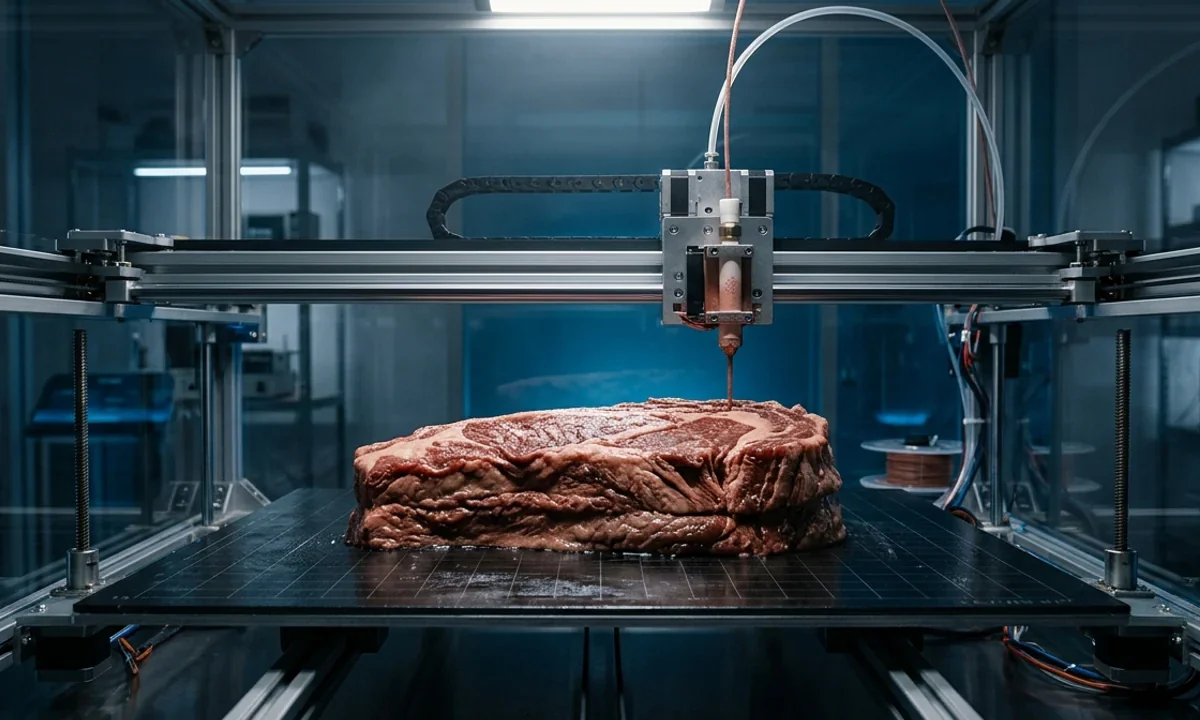
On July 14, 2026, Steakholder Foods said its first Perfecta shipment had reached the United States, moving 3D-structured meat from demonstration kitchens toward retail distribution. The company expects dozens of northeastern stores to receive the line in coming months through KeHE Distributors, before a broader rollout. That is the clearest commercial signal yet: printed whole cuts are entering ordinary food channels, not merely appearing at technology showcases.
The shipment followed Steakholder Foods' May 20 announcement that Perfecta would launch in the second half of 2026. Arik Kaufman, the company's chief executive, called the planned U.S. entry a pivotal commercialization step in that release. Perfecta includes marbled steak, filet mignon, chicken breast, burgers, and fish patties, although Steakholder has not published independent sell-through data or final store-level pricing. Pick3DP could not independently confirm those details at publication time.
Redefine Meat established the European reference point earlier. Its November 2021 commercial launch placed plant-based beef and lamb whole cuts in selected restaurants across Israel, the United Kingdom, Germany, and the Netherlands. By July 2024, Redefine had moved its flank steak into European retail through Ocado in Britain and Coop in Switzerland, with Dutch chains scheduled to follow. The company said the product had already appeared in food service across more than nine countries.
These developments matter because whole-cut texture has long separated printed meat from conventional plant-based patties. Burgers can hide structural weakness inside a ground format. Steak cannot. A product must hold aligned fibers, distributed fat, moisture, and browning behavior through cooking.
For readers tracking digital fabrication, the market shift resembles the move from prototyping to low-volume production in industrial AM. The hardware still matters, but repeatable recipes, distribution agreements, and retailer acceptance now determine commercial progress. In our experience tracking food-printing launches, distribution has become the harder milestone. Perfecta's northeastern rollout gives the sector a measurable test: whether shoppers will repeatedly buy structured protein after the novelty fades.
How Bio-Inks Build Muscle Fiber
Food bioprinters build structured protein much as material-extrusion systems build engineered parts: a digital model controls where each edible formulation lands. Instead of thermoplastic filament, the machine deposits printable food matrices, often called bio-inks, through separate nozzles. Redefine Meat describes its process as Meat Matrix Additive Manufacturing, with voxel-level control over plant-based muscle, fat, and blood analogues.
The digital recipe acts like a manufacturing file. Producers can select a target cut, then adjust fiber direction, thickness, shape, and the ratio between lean and fatty material without rebuilding a production line. Redefine says its printers can change combinations of muscle and fat without retooling. That flexibility gives digital fabrication an advantage over fixed molds when a factory wants several products from one platform.
 Credit © Pick3DP
This diagram illustrates the stratified bio-printing process, using various bio-inks to create realistic plant-based meat textures. It highlights the precision and flexibility of 3D printing in producing sustainable food alternatives.
Fiber orientation carries the hardest technical burden. Ground products need flavor, binding, and juiciness, but not long directional strands. A whole cut must resist the fork differently across and along its grain. By placing protein matrices along controlled paths, printers can create anisotropy, the same directional behavior engineers consider in AM parts. Millimeter-scale placement also lets developers position fat pockets where heat can melt them during cooking.
The Three-Ink System
Redefine Meat describes three material families: muscle, fat, and blood. Its formulas use vegetable proteins, including soy and pea, while other developers work with chickpea or fungal proteins. The muscle matrix supplies the fibrous body. A separate fat matrix uses plant oils or solid fats selected for melting behavior and mouthfeel, while color and flavor systems can include pigments, yeast-derived ingredients, and natural flavorings.
Multiple nozzles deposit those materials together rather than blending everything into one uniform paste. That distinction matters. A homogeneous mixture can become soft under heat because fat, water, and protein occupy the same continuous phase. Spatial separation lets the printed cut hold its form while zones soften or release moisture.
The technology remains closer to food structuring than medical bioprinting. Plant-based products contain no living cells, and the word bioink can blur that difference. Aleph Farms instead grows animal cells, then structures them within a plant-protein matrix. The production biology differs.
Companies Racing to Scale Production
Redefine Meat has built the broadest visible commercial footprint among printed whole-cut specialists. Its materials show food-service launches in Israel, Britain, Germany, and the Netherlands from 2021, followed by wider European restaurant and retail distribution. Redefine reported more than 650 participating European restaurants in January 2023 and said its products had reached 13 countries. The company does not publish audited market share, so leadership is best judged by distribution rather than percentage control.
Steakholder Foods follows a different model. Alongside Perfecta, it markets two industrial platforms: the MX200 for meat analogues and the HD144 for fish. The strategy combines proprietary printers with premixes, allowing manufacturers to produce structured foods without developing every formulation internally. Its roadmap has included hybrid plant-based and cultivated inputs, though current Perfecta products are plant-based.
Spain's Novameat and Cocuus remain scaling challengers. Cocuus said in January 2026 that its UpgradedMeat project carries a €1.09 million budget and €546,273 government grant to move hybrid meat printing from pilot validation toward industrial conditions. Its "Food to Data, Data to Food" software digitizes animal cuts and reproduces their structure in multiple formats. Public evidence of broad retail sell-through remains limited.
 Credit © Steakholder Foods
The Steakholder MX 200 utilizes advanced FPL Technology to 3D print meat, showcasing innovation in sustainable food production.
The field extends beyond steak. Austria's Revo Foods sells 3D-structured seafood alternatives in European supermarkets, including a fungi-protein filet with algae oil. SavorEat uses a Robot Chef that forms and cooks customized plant-based portions; the company says it can produce up to 90 patties per hour. Aleph Farms occupies the cultivated segment: Israel approved its cell-cultivated petit steak, supported by a soy-and-wheat matrix, in January 2024.
Distribution reveals the market's limits. Premium restaurants, specialty retailers, university pilots, and selected supermarket chains dominate, while mass grocery penetration remains uneven. Each company solves a different bottleneck: Redefine emphasizes finished whole cuts, Steakholder sells production infrastructure, Revo targets seafood, SavorEat personalizes meals, and Aleph Farms develops cultivated tissue.
That fragmentation is not weakness alone. It shows the category has not standardized around one feedstock, machine architecture, or route to market. For buyers and investors, shipment volume, repeat orders, and plant utilization now matter more than demonstration quality.
Market Size and Cost Reality
The most recent public market forecast points to rapid expansion, even if today's commercial footprint remains small. A Fact.MR market analysis released in June 2026, and distributed through openPR, estimated the global 3D-printed food market at approximately US$716 million in 2026. The same forecast projects the sector will reach roughly US$10.1 billion by 2036, representing a compound annual growth rate of about 30% over the ten-year period. Fact.MR also estimated that Europe accounts for nearly 27% of the current market, reflecting the region's early investment in food technology, alternative proteins, and supportive regulatory initiatives.
Those figures deserve context. The forecast measures the broader 3D food printing market rather than printed meat alone. That includes confectionery, customized nutrition, bakery products, seafood alternatives, and structured plant proteins. Publicly available research still does not isolate commercial revenues generated exclusively by printed whole-cut meat, making direct comparisons between companies difficult.
1Global 3D-Printed Food Market Forecast (2026-2036)
| Metric | 2025 | 2026 (Estimated) | 2036 (Forecast) | Source |
|---|---|---|---|---|
| Global Market Size | US$530 million | US$716 million | US$10.14 billion | Fact.MR, 3D-Printed Food Market, March 2026 |
| Forecast CAGR (2026-2036) | - | 30.4% | - | Fact.MR |
| Absolute Market Growth | - | - | +US$9.42 billion | Fact.MR |
| Largest End-User Segment (2026) | - | Commercial foodservice (~51%) | - | Fact.MR |
| Leading Technology (2026) | - | Extrusion-based printing (~46%) | - | Fact.MR |
Fact.MR, 3D-Printed Food Market, March 2026
2Regional Market Snapshot (2026)
| Region / Country | Market Position | Forecast CAGR (2026-2036) | Key Insight |
|---|---|---|---|
| Europe | ~27% of global market | - | Largest regional market, driven by food-tech investment and early commercialization. |
| China | Fastest-growing major market | 32.5% | Government support and automated food manufacturing accelerate adoption. |
| United States | Major commercialization hub | 29.8% | Growth supported by restaurant innovation and digital food production. |
| Japan | Mature innovation market | 28.4% | Precision nutrition and healthcare applications drive demand. |
| Germany | European manufacturing leader | 27.6% | Strong engineering base and food manufacturing automation. |
| United Kingdom | Established adoption market | 26.9% | Commercialization continues through foodservice and specialty production. |
Hardware economics remain another major constraint. Industrial food printers cost substantially more than conventional extrusion systems, while manufacturers must also invest in food-safe production environments, recipe development, quality assurance, and specialized consumables. Those capital requirements limit adoption to well-funded startups, food manufacturers, and research organizations rather than small food producers.
Product pricing reflects those economics. Premium printed whole cuts have commonly appeared in food-service channels at prices approaching US$40 per kilogram, according to industry reporting and company commercialization discussions. That premium places printed steak well above conventional beef and most plant-based alternatives. Lower equipment costs, faster printing speeds, larger production volumes, and improved ingredient sourcing will all be required before supermarkets can realistically offer printed whole cuts at mainstream prices.
From an investment perspective, today's market remains capacity constrained rather than demand constrained. Production volume, not consumer curiosity, represents the industry's biggest commercial bottleneck.
What Comes Next For Consumers
A February 2026 review titled "Additive Manufacturing in Food Systems," highlighted by Fabbaloo, outlined both the promise and the remaining engineering barriers facing food printing. The review concluded that additive manufacturing offers meaningful advantages for customized nutrition, waste reduction, ingredient precision, and localized production. It also emphasized that industrial throughput, regulatory harmonization, and consumer acceptance remain unresolved challenges before widespread commercialization becomes practical.
Environmental performance continues to drive investment. Structured plant proteins generally require fewer natural resources than conventional livestock production, while digital manufacturing allows producers to deposit ingredients only where needed, reducing processing waste. Companies also see value in tailoring protein, fat, micronutrients, and texture for different demographic groups, an advantage conventional meat processing cannot easily match.
More 3D-printed steaks are coming to Europe - Source (Youtube@Reuters)
Consumer behavior, however, may prove just as important as manufacturing capability. Taste, appearance, cooking performance, labeling transparency, and perceived naturalness will determine repeat purchases more than technical sophistication. Pick3DP readers have asked about this before. The history of additive manufacturing shows that engineering success alone rarely guarantees commercial success.
What This Means for Pick3DP Readers
Readers following additive manufacturing should view meat printing as an emerging industrial application rather than a mature consumer market. The most meaningful indicators during the next 12 to 24 months will not be laboratory demonstrations or funding announcements. Instead, monitor retail expansion, production capacity, repeat distribution agreements, regulatory approvals, and manufacturing utilization.
For investors, the strongest signals will come from companies demonstrating scalable production economics instead of prototype performance. Equipment developers capable of lowering production costs may ultimately capture as much value as food brands themselves.
For engineers and AM professionals, food printing introduces another commercially relevant application of Material Extrusion, Multi-extrusion, Material Blending, Bioink, Bioprinting, Digital Fabrication, Voxel control, Biocompatible Material research, Prototyping, and broader AM manufacturing concepts. The second half of 2026, particularly the U.S. commercial rollout of printed whole cuts, will provide the clearest indication yet of whether structured protein can evolve into a sustainable parallel supply chain rather than remain a technological curiosity.
For readers calibrating expectations on deposition rates, layer fidelity, and toolpath constraints that carry over from polymer AM into edible bioinks, our primer on what is 3D printing grounds these food-tech claims in process fundamentals and failure modes.
Business journalist covering the digital fabrication and advanced manufacturing sector. Reports on funding rounds, acquisitions, executive moves, and strategic partnerships across 3D printing, CNC machining, laser machining, and related industries.