
The Ultimate Guide: MJF vs SLS 3D Printing Explained

Curious about MJF vs SLS for industrial printing? Explore real differences in speed, finish, and cost between sls vs mjf technologies before choosing your next production method.
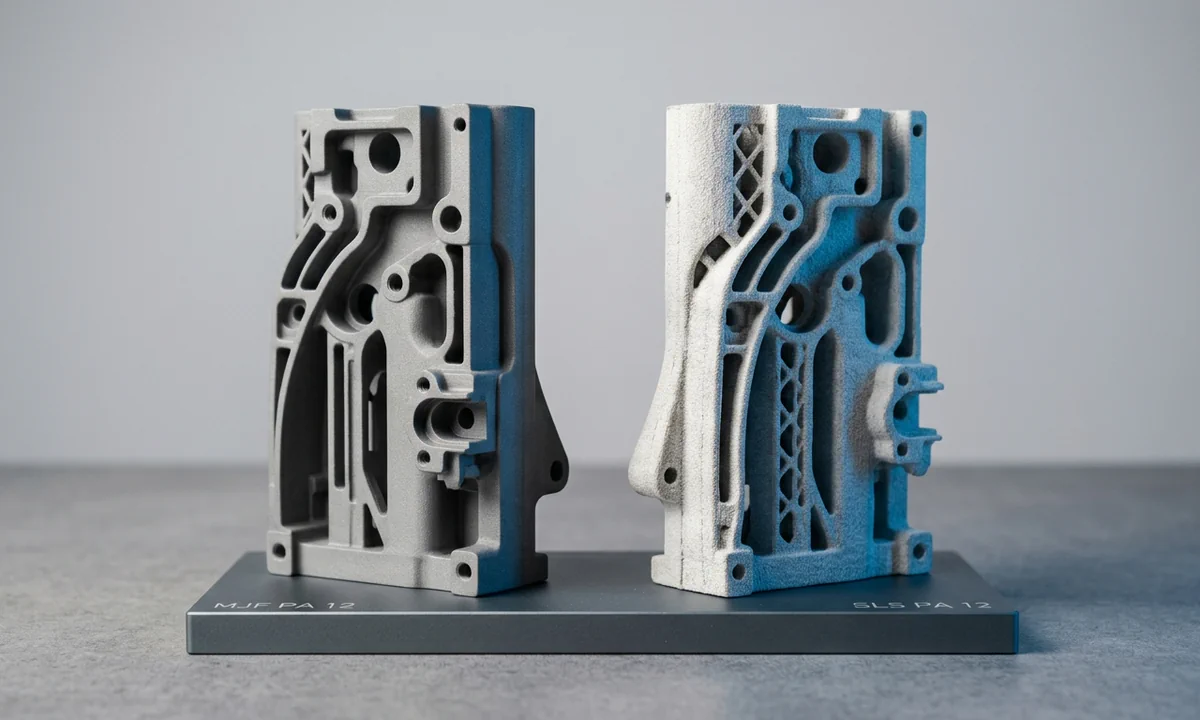
Two powder-filled build chambers can produce nylon parts that look remarkably similar on a workbench, yet they often arrive there through very different engineering decisions. The core difference is straightforward: Multi Jet Fusion (MJF) uses inkjet heads to deposit fusing and detailing agents before infrared energy bonds each layer, while Selective Laser Sintering (SLS) scans the powder with one or more lasers that fuse selected regions directly. Both processes create strong, support-free polymer parts, but they differ in production speed, material flexibility, operating costs, and surface characteristics.
That distinction explains why buyers regularly compare MJF vs SLS before committing to an industrial additive manufacturing platform. Marketing materials often highlight a single advantage, such as faster throughput or broader material options, while glossing over the compromises. Reality is more nuanced.
Product designers evaluating functional prototypes, engineering teams planning bridge production, and experienced makers exploring industrial services all face the same question: which process delivers the best balance for a specific application rather than the broadest list of specifications? The answer changes depending on geometry, production volume, mechanical requirements, and available budget.
Neither technology replaces the other. Instead, each occupies a strong position within polymer powder-bed fusion. HP's Multi Jet Fusion gained rapid adoption because it shortened production cycles for many nylon components, while SLS continues to thrive thanks to decades of process maturity, an expanding machine ecosystem, and wider material compatibility.
Treat this comparison as a practical buying framework instead of a search for a universal winner. The better choice depends on the parts you intend to manufacture.
MJF vs SLSInside Multi Jet Fusion
1How the Process Works
Unlike laser-based powder fusion, Multi Jet Fusion prints an entire layer in a coordinated sequence rather than tracing every contour individually. A recoater roller spreads a thin layer of polymer powder across the build area, although some systems may use alternative powder distribution methods depending on machine generation. Printheads then deposit microscopic droplets of two different chemical agents: a fusing agent where the part should solidify and a detailing agent around edges to sharpen feature definition and reduce unwanted heat spread.
Infrared lamps pass across the build surface immediately afterward. Regions containing the fusing agent absorb substantially more thermal energy than untreated powder, allowing the selected geometry to melt while surrounding material remains loose enough to support overhangs and internal cavities. Once the layer solidifies, another powder layer arrives and the sequence repeats.
The process builds every component inside a packed powder bed simultaneously. Build time therefore depends more on the height of the tallest part than on the number of individual components sharing the chamber, making production planning noticeably different from technologies that trace every contour independently.
2Materials and Production Strengths
Today, PA12 remains the most widely used MJF material because it balances strength, dimensional stability, chemical resistance, and repeatable mechanical performance. Manufacturers also offer PA11 for greater ductility, glass-filled nylon formulations for higher stiffness, flame-retardant materials for specialized industries, and several elastomeric options, though availability varies by hardware generation and regional supplier.
Production efficiency represents one of MJF's strongest advantages. Because infrared energy processes broad areas simultaneously instead of following individual toolpaths with a laser, many production facilities report shorter build times for densely packed jobs. Actual gains vary with packing density, layer thickness, and machine configuration, so broad percentage claims deserve careful scrutiny.
Surface quality also attracts many users. Fresh MJF components generally exhibit a consistent matte gray finish with relatively uniform texture across large production batches. Fine text, embossed features, and small lattice structures often reproduce cleanly, provided the Mesh quality and minimum feature recommendations match the selected material.
Industrial users frequently orient parts to maximize chamber utilization rather than simply minimizing print time. Thoughtful Part Orientation still influences dimensional accuracy, cooling behavior, and cosmetic appearance, even though unsupported geometries remain one of powder-bed fusion's defining strengths.
Large manufacturers often pair MJF with automated depowdering, bead blasting, dyeing, vapor smoothing, and quality inspection systems. Those integrated workflows explain why the technology has become especially popular for production brackets, housings, fixtures, consumer products, and customized end-use nylon components.
MJF vs SLSHow SLS Still Competes
1Laser-Based Powder Fusion
Selective Laser Sintering predates Multi Jet Fusion by decades, and that longer history still matters. Thousands of engineering teams have refined design rules, qualification procedures, and manufacturing workflows around SLS, creating an ecosystem that extends far beyond any single machine manufacturer.
Instead of depositing chemical agents, SLS spreads a fresh powder layer with a Recoat Blade or, in some systems, an alternative recoating mechanism depending on machine design. A high-powered laser then scans only the regions defined by the sliced CAD model, heating polymer particles until they fuse into a solid cross-section. Loose powder supports the remaining geometry throughout the build, eliminating dedicated support structures for most parts.
Each successive layer repeats the same sequence until the complete build finishes. Cooling afterward can require many hours because rapid temperature changes increase the risk of warping or internal stresses, particularly in larger components.
2Why Engineers Still Choose SLS
Material flexibility remains one of SLS's strongest selling points. Beyond standard PA12 and PA11, many commercial systems process filled nylons, polypropylene, TPU elastomers, specialty composites, and application-specific engineering powders. Exact compatibility depends on the machine manufacturer, laser configuration, and validated process parameters rather than the SLS process itself.
Mechanical performance frequently matches demanding engineering applications. Well-optimized SLS parts demonstrate excellent strength, predictable dimensional stability, and reliable fatigue resistance. Engineers commonly verify those characteristics through Tensile Testing before approving components for production or regulated industries.
Surface finish generally appears slightly rougher than comparable MJF parts because partially fused powder particles remain visible after printing. Most production environments remove residual powder through blasting, tumbling, or media finishing before applying optional dyeing or coating processes.
Speed comparisons require context. A sparsely populated build may finish competitively because the laser scans relatively little material, while densely packed production volumes often favor MJF's layer-wide heating approach. Geometry complexity also influences scan distance, making direct performance comparisons difficult without identical production scenarios.
SLS also benefits from broader vendor competition. EOS, 3D Systems, Farsoon, Nikon SLM Solutions' polymer partnerships, Formlabs, and several other manufacturers supply systems that target different production scales. That wider hardware landscape gives buyers more flexibility when balancing investment cost, software ecosystem, available materials, and long-term service support.
MJF vs SLSSide-by-Side Performance Test
A specification sheet rarely tells the whole story. Two parts may share the same nominal dimensions yet behave differently after assembly, finishing, or repeated mechanical loading. That is why comparing MJF vs SLS requires looking beyond a single metric and considering how each process performs across the entire manufacturing workflow.
The table below summarizes the practical differences that matter most during machine selection.
| Technology | Pros | Cons | Best Use Case | Typical Cost |
|---|---|---|---|---|
| MJF | Fast production, consistent surface finish, excellent batch throughput | More limited machine ecosystem, narrower validated material portfolio | Medium to high-volume nylon production | Machine: $150,000-$500,000+, Material: $60-$120/kg |
| SLS | Broad material compatibility, mature ecosystem, multiple hardware vendors | Longer builds for dense jobs, rougher surface finish | Functional prototypes and specialized engineering parts | Machine: $20,000-$1,000,000+, Material: $70-$150/kg |
1Surface Finish
Fresh MJF components usually leave the powder bed with a smoother, more uniform matte appearance. The detailing agent limits heat spread along feature boundaries, producing cleaner text, sharper edges, and more consistent cosmetic results.
SLS parts typically display a slightly grainier texture because partially fused powder particles remain visible after depowdering. For functional engineering components, that difference often matters little. Consumer-facing products, however, frequently benefit from additional finishing before shipment.
2Mechanical Properties
Strength comparisons generate more debate than almost any other specification.
Well-processed MJF and SLS parts both achieve excellent mechanical performance when manufacturers follow validated process parameters. Differences often shrink after designers optimize wall thickness, orientation, and cooling procedures.
MJF commonly delivers highly consistent properties across densely packed production builds because the infrared heating process treats an entire layer simultaneously. SLS, meanwhile, has accumulated decades of material characterization across numerous engineering polymers, making qualification easier for organizations with established testing standards.
Neither process automatically produces stronger parts. Material selection usually influences performance more than the fusion mechanism itself.
3Dimensional Accuracy
Most industrial systems achieve dimensional tolerances suitable for functional prototypes and production components, typically around ±0.2 to ±0.4 mm depending on part size, calibration, and geometry.
Part orientation continues to matter.
Long, thin components may shrink differently than compact geometries regardless of technology. Internal channels, lattice structures, and thin walls also demand careful design to maintain dimensional consistency.
4Production Throughput
Throughput often separates these technologies more clearly than any other characteristic.
MJF generally gains an advantage during densely packed production because every layer receives infrared exposure simultaneously after the printheads deposit fusing agents. Whether the chamber contains twenty parts or two hundred, build time depends primarily on layer count rather than individual scan paths.
SLS performance changes with geometry.
A laser must physically trace every contour and internal feature. Simple components with generous spacing can print efficiently, but complex assemblies packed tightly together increase scan distance and extend build time.
Cooling also affects productivity.
Both technologies require controlled cooling before depowdering, yet SLS builds frequently spend longer inside the machine to reduce thermal stress. That additional downtime lowers effective machine utilization in continuous manufacturing environments.
5Post-Processing
Neither process produces finished parts immediately after printing.
Operators first remove loose powder through compressed air, bead blasting, or automated depowdering equipment. Manufacturers then choose optional finishing steps such as tumbling, dyeing, vapor smoothing, machining, or coating depending on cosmetic and functional requirements.
MJF's smoother starting surface often shortens cosmetic finishing for black consumer products.
SLS compensates with greater flexibility because many specialized materials tolerate secondary machining, bonding, painting, and thermal treatments particularly well.
6Scalability
Production planning changes once annual demand reaches thousands of components.
MJF frequently becomes the stronger economic choice for repeat production runs involving standardized nylon materials. High packing density and predictable build times improve scheduling and reduce labor cost per part.
SLS remains exceptionally competitive where production batches vary widely, certified engineering materials drive purchasing decisions, or organizations value hardware independence over process standardization.
MJF vs SLSMatching Technology to Applications
Choosing between MJF and SLS starts with the application rather than the machine. Both technologies build durable polymer parts without support structures, but different manufacturing goals shift the balance toward one process or the other.
1Functional Prototyping
Engineering prototypes demand dimensional stability, repeatable performance, and rapid iteration.
SLS continues to excel when design teams need access to a broad selection of engineering powders. A company developing a robotic gripper, for example, may test standard nylon, glass-filled composites, and flexible TPU on compatible systems before committing to production.
MJF becomes attractive when prototype quantities increase from one or two parts to several dozen. Faster build cycles can shorten development schedules while maintaining consistent quality across every iteration.
2End-Use Production Parts
Small production runs represent one of MJF's strongest markets.
Manufacturers producing custom housings, consumer electronics enclosures, replacement parts, or industrial brackets often prioritize throughput and repeatability. MJF supports these goals well, especially when the product family relies primarily on PA12 or PA11.
SLS also serves production successfully, particularly where specialized materials outweigh pure manufacturing speed.
3Medical Applications
Medical manufacturing rarely rewards broad generalizations.
Both technologies produce components for orthotics, prosthetics, surgical planning models, and selected medical devices, provided validated materials and regulatory requirements align with the intended application.
Material certification, traceability, and documented manufacturing controls matter far more than choosing MJF or SLS alone.
4Automotive and Aerospace Components
Automotive suppliers frequently use MJF for fixtures, lightweight ducting, cable guides, and customized production aids because high packing density improves manufacturing efficiency.
Aerospace organizations often maintain substantial SLS capacity as well. Long-standing qualification data, established engineering workflows, and specialized high-performance materials continue to justify that investment despite newer alternatives.
5Short-Run Manufacturing
Bridge production sits between prototyping and mass manufacturing.
If you need several hundred identical nylon parts within tight deadlines, MJF often provides lower cost per component through faster production cycles.
If every production batch differs, incorporates unusual engineering materials, or supports ongoing design changes, SLS usually offers greater flexibility despite somewhat longer build times.
Neither technology dominates every category. Successful manufacturers match the printing process to production goals instead of expecting one platform to outperform the other under every condition.
MJF vs SLSCost Differences Explained
Sticker price tells only part of the story. A machine that costs less upfront may become more expensive over five years if powder waste, labor, maintenance, and production capacity fail to match your workload. That is why experienced buyers calculate cost per finished part instead of focusing exclusively on equipment pricing.
Industrial MJF systems generally start around $150,000 and can exceed $500,000 depending on automation, build volume, and post-processing equipment. SLS spans a much wider range. Compact professional systems begin near $20,000 to $40,000, while large production platforms from established manufacturers can reach $1 million or more.
Material economics also differ. Both technologies recycle unfused powder by blending reclaimed material with fresh feedstock, but acceptable refresh ratios depend on the specific material and machine. MJF often achieves favorable production economics because many validated materials require comparatively lower fresh powder input between builds. SLS varies more widely since reuse recommendations differ across powder formulations and equipment vendors.
Operating expenses extend beyond powder. Labor for depowdering, preventive maintenance, calibration, energy consumption, and machine utilization all influence the final manufacturing cost. A lightly loaded production cell rarely captures the efficiency gains promised by either technology.
High-volume production frequently shifts the advantage toward MJF because faster throughput spreads fixed operating costs across more components. Smaller engineering teams producing diverse prototypes may find SLS delivers better long-term value through broader material access and greater hardware choice.
The least expensive machine does not always produce the least expensive parts.
MJF vs SLSPros and Trade-Offs
Every additive manufacturing technology succeeds because it solves a particular manufacturing problem better than its competitors. MJF and SLS follow that pattern closely. Neither deserves blanket praise or blanket criticism because both deliver excellent results within the right production environment.
1Where MJF Excels
Production consistency stands out immediately.
Manufacturers running hundreds of similar nylon parts often appreciate MJF's predictable throughput and uniform build quality. Layer-wide infrared fusion allows densely packed jobs to finish efficiently without the laser scan paths that govern SLS production time.
Surface appearance also works in MJF's favor. Fresh components usually require less cosmetic refinement before dyeing or shipment, particularly for consumer products where texture influences perceived quality.
Automation strengthens the platform further. Many production facilities integrate powder handling, depowdering, quality inspection, and finishing into highly repeatable manufacturing cells.
2MJF Limitations
Material choice remains narrower than many buyers expect.
Although validated material options continue to expand, organizations needing uncommon engineering polymers or specialty composites may discover that compatible MJF materials simply do not exist for their application.
Vendor choice also remains relatively limited because HP established the process and still defines much of the commercial ecosystem.
3Where SLS Excels
Material flexibility keeps SLS highly competitive.
Engineering teams regularly choose SLS because they can select from a broader collection of nylons, elastomers, filled composites, and specialized powders validated across multiple hardware platforms.
The mature ecosystem also provides confidence. Designers, service bureaus, and regulated industries have accumulated decades of process knowledge, qualification procedures, and documented production experience using SLS equipment.
Competition among machine manufacturers benefits buyers through broader pricing, software, and service options.
4SLS Limitations
Production speed can become the limiting factor.
Laser scanning takes longer as geometry complexity and build density increase. That difference may remain small during prototype work but grows noticeably during larger manufacturing runs.
Surface finish also demands realistic expectations. Functional performance rarely suffers, yet additional finishing often improves appearance for customer-facing products.
5Practical Perspective
Many published comparisons exaggerate relatively small differences while ignoring application requirements.
If your production relies on standardized nylon parts manufactured in substantial quantities, MJF frequently offers stronger manufacturing economics. If unusual materials, established qualification procedures, or hardware flexibility matter more, SLS remains an outstanding choice.
Those conclusions complement rather than contradict each other. Manufacturing priorities determine the winner.
MJF vs SLSChoosing the Better Fit
Selecting between MJF and SLS becomes much easier once you define the production objective before comparing technical specifications. Buyers who begin with machine features often reach the wrong conclusion because they evaluate capabilities that have little impact on their actual manufacturing workflow.
Start with production volume.
If your organization expects to manufacture hundreds or thousands of nearly identical nylon components every month, MJF often delivers the stronger business case. Faster throughput, consistent batch quality, and efficient chamber utilization help reduce manufacturing cost per part over sustained production.
Prototype-focused engineering groups face a different calculation.
Teams evaluating multiple material formulations, changing designs weekly, or experimenting with specialized engineering polymers frequently benefit more from SLS. Material flexibility often outweighs modest differences in build speed during product development.
Budget deserves careful analysis beyond the purchase price.
A lower-cost SLS system may fit a smaller engineering department perfectly, while a heavily automated MJF production line can generate better long-term returns for manufacturers running continuous production. Neither investment makes financial sense if machine utilization remains low.
Geometry also influences the decision.
Both technologies produce complex internal channels, lattice structures, and unsupported overhangs extremely well. Very dense production builds generally favor MJF because print time depends largely on build height. Highly varied prototype batches often fit naturally within established SLS workflows.
Use the following framework as a practical starting point.
- Choose MJF if you need: High-volume nylon production with consistent throughput.
- Choose MJF if you need: Consumer products requiring smoother as-printed surfaces.
- Choose SLS if you need: The broadest selection of validated engineering materials.
- Choose SLS if you need: Maximum flexibility across multiple machine vendors.
- Choose either technology if you need: Strong functional prototypes made from standard engineering nylon. Compare local service availability, production schedule, and total project cost before deciding.
The strongest purchasing decisions rarely come from comparing marketing claims. They come from matching manufacturing priorities to the strengths each technology genuinely offers.
MJF vs SLSFinal Takeaways Compared
MJF and SLS solve the same manufacturing challenge from different directions. Multi Jet Fusion uses fusing agents and infrared energy to produce nylon parts with high throughput and consistent surface quality, making it particularly attractive for production environments where repeatability and output volume drive purchasing decisions. Selective Laser Sintering relies on laser scanning instead, offering a mature ecosystem, broader material compatibility, and decades of proven industrial experience across demanding engineering applications.
Neither technology deserves the title of universal winner because each excels under different manufacturing priorities.
Choose MJF if your primary goal is efficient production of large batches of standard nylon components, predictable manufacturing costs, and reduced finishing for customer-facing products. Those advantages become increasingly valuable as production volume grows.
Choose SLS if your projects demand specialized engineering materials, vendor flexibility, established qualification data, or frequent design changes during development. The broader material ecosystem continues to make SLS an excellent choice for research, functional prototyping, and many regulated industries.
Before investing in either platform, compare the complete manufacturing workflow rather than isolated specifications. Material availability, annual production volume, post-processing requirements, local service support, and long-term operating costs usually influence project success far more than a single speed or strength metric.
Viewed through that practical lens, the MJF vs SLS decision becomes much simpler. Match the technology to the job, not the marketing, and both processes can deliver exceptional polymer parts.
Senior editor and industry commentator with 15 years covering digital fabrication. Offers informed perspective on the business, ethics, and societal impact of 3D printing, CNC machining, laser machining, and related technologies across guides and industry news.