
BigRep ONE.5X: Large-Format Printing Now Automated and Pellet-Ready

BigRep just redefined large scale printing with the automated ONE.5X and a game changing pellet extrusion partnership. Dive into the full technical breakdown and see what is new.
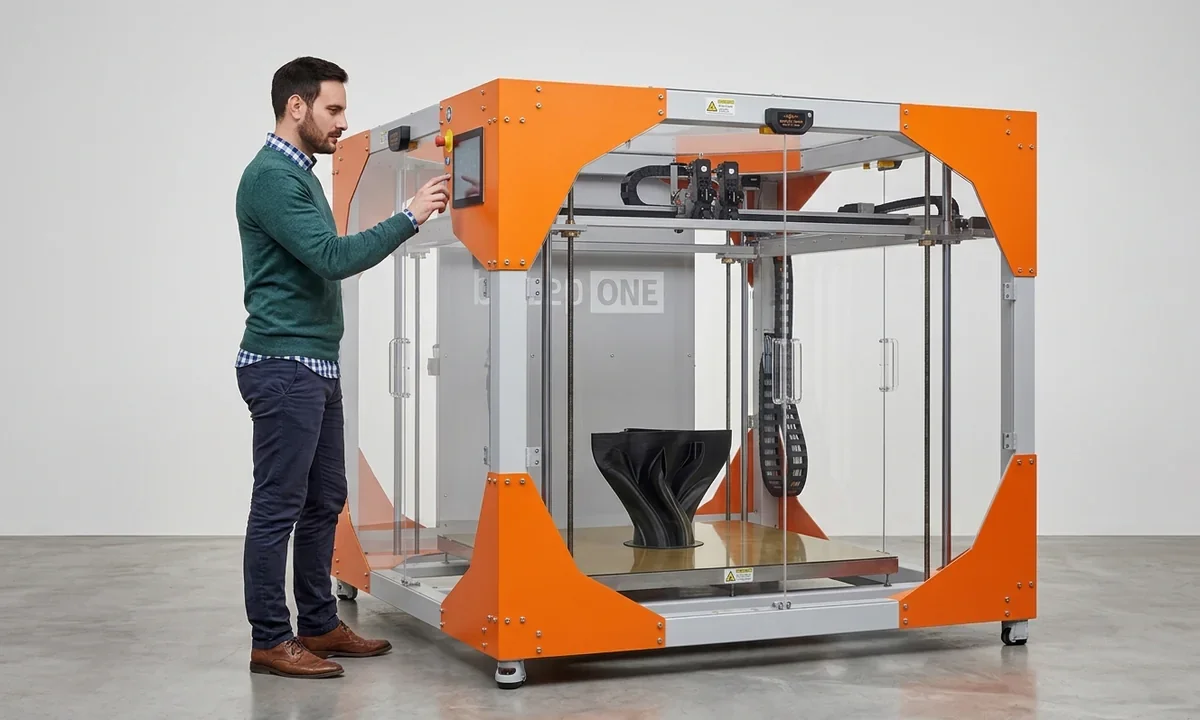
BigRep announced the ONE.5X on April 2026 at RAPID + TCT in Boston, with pricing not yet disclosed and availability listed as late 2026, positioning the machine around full automation and pellet-ready workflows for large-format production. According to the company's official announcement released during the event, the system introduces XYZ Auto-Calibration and Adaptive Bed Mesh Leveling to remove manual setup steps that previously required operator intervention. That matters immediately.
Engineers describe the calibration system as a closed-loop process that measures gantry alignment, nozzle offset, and bed flatness before every job, then adjusts parameters without user input. Adaptive Bed Mesh Leveling builds a high-resolution map of the print bed surface and dynamically compensates during extrusion. In practical terms, this reduces first-layer failure rates, which remain a common bottleneck in large-format fused filament fabrication.
Automation extends beyond setup. The ONE.5X integrates Auto-Sequential Printing and Relay Mode, both aimed at continuous production cycles. Auto-Sequential Printing queues multiple jobs and executes them one after another without stopping the machine. Relay Mode allows a second system to take over if the primary unit encounters a fault, a feature the company says supports 24/7 uptime in factory environments. That is a clear shift toward lights-out manufacturing.
Compared to the previous ONE platform, these features mark a direct response to operator dependency. What has not changed is the core cubic meter build volume and gantry architecture. Should existing ONE users upgrade? If downtime and labor costs dominate your workflow, the answer leans yes. If your current setup already runs stable batches, the value depends on how much automation you actually need.
Performance and Speed Enhancements
Print speed claims reach 250 mm/s, a figure BigRep attributes to new firmware-level controls including pressure advance and vibration compensation. According to the company's engineering team, pressure advance adjusts extrusion flow in real time to match acceleration changes, preventing over-extrusion at corners and under-extrusion during rapid moves. That keeps edges cleaner.
Vibration compensation addresses resonance in large gantry systems, where mass and inertia often degrade surface finish at higher speeds. Sensors monitor motion artifacts and apply corrective signals to stabilize the toolhead path. In theory, this allows faster travel without the typical trade-off in dimensional accuracy.
Here is how the core performance specs compare:
| Specification | Value |
|---|---|
| Max Print Speed | 250 mm/s |
| Motion Control | Vibration Compensation |
| Extrusion Control | Pressure Advance |
| Build Volume | 1 m³ |
In our experience tracking this space, large-format systems rarely sustain high speeds without visible artifacts, especially on long toolpaths. BigRep claims consistent surface quality at these velocities, but Pick3DP could not independently confirm this at the time of writing. That remains a key unknown.
Compared to competitors like Modix BIG-Meter and CEAD Flexbot, which typically operate below 150 mm/s for reliable output, the ONE.5X targets a higher throughput bracket. Whether that translates to real production gains depends on material choice and part geometry. That's the practical limit.
Massive Dimension Pellet Partnership
A separate announcement tied to the ONE.5X launch confirms a collaboration with Massive Dimension, bringing the MDX pellet extruder into the BigRep ecosystem. According to Massive Dimension's official statement, the MDX unit enables Fused Granulate Fabrication using raw plastic pellets instead of filament, a shift that directly impacts material cost structures.
Pellet extrusion reduces feedstock costs by up to 60 percent compared to industrial filament, based on current market pricing for engineering-grade polymers. That is not a small margin. The MDX extruder itself uses a lightweight screw-based design, which lowers the moving mass on the gantry and improves responsiveness during high-speed printing. Maintenance also changes. Operators can disassemble and clean the screw assembly more easily than traditional filament-based hotends, which often clog under high throughput.
The integration introduces a new toolhead option on the ONE.5X platform, allowing users to switch between filament and pellet workflows depending on application requirements. Filament runout sensors remain in place for traditional extrusion, while pellet feeding systems rely on hopper-based supply. That dual capability expands material flexibility.
Here is a comparison against typical filament systems:
| Feature | ONE.5X Pellet | Standard Filament |
|---|---|---|
| Material Cost | Low | High |
| Throughput | High | Moderate |
| Maintenance | Modular | Hotend-based |
| Material Range | Broad | Limited |
That said, pellet extrusion introduces variability in flow consistency, especially with recycled materials. BigRep states that the MDX system stabilizes output through controlled feed rates, though this has not been independently verified. Worth watching. The partnership signals a clear move toward cost-efficient large-scale production, aligning with trends we have observed across industrial additive manufacturing this year.
Technical communicator specialising in 3D printing workflows, covering the full content spectrum: foundational guides, step-by-step how-to tutorials, hands-on reviews, curated top picks, troubleshooting solutions, and industry news.