
PolyJet vs SLA: Which Resin 3D Printing Process Is Right for You?

Polyjet vs SLA: two resin heavyweights, very different strengths. We break down cost, detail, and speed, so read on to see which one wins your project.
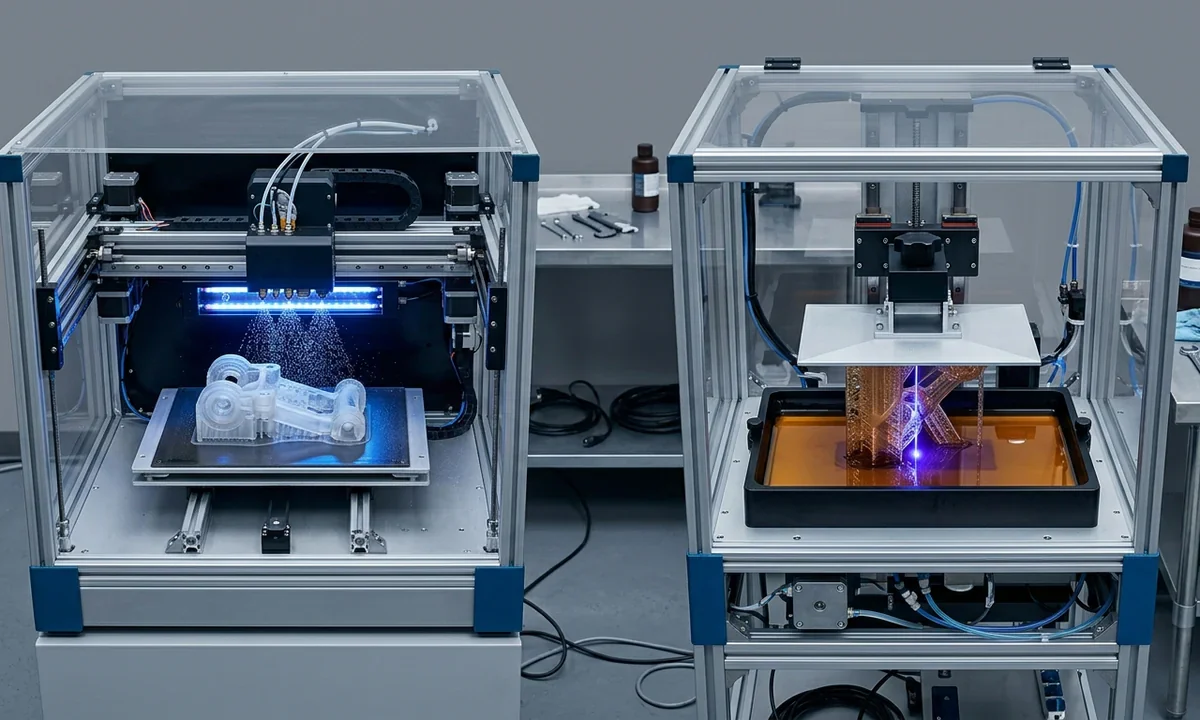
SLA generally wins on affordability, larger single-material builds, and broad accessibility, while PolyJet leads in multi-material capability, surface finish, and realistic prototype simulation. That recommendation changes if your project requires soft-touch grips, transparent and rigid materials in one part, or highly realistic appearance models. In those cases, PolyJet becomes the stronger option despite its much higher operating cost.
Neither technology replaces the other because they solve different engineering problems. SLA focuses on producing highly accurate parts from a single photopolymer resin using vat photopolymerization, making it an excellent fit for functional prototypes, casting patterns, and detailed models. PolyJet, by contrast, deposits microscopic droplets of photopolymer through material jetting print heads before instantly curing them with UV light, allowing several materials and colors to coexist within one print.
Price creates the biggest divide. Desktop SLA printers now start below $300, while industrial PolyJet systems often begin around $20,000 and can exceed $300,000 depending on build size and material capabilities.
If your decision depends primarily on budget, SLA almost always comes out ahead. If realism, multi-material functionality, or presentation-quality prototypes matter most, PolyJet usually justifies its premium. The comparison becomes genuinely close only when your application demands exceptional cosmetic quality without requiring multiple materials.
PolyJet vs SLA: The Basics
Liquid photopolymer sits at the heart of both technologies, but the way each printer converts that resin into a finished part differs dramatically. SLA cures an entire geometry one layer at a time inside a resin vat, whereas PolyJet sprays microscopic droplets onto the build tray before curing each deposited layer almost instantly.
The core mechanical difference is straightforward: SLA relies on controlled light exposure inside a vat of resin, while PolyJet works much like an inkjet printer that dispenses photopolymer instead of ink.
SLA, short for Stereolithography, was commercialized by 3D Systems and became one of the first successful additive manufacturing technologies. Modern desktop systems from companies such as Formlabs, Elegoo, and Anycubic made the process accessible to engineers, designers, dental laboratories, and hobbyists alike. A laser or projected light source selectively cures each cross-section before the platform moves to begin the next layer.
PolyJet originated with Objet, later acquired by Stratasys, and remains primarily an industrial manufacturing process. Instead of exposing an entire resin surface, print heads jet thousands of tiny photopolymer droplets onto the build platform. UV lamps cure every droplet almost immediately, allowing the printer to combine rigid, flexible, transparent, and colored materials within a single build.
Many buyers assume both processes produce identical-looking parts because they both use resin. They often look similar at first glance, but the underlying capabilities differ considerably. PolyJet generally delivers smoother cosmetic surfaces, finer color transitions, and true multi-material assemblies. SLA usually provides comparable dimensional precision for single-material parts while costing substantially less.
If you need to refresh core terminology, our guide on What is 3D Printing offers a quick primer for all skill levels. Engineers deciding on the fundamental material choice should read our guide on FDM vs SLA for an overview of filament versus resin printing.
PolyJet vs SLA at a Glance
Comparing specifications side by side reveals where each technology excels and where the differences matter less than marketing claims suggest.
| Technology | Pros | Cons | Best Use Case | Typical Cost |
|---|---|---|---|---|
| SLA | High accuracy, relatively low equipment cost, broad resin selection, larger desktop ecosystem | Single-material printing, manual resin handling, post-curing required | Functional prototypes, dental models, casting patterns | Desktop: $250-$8,000; Industrial: $10,000-$150,000+ |
| PolyJet | Multi-material printing, exceptional surface finish, color capability, dissolvable supports | Very high machine cost, expensive materials, industrial maintenance | Appearance models, medical visualization, overmolded prototypes | Industrial: $20,000-$300,000+ |
The following comparison highlights the practical differences engineers evaluate during equipment selection.
| Category | SLA | PolyJet | Winner |
|---|---|---|---|
| Printing mechanism | Laser or projected light cures resin vat | Inkjet heads deposit UV-cured droplets | Tie |
| Material options | Single resin per build | Multiple materials and colors simultaneously | PolyJet |
| Resolution and accuracy | Excellent, typically ±0.1 to ±0.2 mm | Excellent, often comparable with smoother surfaces | Tie |
| Surface finish | Very smooth | Outstanding with minimal visible layering | PolyJet |
| Printing speed | Efficient for larger single-material parts | Fast for detailed multi-material models | Depends on application |
| Machine cost | Accessible across desktop and professional markets | Industrial investment only | SLA |
| Material cost | Lower resin prices | Higher proprietary material costs | SLA |
| Support removal | Washing and UV post-curing | Dissolvable or water-jet support removal | PolyJet |
| Maintenance | Moderate | Higher because of print heads and proprietary systems | SLA |
| Accessibility | Hobbyists, studios, professionals | Primarily industrial organizations | SLA |
Two differences usually determine the purchasing decision. PolyJet alone combines multiple materials, Shore hardness values, transparent regions, and color gradients within one print. SLA cannot replicate that capability regardless of resin selection.
SLA counters with a much lower cost of ownership and broader accessibility. Small engineering firms can purchase several professional SLA systems for the price of one entry-level industrial PolyJet machine. Build volumes also tend to favor SLA in many desktop and midrange systems.
Some criteria remain surprisingly close. Both technologies produce highly detailed photopolymer parts, both require cleaning and post-processing, and both outperform filament-based systems for cosmetic appearance. Understanding the foundational differences in Filament vs Resin 3D Printing helps clarify the trade-offs in part strength and surface finish. Since Polyjet is a form of material jetting, a deeper dive into Material Jetting vs Binder Jetting provides valuable technical context.
Polyjet vs SLAWho Wins Each Use Case
Selecting between these technologies becomes much easier once you match the printer to the project rather than comparing specifications in isolation. A consumer product mockup, a surgical planning model, and a functional engineering prototype may all require excellent detail, yet each favors a different production method.
1Choose SLA if:
- You need affordable, highly detailed single-material prototypes for product development.
- You produce casting patterns for jewelry or investment casting where specialized burn-out resins matter.
- Your engineering team needs larger build volumes without purchasing an industrial machine.
- You operate a small design studio, dental laboratory, or engineering office with a limited equipment budget.
2Choose PolyJet if:
- You need multiple materials, colors, or transparency within a single printed assembly.
- You create realistic appearance models for customer reviews before manufacturing.
- Your design requires rubber-like overmolds, living hinges, or ergonomic grip simulations.
- You produce highly detailed medical visualization models where anatomical realism improves communication.
Neither technology fits every application. Large functional engineering components often benefit more from FDM because thermoplastics generally provide better mechanical durability at lower cost. Production-ready nylon parts frequently favor powder-bed systems instead. For high-volume production analysis, our ultimate guide explaining MJF vs SLS 3D Printing is a crucial resource for comparative evaluation.
If your project could reasonably use either technology, ask one question before requesting quotations: Does the finished part require more than one material or color? If the answer is yes, PolyJet usually justifies its premium. If the answer is no, SLA commonly delivers nearly the same geometric quality for a fraction of the investment.

Total Cost: PolyJet vs SLA
Machine pricing creates the widest financial gap between these technologies. Entry-level desktop SLA printers now start below $300, professional systems commonly range from $3,000 to $15,000, and larger industrial machines can exceed $150,000. PolyJet systems occupy an entirely different market segment, with most commercial machines beginning around $20,000 and premium production models surpassing $300,000.
Consumables widen that difference further. Standard SLA resins typically cost between $35 and $200 per liter depending on formulation, while engineering and specialty resins command higher prices. PolyJet materials frequently cost $250 to $500 per cartridge, and many systems require proprietary support materials that add directly to every build.
Post-processing also affects ownership costs. SLA users normally need an isopropyl alcohol washing station, a UV post-curing unit, replacement gloves, filters, and periodic resin tank maintenance. PolyJet users avoid manual washing with uncured resin but often rely on dedicated water-jet cleaning systems, support removal equipment, scheduled print-head maintenance, and manufacturer service contracts.
Learning time differs as well. Most engineers become comfortable operating a desktop SLA printer within a few days. PolyJet platforms introduce additional workflow complexity because users manage multiple materials, support strategies, calibration procedures, and preventive maintenance schedules.
For a typical small product design studio printing several prototypes each week, a realistic first-year SLA investment often falls between $2,000 and $12,000, including printer, consumables, finishing equipment, and replacement parts. A comparable PolyJet workflow can easily exceed $40,000 during the first year before accounting for service agreements.
Short-term affordability clearly favors SLA. PolyJet begins to justify its higher ownership cost only when realistic multi-material prototypes replace multiple outsourced iterations or accelerate expensive product development programs.

Polyjet vs SLAPerformance Where It Counts
Finished parts reveal the strengths of each process more clearly than specification sheets. PolyJet consistently produces exceptionally smooth surfaces, crisp text, transparent features, and convincing material transitions. SLA matches much of that geometric precision for single-material parts and often reaches dimensional accuracy around ±0.1 mm under well-controlled conditions.
Reliability depends on the application rather than a universal winner. SLA delivers predictable results across large batches of identical components, while PolyJet excels when one build combines rigid structures, flexible seals, transparent windows, and cosmetic textures. Daily operation also differs because SLA requires resin handling and UV post-curing, whereas PolyJet demands greater machine maintenance and proprietary consumables.
Printing speed varies with geometry. Large single-material components frequently complete faster on SLA systems because the workflow remains straightforward. Complex assemblies that would require several separate SLA prints often finish sooner on PolyJet because the printer fabricates every material simultaneously.
One scenario narrows the performance gap considerably. If your project only requires a highly detailed single-material prototype with no flexible features, color gradients, or transparency, modern professional SLA printers can deliver results that approach PolyJet quality while costing dramatically less.
For manufacturing engineers prioritizing material properties, it's worth reviewing PolyJet vs SLS for a comprehensive technology assessment. To explore another key comparison, see our detailed SLA vs SLS comparison to understand the difference between liquid and powder-based technologies.
Our Verdict: PolyJet vs SLA
Three differences separate these technologies more than any specification sheet. First, SLA offers dramatically lower equipment and operating costs, making it the practical choice for individuals, small engineering teams, and businesses building single-material prototypes. Second, PolyJet stands alone if your project requires multiple materials, realistic textures, transparent sections, or full-color presentation models within one print. Third, accessibility differs sharply because desktop SLA printers are widely available, while PolyJet remains an industrial solution for organizations that can justify its investment.
Choose SLA if your priority is affordable, accurate prototypes, functional engineering models, dental applications, casting patterns, or larger single-material parts. It delivers outstanding precision without the financial commitment of an industrial platform.
Choose PolyJet if visual realism directly affects design validation, customer presentations, ergonomic testing, or medical visualization. The ability to combine rigid and flexible photopolymers inside one build still sets it apart from nearly every other resin printing technology.
Neither technology universally outperforms the other. Your decision should reflect the type of parts you produce most often rather than the most impressive feature on a product brochure.
If you needed to explain the difference to a colleague in one sentence, say this: SLA creates highly accurate single-material resin parts at a much lower cost, while PolyJet produces premium multi-material prototypes with unmatched realism for organizations willing to pay substantially more.
Technical communicator specialising in 3D printing workflows, covering the full content spectrum: foundational guides, step-by-step how-to tutorials, hands-on reviews, curated top picks, troubleshooting solutions, and industry news.