
SLA vs SLS: Understanding the Difference in Powder and Liquid 3D Printing

Confused about SLA vs SLS? One melts powder, the other cures liquid resin - and the difference between SLA and SLS decides your whole project. Dig into the full breakdown.
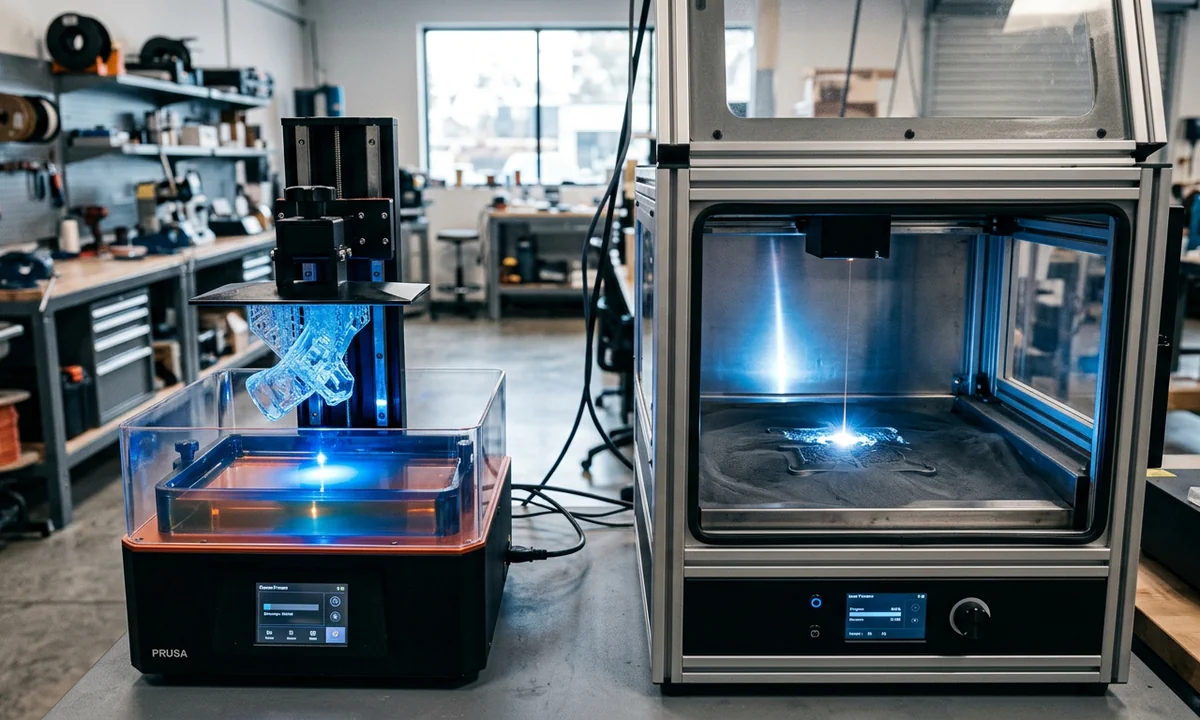
Walk into almost any discussion about resin 3D printing and someone will eventually compare SLA and SLS as though they solve the same problem. They do not. Both technologies rely on lasers, yet they work with completely different materials. SLA hardens liquid photopolymer resin layer by layer, while SLS fuses powdered thermoplastics into solid parts. That single distinction shapes everything from surface finish to strength, operating cost, and post-processing.
Most buyers reach this comparison while deciding whether to buy a printer, outsource production, or simply understand why two printed parts can look and perform so differently. The confusion grows because both technologies produce highly accurate components, both appear regularly in professional prototyping, and both avoid the visible layer lines associated with many filament printers.
The practical choice comes down to priorities. SLA excels when smooth surfaces, tiny details, and visual presentation matter most. SLS stands out when functional strength, durability, and complex unsupported geometry take priority.
Neither process replaces the other. Instead, each occupies a different position in modern additive manufacturing. Understanding that distinction before comparing prices or specifications saves time, prevents expensive purchasing mistakes, and makes later decisions about materials, finishing, and production volume far easier.
SLA vs SLSSLA: Printing With Liquid Resin
A vat of liquid resin may look motionless, but every laser pass permanently changes the material beneath the surface. SLA, short for Stereolithography, directs a finely focused ultraviolet laser across a photopolymer resin tank. Wherever the beam touches, the resin cures into solid plastic. After one layer finishes, the build platform shifts by a fraction of a millimeter and the next layer begins.
That approach delivers exceptional detail. Desktop SLA systems commonly print at layer heights between 25 and 100 microns, while laser spot sizes often remain small enough to reproduce embossed text, intricate lattice structures, and delicate decorative features that challenge many other desktop technologies. Dental aligner molds, jewelry casting patterns, miniature figures, and presentation-quality prototypes all benefit from that precision.
Smooth surfaces rarely come straight off the machine. Every SLA print requires support structures because partially cured resin cannot suspend overhangs by itself. Removing those supports leaves small contact marks that often need light sanding. Operators then wash parts in isopropyl alcohol or another approved cleaning solution to remove uncured resin before placing them inside a UV curing chamber. Final curing increases stiffness and stabilizes the material properties.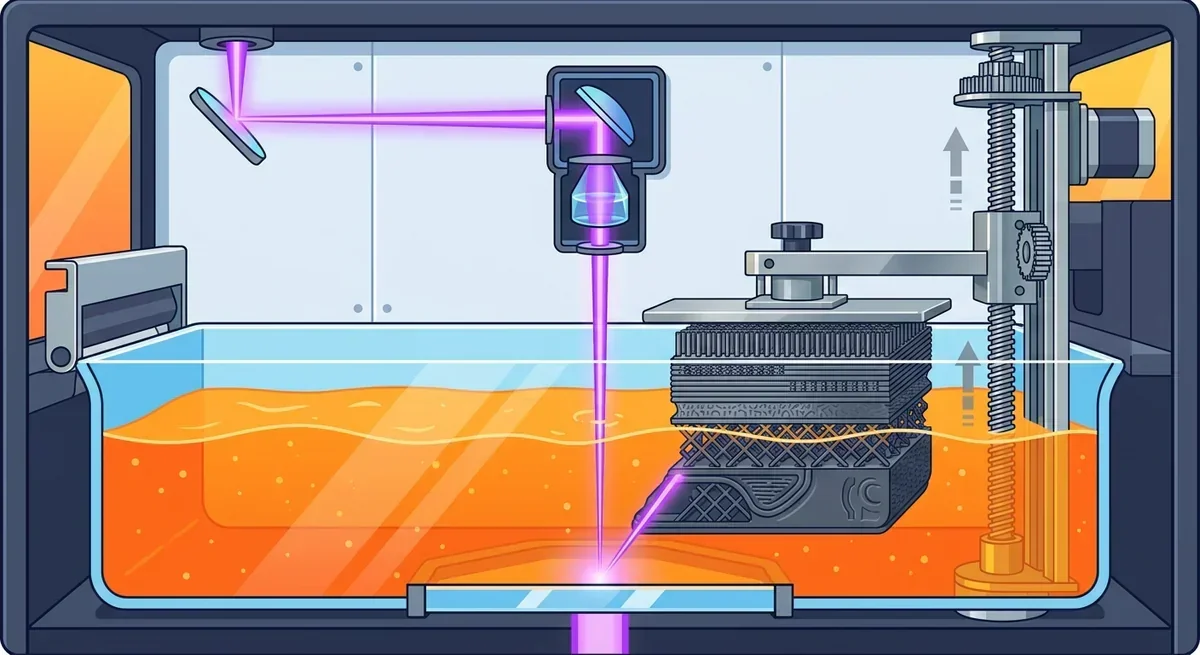
Material selection continues to improve. Standard resins prioritize appearance, while engineering formulations target higher impact resistance, elevated heat tolerance, flexibility, or biocompatibility for specific industries. Even so, photopolymers remain different from engineering thermoplastics. Many become brittle after repeated impacts or long-term ultraviolet exposure, though performance varies by formulation.
Desktop accessibility makes SLA attractive to makers and design teams. Entry-level resin printers cost well under $200, while professional systems such as the Formlabs Form 4 approach the $4,000 range before accessories. Resin prices usually fall between $35 and $200 per liter depending on formulation.
Choose SLA when visual quality outweighs mechanical abuse. It produces outstanding presentation models and highly detailed prototypes, but heavily loaded hinges, clips, and production fixtures usually demand a tougher manufacturing process.
SLA vs SLSSLS: Fusing Powder With Lasers
Instead of liquid resin, SLS begins with a thin layer of powdered thermoplastic spread evenly across a heated build chamber. A high-powered laser selectively fuses the particles wherever the digital model requires solid material. Once the layer finishes, a recoater spreads fresh powder across the surface and the process repeats until the entire part forms inside the surrounding powder bed.
Unused powder performs an important job. Because loose material naturally supports every overhang, bridges, and internal cavity, SLS rarely requires dedicated support structures. Designers can pack multiple components into one build, nest moving assemblies together, and create intricate internal channels without worrying about support removal afterward.
Nylon dominates the process because it balances strength, toughness, fatigue resistance, and dimensional stability. PA12 remains the industry standard, while PA11 offers greater flexibility and impact resistance. Glass-filled and carbon-filled formulations also exist for applications demanding higher stiffness, although machine compatibility varies.
Finished parts emerge buried beneath warm powder rather than attached to a build plate. Operators allow the chamber to cool gradually, excavate each component, brush away excess powder, then complete depowdering with compressed air or bead blasting. Freshly cleaned surfaces feel slightly grainy compared with SLA because individual powder particles leave a fine textured finish.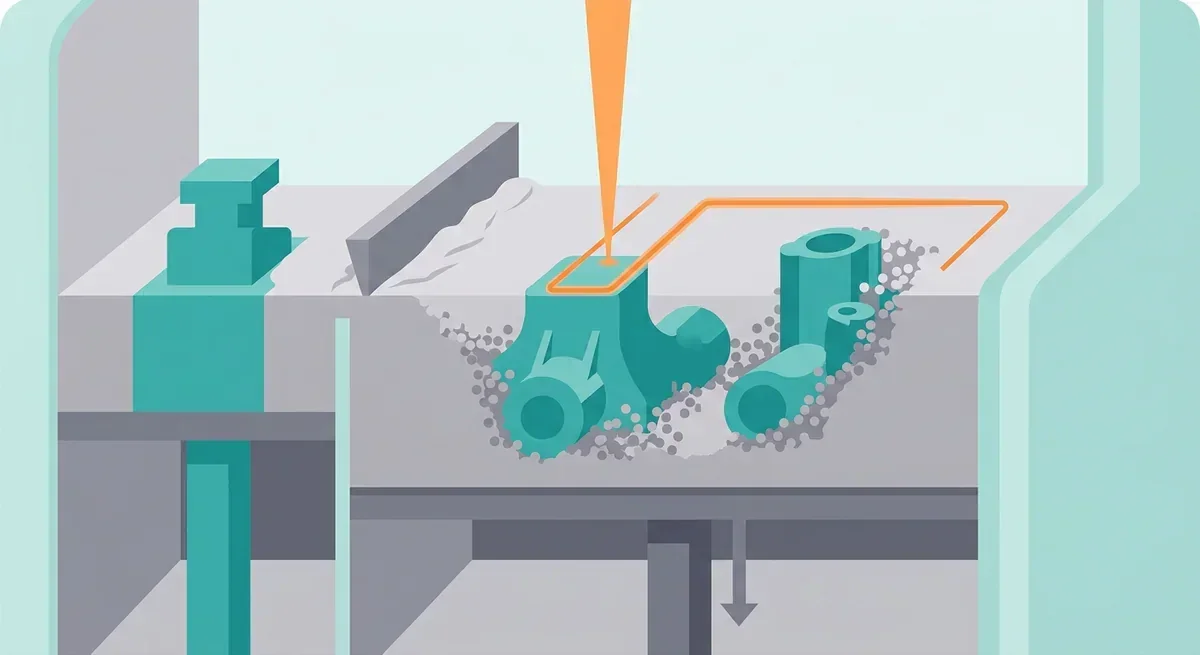
Mechanical performance explains why many engineering teams prefer SLS. Nylon parts generally tolerate repeated flexing, snap-fit features, and functional testing far better than standard photopolymer resin. Strength also remains more consistent in multiple directions because the surrounding powder supports every layer throughout the build.
Access presents the largest barrier. Benchtop SLS systems typically begin around $25,000, while industrial platforms cost substantially more. Powder materials also carry higher operating expenses, although unused powder often mixes with fresh material for future builds according to manufacturer guidelines.
If your priority centers on durable functional components rather than showroom surface finish, SLS often delivers the better long-term value despite the higher equipment investment.
SLA vs SLS, Side by Side
The table below compares the characteristics that influence purchasing decisions most often, from print quality and strength to operating costs and practical applications.
| Technology | Pros | Cons | Best Use Case | Typical Cost |
|---|---|---|---|---|
| SLA | Outstanding surface finish, very high detail, excellent dimensional accuracy, wide range of specialty resins | Requires supports, resin handling, washing and UV curing, standard resins can be brittle | Visual prototypes, dental models, jewelry patterns, display parts | Desktop printers: $180 to $4,000. Resin: $35 to $200 per liter |
| SLS | Strong functional parts, no supports, complex internal geometry, excellent material efficiency | High machine cost, rougher surface finish, powder handling equipment required | Engineering prototypes, production parts, jigs, fixtures, snap-fit components | Benchtop systems: about $25,000 and up. Nylon powder: roughly $60 to $150 per kg |
Looking only at print quality makes the comparison seem easy. SLA consistently produces smoother surfaces, sharper edges, and finer cosmetic detail than SLS. Small engraved text, decorative textures, and transparent components all benefit from resin printing. If appearance drives the project, SLA usually wins without much debate.
Mechanical performance changes the picture completely. SLS produces parts from engineering thermoplastics rather than photopolymers, giving them higher toughness, greater fatigue resistance, and better long-term durability. Living hinges, clips, housings, and production fixtures survive repeated loading far more reliably when printed in nylon powder.
Support requirements also separate the two technologies. SLA depends on supports for virtually every overhang, and removing them becomes another finishing step that may leave visible marks. SLS eliminates that concern because the surrounding powder naturally supports every feature throughout the build. Designers can print enclosed channels, moving assemblies, and complicated lattice structures without planning support placement.
Printing speed deserves careful interpretation because neither technology always finishes first. A single detailed SLA model may complete faster than an equivalent SLS job, particularly on modern desktop resin printers. Fill an entire SLS build chamber with dozens of parts, though, and productivity changes dramatically. Since every component builds simultaneously inside one powder bed, the time required depends more on the height of the tallest part than on the total number of parts.
Material flexibility also favors different priorities. SLA offers dozens of specialized photopolymers designed for casting, dental work, flexible components, high-temperature testing, or optical clarity. SLS supports fewer materials overall, but engineering nylons cover a broad range of industrial applications where durability matters more than visual perfection.
Dimensional accuracy remains excellent for both technologies when machines receive proper calibration. Professional SLA systems commonly achieve tolerances around ±0.1 mm for smaller components. Industrial SLS machines often deliver similar practical accuracy, although thermal shrinkage requires compensation during process calibration, especially on larger parts.
Accessibility creates perhaps the largest gap. Resin printers now occupy the consumer market, making SLA realistic for hobbyists, schools, and small studios. SLS remains largely a professional technology because equipment costs, powder management, ventilation, and maintenance exceed what most home workshops can justify.
Neither technology dominates every category. SLA delivers superior presentation quality, while SLS produces stronger functional components that better withstand real-world mechanical use.
SLA vs SLSWhat Each Technology Actually Costs
Sticker price tells only part of the story because ownership costs extend well beyond the printer itself. Consumables, maintenance, finishing equipment, failed prints, and labor all influence the true investment over time.
Desktop SLA has become remarkably affordable. Entry-level machines from manufacturers such as Elegoo, Anycubic, and Creality often sell between $180 and $500. Mid-range systems with larger build volumes typically fall between $700 and $1,500, while professional platforms such as the Formlabs Form 4 approach $4,000 before optional accessories. Resin generally costs between $35 and $200 per liter depending on mechanical properties, color, and certification requirements.
Additional expenses accumulate quickly. Most users purchase wash stations, UV curing chambers, nitrile gloves, disposable filters, cleaning containers, ventilation equipment, and isopropyl alcohol. Resin waste also deserves consideration because failed prints, contaminated cleaning liquid, and expired material increase operating costs over time.
SLS occupies a different financial category. Benchtop systems generally begin around $25,000, while industrial production platforms frequently exceed $100,000. Buyers often add dedicated powder handling equipment, compressed air systems, blasting cabinets, and environmental controls before producing their first part.
I Tested the Formlabs Form 4 - Here's the Truth! - Source (Youtube@Elevated Systems)
Material pricing narrows the gap slightly. Nylon powder commonly ranges from about $60 to $150 per kilogram depending on grade and supplier. Many manufacturers allow operators to recycle a portion of unused powder by blending it with fresh material, reducing waste compared with technologies that discard all unused feedstock.
Labor costs differ as well. SLA demands support removal, washing, and UV curing for every print. SLS eliminates supports but replaces those tasks with cooling, powder recovery, depowdering, and media blasting. Neither workflow finishes when the printer stops.
For occasional prototypes, desktop SLA usually delivers the lowest overall cost. Businesses producing functional engineering parts in larger batches often recover the higher purchase price of SLS through improved throughput, stronger components, and reduced support-related labor.
SLA vs SLSMatching Method to the Job
Choosing between SLA and SLS becomes much easier once you define what the finished part must accomplish rather than focusing on printer specifications.
Choose SLA if you need:
- Extremely smooth presentation models
- Fine embossed or engraved details
- Dental models and surgical guides
- Jewelry casting patterns
- Transparent or translucent components
- Highly detailed miniature figures
- Customer demonstration prototypes
Choose SLS if you need:
- Functional mechanical prototypes
- Durable snap-fit components
- Lightweight lattice structures
- Complex internal channels
- Production fixtures and jigs
- Small manufacturing batches
- Nylon parts that tolerate repeated stress
Some projects fall between those categories. A consumer electronics company, for example, might print an attractive enclosure with SLA for executive approval while producing the internal mounting brackets with SLS for engineering validation. Each process solves a different problem despite manufacturing parts from the same CAD model.
Batch size also influences the decision. Printing five cosmetic prototypes generally favors SLA because setup remains simple and machine costs stay low. Producing fifty functional nylon clips changes the economics. SLS packs those components efficiently into a single powder bed without adding support structures, reducing labor once production volumes increase.
Consider the environment where the finished part will operate. Resin components work well indoors, especially when appearance carries the greatest weight. Functional nylon parts tolerate repeated handling, vibration, moderate heat, and mechanical loading far better, making them more appropriate for manufacturing aids and end-use products.
Still undecided? Use one practical tiebreaker. Ask whether failure would come from cosmetic flaws or mechanical stress. If appearance determines success, choose SLA. If strength determines success, choose SLS. That single question resolves most purchasing decisions without comparing dozens of technical specifications.
SLA vs SLSThe Verdict, Plus Where Filament Fits
SLA and SLS rarely compete as direct replacements because they optimize different outcomes. If your priority is surface quality, visual realism, and extremely fine detail, SLA remains the stronger choice. If your project demands mechanical durability, repeated functional testing, or low-volume production parts, SLS offers clear advantages despite the higher investment.
Accessibility also shapes the decision. Desktop SLA printers have become common in home workshops, classrooms, and design studios because entry costs have dropped dramatically over the past few years. SLS continues to target professional engineering teams, service bureaus, and manufacturers that can justify the equipment cost through production efficiency and stronger end-use components.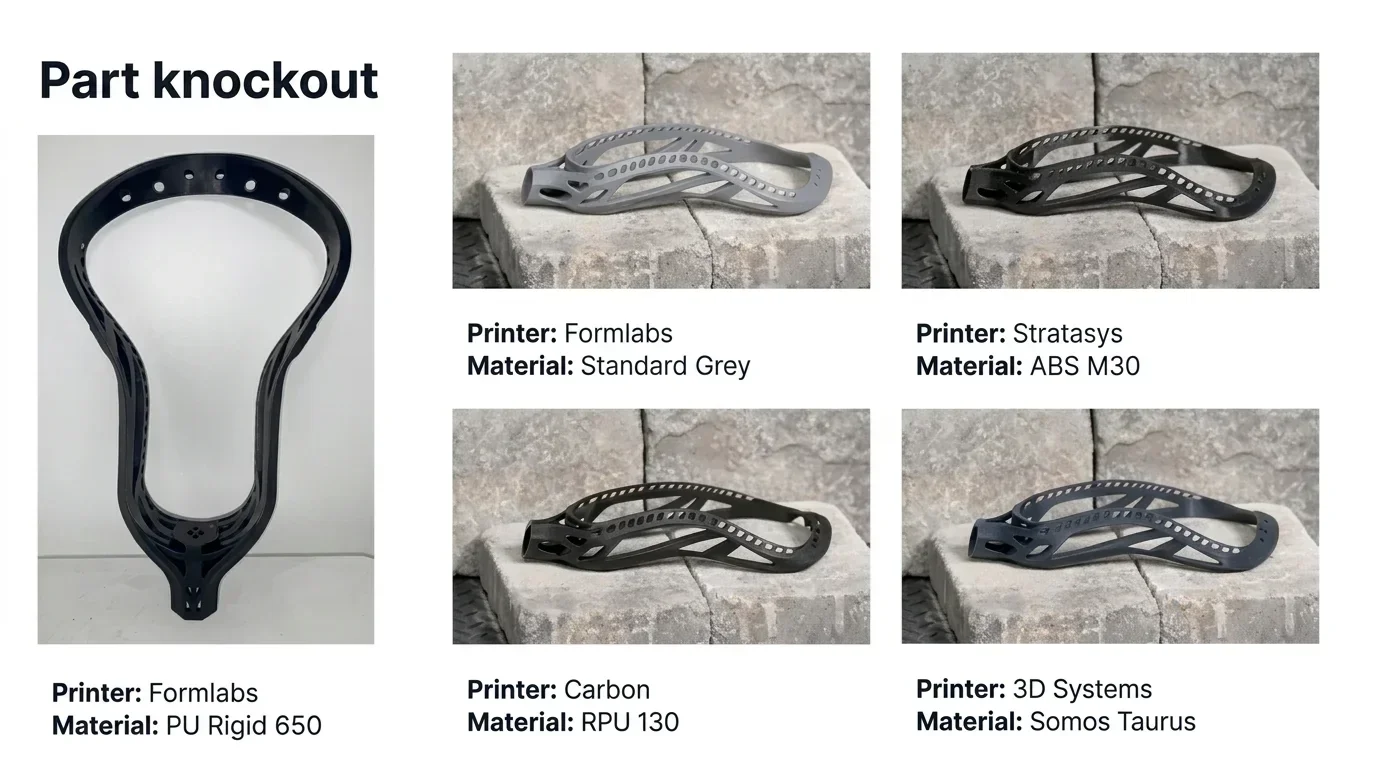
Many readers also compare both technologies with filament printing, especially FDM. That comparison introduces a different tradeoff. FDM melts thermoplastic filament through a heated nozzle instead of curing resin or sintering powder. It remains the least expensive way to produce functional plastic parts, with reliable desktop machines available for a few hundred dollars and materials costing only $15 to $40 per kilogram.
Surface quality generally favors SLA. Mechanical performance often favors SLS. Overall affordability still belongs to FDM.
For many makers, FDM becomes the first printer, SLA becomes the detail printer, and SLS remains a technology they access through a professional print service when nylon strength or unsupported geometry justifies the added expense. That progression reflects how the technologies complement each other rather than replacing one another.
SLA vs SLSThe Difference in One Sentence
One laser hardens liquid resin into exceptionally detailed parts, while the other fuses plastic powder into durable engineering components. Everything else follows from that distinction.
Choose SLA if your project depends on smooth surfaces, tiny features, or presentation-quality appearance. Choose SLS if strength, toughness, unsupported geometry, and functional performance determine whether the part succeeds. Neither recommendation changes simply because one technology costs more than the other.
Budget deserves equal attention. Desktop SLA systems have become realistic purchases for hobbyists, educators, and small product teams. SLS remains substantially more expensive to own, but its ability to produce strong nylon parts without support structures often lowers production costs for engineering work and short manufacturing runs.
Filament printing still occupies an important place in the conversation. FDM delivers the lowest equipment and material costs, making it the logical starting point for many users who do not require resin-level detail or industrial nylon performance. Rather than viewing FDM, SLA, and SLS as competing technologies, think of them as three complementary manufacturing tools that solve different problems.
The simplest way to remember the comparison is this: SLA creates beautiful parts from liquid resin. SLS creates durable parts from powdered nylon. FDM creates affordable parts from melted filament. Once you know which outcome matters most, the right technology usually becomes obvious.
3D printing and 3D scanning researcher with 10+ years of experience in materials science and additive manufacturing. Expert in FDM, SLA, and SLS technologies, covering in-depth guides, product reviews, top picks, troubleshooting articles, and industry news.