
Best 3D Printers for Beginners in May 2026
Budget no longer means basic. These are the best 3D printers under $500 in 2026 — tested and battle-proven for speed, reliability, detail, and real-world usability across FDM and resin.
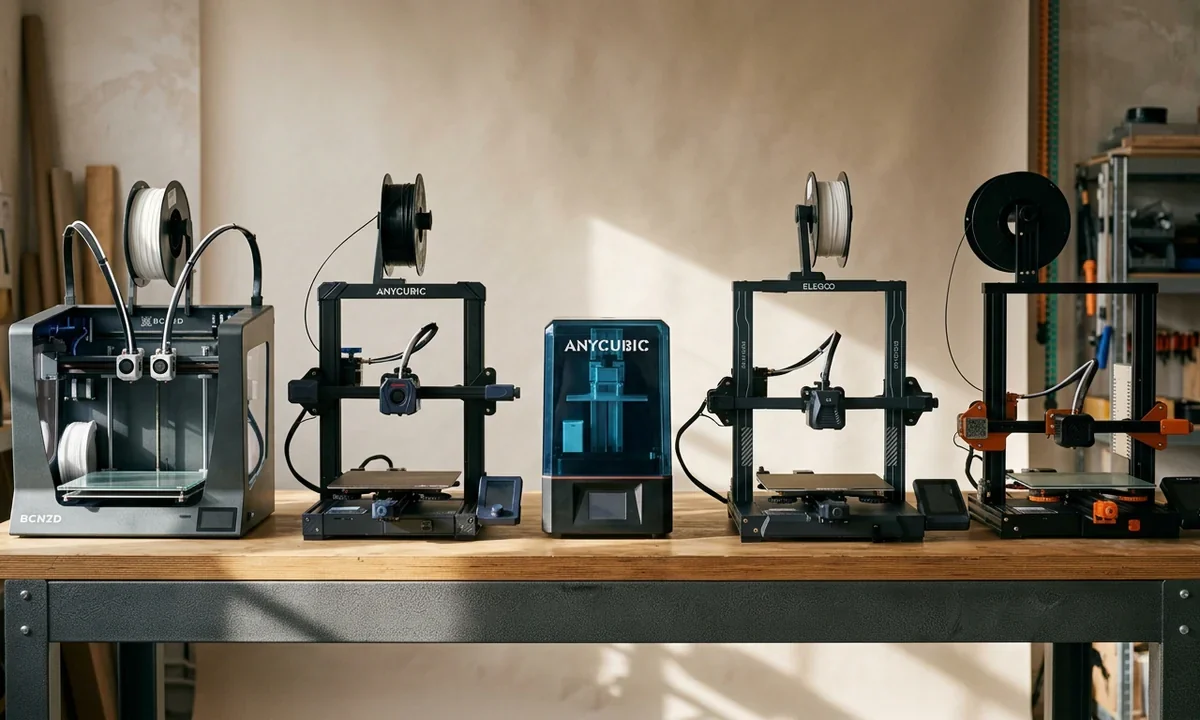
There was a time - not that long ago - when spending under $500 on a 3D printer meant dealing with wonky bed leveling, spaghetti-fied prints, and firmware that hated you. Today? Entire print farms are built on machines under that price tag.


Whether you're looking to print tabletop minis, cosplay armor, or parts for your custom drone, you've now got options. Legit ones. We've tested them. We've fought with them. We've reprinted Benchy 38 times on them. Here's what actually delivers in 2026.

BCN3D Sigma D25 - Under $5000
Let's start with the elephant in the room: Creality still dominates the budget FDM space. The Ender 3 S1, released in late 2022, remains a staple for under $500. It's not just hype - this printer delivers.
Direct drive extruder? Check. CR Touch auto-bed leveling? Yep. Dual Z-axis for added stability? Absolutely. You're getting a printer that's plug-and-play 90% of the time.
It's not perfect. The UI feels dated, and the fans are louder than you'd like. But the print quality? Consistent, clean, and surprisingly good on flexible filaments. On Reddit's r/FixMyPrint, folks rarely post issues with the S1 - because it rarely screws up.

What we like:

- Direct-drive means easier TPU prints.
- Decent build volume: 220 x 220 x 270mm.
- Pre-assembled out of the box.
What's annoying:
- Interface is a bit clunky.
- Loud stepper drivers and fans (you'll hear it overnight).
It's the best 3D printer under $500 for most people. Period.
Anycubic Kobra 2 - Fast & Beginner-Friendly

If you're just dipping your toes in, the Kobra 2 deserves a long look. It prints fast - really fast - for the price. We're talking 250mm/s out of the box, with decent results at those speeds.
The LeviQ auto-leveling system is miles better than what early Ender models offered. No more fiddling with paper or twisting knobs for 20 minutes.
Real talk: The build quality isn't as robust as pricier models. The extruder's plastic casing feels a little fragile. But it delivers surprisingly crisp results, especially on PLA. And the touchscreen UI is refreshingly modern.
Online reviews on YouTube and Amazon frequently mention its ease of use and reliable first-layer adhesion - two of the most frustrating parts for beginners. dddd
Highlights:
- 250mm/s printing speed.
- Automatic mesh leveling.
- 4.3-inch responsive touchscreen.
Drawbacks:
- Plastic parts aren't confidence-inspiring.
- The default fan curve is loud. You'll want to tweak it.
For first-timers and speed demons, it's one of the best budget 3D printers in 2026.
Anycubic Photon Mono M5s - High-Res Resin Under $500
Let's switch gears to resin. The Photon Mono M5s is brutal when it comes to print detail. We're talking 12K resolution. That's 19 microns of XY resolution. It's sharper than reality.
But resolution is only half the story. Anycubic added smart sensors to detect leveling issues and failed prints - saving you hours and liters of resin.

SLA printing still comes with mess and cleanup (alcohol baths, UV curing, etc.), but if you're into minis or dental models, this one's a killer pick.
On Reddit's r/resinprinting, users have praised the M5s for its consistency and minimal supports required. Some say it outperforms more expensive Elegoo Saturn models.
Why it stands out:
- 12K monochrome screen = ultra-detailed prints.
- Print failure detection and leveling assist.
- 7.6-inch screen, large build area for resin.
Why you might skip it:
- Resin cleanup is still a hassle.
- Learning curve is steeper than FDM.
It's the best 3D printer under 500 dollars - if resolution is your top priority.
Elegoo Neptune 4 - CoreXY Powerhouse for $300-ish

Now this one surprised us. The Neptune 4 sports a CoreXY design - a layout usually reserved for $600+ printers. Translation? Speed and precision.
It can hit 500mm/s (though let's be real, your layer quality will depend on tuning). The Klipper firmware is pre-installed. That's a huge win for print nerds who want fast acceleration and silent stepper control.
It also comes with a PEI bed, dual cooling fans, and a direct drive setup. In other words: All the mods you'd normally add later - already there.
Downsides? The setup instructions are weak, and Elegoo's support isn't lightning fast. But the hardware punches way above its price.
Top reasons to love it:
- CoreXY design = faster, more accurate motion.
- Pre-installed Klipper firmware.
- Excellent community support on YouTube.
Trade-offs:
- Setup isn't super intuitive.
- Firmware updates can be a bit janky.
Still, if you're a tinkerer or want more performance for less, this is a gem.
Voxelab Aquila D1 - Underrated and Hackable
You've probably seen Voxelab printers in off-brand corners of Amazon. Don't sleep on them. The Aquila D1 is essentially an open-source Ender 3 clone - with thoughtful improvements.
Metal dual Z-axis. Silent stepper drivers. 32-bit board. All in a sub-$250 machine. It's like they asked Reddit what to fix from the Ender 3, and then actually listened.
The downside? The firmware is barebones. Most users immediately flash Marlin or Klipper. But that's the point - it's a playground for modders.
If you want to learn the inner workings of a printer, start here. Tons of YouTube tutorials exist for upgrades, firmware flashing, and hardware mods.
| Use Case | Why Aquila D1 Delivers |
|---|---|
| Functional parts (gears, brackets) | Fast, precise prints with solid adhesion and stability. |
| Flexible and specialty filaments | Direct-drive + high-temp hot end handle TPU, PETG, ABS, even CF blends (with mod). |
| Beginners entering 3D printing | Quick assembly, auto-leveling, beginner-friendly UI, with room for firmware upgrades. |
| Customization projects/hobby mods | Open-source board and good community support - great for tinkerers. |
| Long or complex print jobs | Filament sensor + power-loss recovery prevent waste and failed prints. |
| Drafting/rapid prototypes | Speed and reliability useful for iterating designs fast. |
It's not for everyone, but it's your sandbox if you're into tinkering.
What About Bambu Lab's P1P? It's Complicated
Yes, it dropped to $399 on sale this year. Yes, it's technically under $500. And yes, it's stupidly good.
But it's not always available at that price, and that sale isn't permanent. The P1P runs CoreXY, has LIDAR-assisted first layers, and can print at 500mm/s reliably. It eats other printers for breakfast.
However, Bambu's cloud dependency and inconsistent customer support make it a polarizing choice. Still, if you catch it on sale - it's a no-brainer.
Conclusion: Which One Should You Buy?
If you're new and just want something that works: Get the Anycubic Kobra 2.
If you're printing minis and need razor-sharp detail: Photon Mono M5s is your jam.
Want a no-fuss, proven FDM printer? Ender 3 S1.
Ready to tinker and tweak every parameter? Go Neptune 4 or Voxelab Aquila D1.
There's no perfect pick. But there are fewer bad ones than ever before - finally. Spend less time fixing z-offsets and more time printing dumb little dragons or replacement fridge handles.
You do you.