
9 CNC Machining Trends to Pay Attention To in 2026

AI-driven machining, hybrid production, and lights-out automation are changing modern manufacturing fast. Explore the CNC trends shaping 2026 before your competitors get there first.
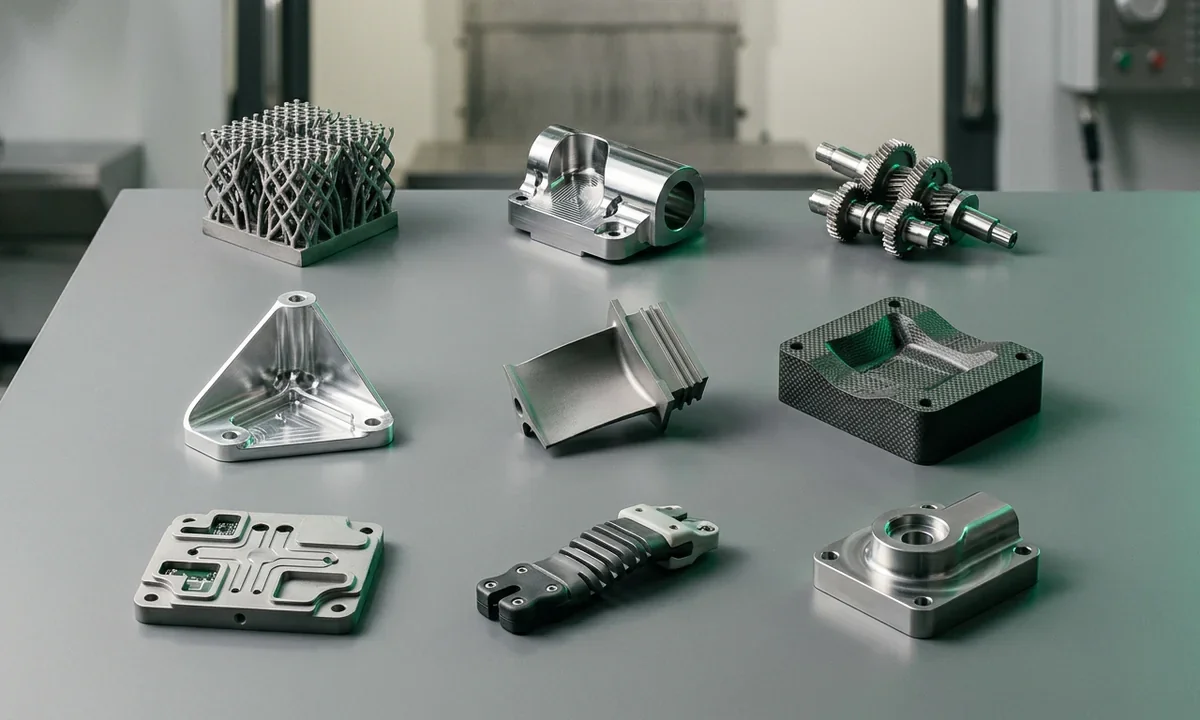
Makino, Siemens, and Sandvik opened 2026 by pushing adaptive machining updates tied to AI-assisted process control, a signal that CNC investment priorities are shifting away from raw spindle speed and toward machine intelligence. According to AMT's January 2026 manufacturing outlook, North American job shops continue to face margin pressure from labor shortages, rising material costs, and unstable lead times. Shops now want machines that react faster, schedule smarter, and cut scrap before operators notice a problem. That's a meaningful change.
Three trends sit at the center of that shift: connected factory networks, AI-driven toolpath optimization, and unattended production cells. Aerospace suppliers and medical manufacturers pushed early adoption through late 2025 because multi-axis machining centers rarely stay profitable when idle time or inconsistent spindle load data interrupt throughput.
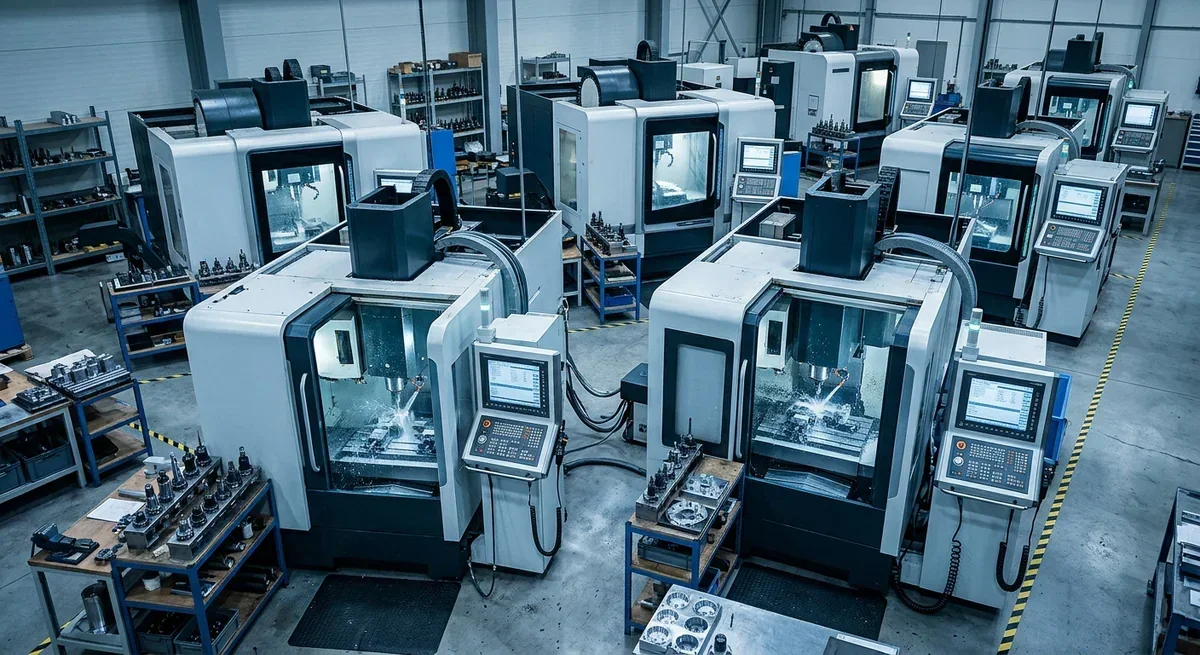
CNC machining centers in a factory highlight trends like connected networks and AI-driven optimization, crucial for reducing idle time.
This list focuses on technologies showing measurable operational impact instead of speculative concepts. We evaluated each trend using four filters: adoption speed, implementation cost, process reliability, and long-term production relevance. Manufacturing engineers, CNC programmers, and factory managers need practical answers now because investment mistakes made in 2026 will likely remain visible for years.
Skills Before Modernization
Shops rushing into automation purchases during early 2026 are discovering the same problem: unstable machining data breaks expensive software faster than most vendors admit in sales presentations. According to Autodesk's late 2025 Fusion manufacturing survey, inconsistent tooling libraries and undocumented setup practices remain two of the biggest barriers blocking CNC automation adoption. Pick3DP readers have asked about this after failed probing and pallet automation deployments.
AI-assisted machining depends on clean process inputs. A controller cannot make reliable feed rate corrections if spindle load baselines vary from one operator shift to another. Shops with poor tool life tracking also struggle to train predictive maintenance systems because the software cannot separate normal wear from unstable programming behavior.
Modern CAM platforms now carry more operational weight than spindle horsepower in many multi-axis environments. Siemens NX, Mastercam, and Fusion 360 expanded simulation and CNC simulation verification features during 2025 because simultaneous machining workflows demand accurate post-processors and stable machine communication. Network reliability matters too. MTConnect and OPC-UA standards only help when machines, inspection stations, and ERP systems exchange data consistently.
The most common mistake remains familiar: companies buy robots before standardizing fixturing, offsets, and process documentation. Intermediate shops should stabilize repeatability first, then expand toward digital twins or lights-out production.
1AI Toolpath Control
Why Shops Are Adopting It
- AI-integrated CNC controllers adjust feed rate and spindle load behavior during live cutting instead of following fixed programming values.
- Aerospace suppliers gained the fastest returns because scrap reduction offsets higher sensor and software costs.
- Real-time thermal compensation improves surface consistency during long production runs on difficult alloys.
- Poor sensor calibration still causes unstable adaptive machining results.
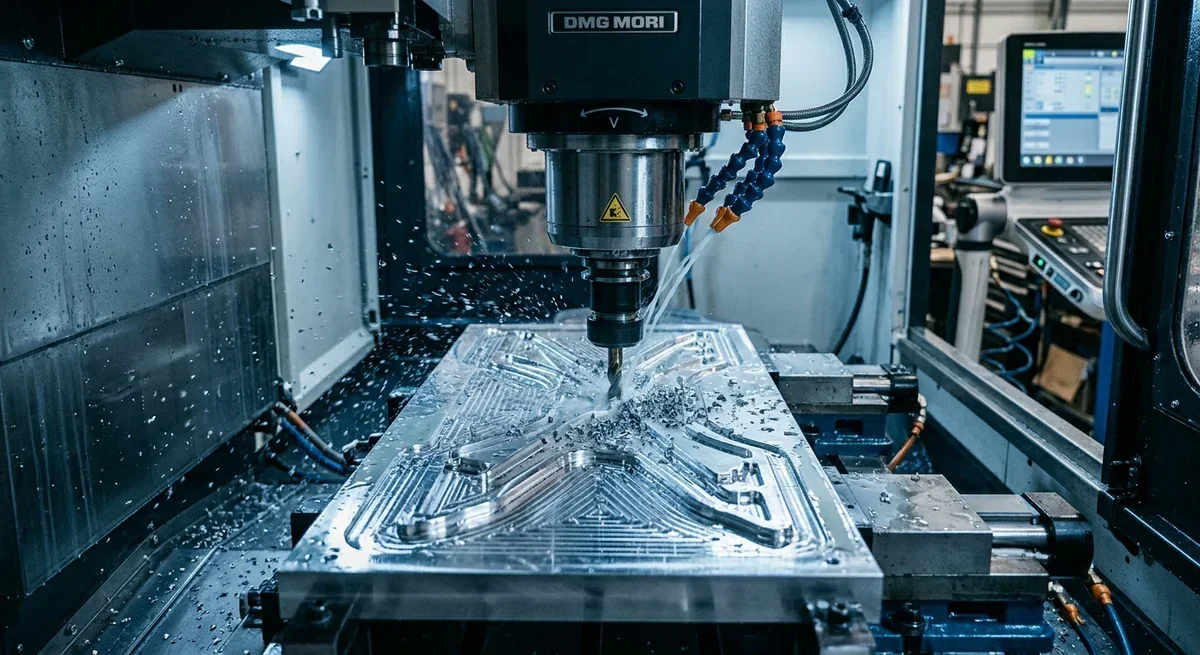
A CNC machine from DMG MORI mills a metal workpiece, showcasing precision machining with coolant application. This highlights trends in reducing scrap and improving surface consistency in aerospace manufacturing.
Sandvik Coromant expanded CoroPlus monitoring integrations, while FANUC and Siemens controller updates added machine learning features tied to adaptive toolpath optimization. These systems combine spindle load tracking and vibration monitoring to react faster than manual operator intervention. Traditional CNC programming cannot respond once the cycle starts.
Early deployments work best when engineers establish baseline spindle-load windows before activating feed overrides. Shops also need verified tooling data from platforms like Machining Cloud because inaccurate cutter geometry creates unstable AI compensation behavior. High-volume manufacturers will likely see return.
2Multi-Axis Expansion
Where Multi-Axis Wins
- 5-axis and 6-axis machining reduce multiple setups by reaching complex surfaces from nearly every angle in one cycle.
- Aerospace housings, orthopaedic implants, and turbine components benefit most from simultaneous rotary motion.
- Surface continuity improves because the cutter maintains more consistent tool engagement across compound geometry.
- Shops still crash machines when operators skip verified CNC simulation before production.
DMG Mori, Okuma, and Haas Automation all expanded multi-axis product lines through late 2025 because aerospace and medical suppliers continue consolidating operations into fewer setups. Indexed machining rotates the part between cuts, while simultaneous machining moves rotary and linear axes continuously during tool engagement. That difference matters when deep cavities, undercuts, or flowing surface geometry demand stable cutter contact.
Successful deployments depend heavily on CAM verification and machine calibration. Engineers running Fusion 360, NX CAM, or Mastercam now spend more time validating post-processors and collision zones than programming simple toolpaths. Shorter tool stick-out also improves rigidity and surface finish consistency during aggressive cuts. Flat aluminum work still favors 3-axis production because setup simplicity often beats multi-axis flexibility on high-volume commodity parts.
3Hybrid Production Systems
Why Hybrid Machines Matter
- Hybrid manufacturing combines additive metal deposition with CNC finishing inside one machine platform.
- Aerospace repair operations benefit because directed energy deposition reduces expensive material waste.
- Near-net-shape production lowers roughing time on difficult nickel and titanium alloys.
- Shops still underestimate how much finish machining deposited material requires.
Mazak and DMG Mori accelerated hybrid system development after aerospace suppliers increased repair and remanufacturing programs through 2025. Machines like the Lasertec series combine deposition heads with precision milling spindles, allowing operators to build and finish parts without moving workpieces between stations. Conventional subtractive machining often removes most of a billet during production. Hybrid workflows dramatically reduce that waste.
Thermal control becomes the operational bottleneck. Engineers must manage heat buildup between deposition passes or dimensional accuracy drifts outside tolerance before finishing begins. Support geometry planning also matters because deposited structures rarely emerge production-ready. Most manufacturers still leave measurable finish allowance for final milling passes. Simple aluminum components remain cheaper on conventional machining centers, especially where production volumes justify dedicated fixtures and optimized roughing strategies.
4Digital Twin Workflows
What Digital Twins Prevent
- Digital twins create live virtual replicas of machines, tooling, fixtures, and toolpaths before cutting begins.
- Aerospace and medical manufacturers use them to reduce expensive setup crashes and prove-out delays.
- Real machine kinematics improve simulation accuracy compared with simplified CAM previews.
- Incomplete machine models remain the most common deployment failure.
Siemens expanded NX digital twin capabilities during 2025, while CGTech continued adding detailed machine verification inside Vericut. These platforms simulate real machine motion using controller-specific parameters, rotary limits, and exact tool assemblies. Traditional dry runs rely heavily on operator observation and manual overrides. Digital twins reduce that dependence.
Accurate modeling takes discipline. Shops must synchronize inspection data, fixture offsets, probing routines, and post-processors or simulation results lose credibility quickly. Production engineers also need updated machine calibration data because worn rotary axes create mismatches between virtual motion and physical cutting. That's still a challenge. Low-complexity shops with stable repeat jobs may not recover the deployment cost because manual prove-outs remain faster for simpler work.
5Lights-Out Production
How Unattended Machining Works
- Lights-out production combines robots, pallet systems, automated probing, and monitoring software to keep machines cutting without operators present.
- High-mix production environments gain the most because spindle uptime expands into nights and weekends.
- Automated loading systems reduce idle handling time between machining cycles.
- Poor chip evacuation still shuts down many unattended cells before morning shifts arrive.
Fastems, FANUC, and Okuma expanded robotic cell partnerships during 2025 as manufacturers searched for ways to offset labor shortages and rising overtime costs. Modern unattended machining extends far beyond simple bar feeders. Advanced production cells now coordinate probing cycles, pallet exchanges, inspection checkpoints, and spindle load alarms through centralized monitoring software.
Reliable automation depends on process stability. Shops running unattended cells need redundant probing routines, consistent workholding repeatability, and programmed air-blast chip clearing before operators leave the floor. Engineers also limit autonomous feed overrides during overnight production because unstable adaptive changes increase crash risk without supervision. Prototype work rarely fits this model because constantly changing fixtures and setups undermine repeatability. That's the tradeoff.
6Predictive Maintenance Growth
What Predictive Systems Track
- Predictive maintenance platforms monitor spindle vibration, servo behavior, temperature drift, and tool wear continuously.
- Automated factories gain the largest savings because unexpected downtime disrupts multiple connected operations.
- Machine monitoring software detects abnormal behavior before catastrophic spindle or axis failures occur.
- Shops often collect machine data without defining maintenance response thresholds first.
According to Hexagon's 2025 manufacturing automation report, predictive maintenance adoption increased sharply across aerospace and automotive machining facilities where downtime costs continue climbing. Unlike scheduled maintenance programs tied to calendar intervals, predictive systems evaluate actual machine condition through sensor feedback and controller data. Reactive repair strategies wait until failures become visible. That approach now looks increasingly expensive.
Successful deployments start with baseline measurement. Engineers track spindle load trends, vibration signatures, and servo temperatures during stable production runs before defining alert thresholds inside CMMS platforms. Shops also need disciplined maintenance response procedures or operators ignore warning notifications after repeated false alarms. Smaller manual job shops may not recover the cost of full-scale monitoring because lower spindle utilization naturally reduces machine stress.
7Sustainable Shop Practices
Where Efficiency Improves Most
- Sustainable machining reduces coolant use, idle energy consumption, and material waste through optimized production strategies.
- Manufacturers facing ESG reporting pressure and higher electricity costs pushed adoption through 2025.
- Minimum-quantity lubrication systems reduce coolant disposal requirements on suitable materials.
- Dry machining still fails on some heat-sensitive alloys requiring aggressive thermal control.
Sandvik Coromant and Seco Tools expanded adaptive toolpath optimization features during late 2025 because cycle-time reduction now doubles as an energy-efficiency strategy. Modern CAM systems remove unnecessary rapid motion, lower spindle load spikes, and maintain more stable cutter engagement. Older flood-coolant roughing workflows consume more power and generate higher coolant disposal costs during long production runs.
Most measurable gains come from process tuning rather than expensive machine replacement. Engineers running adaptive toolpaths often reduce cycle times while extending tool life through smoother cutter engagement. MQL airflow adjustment also matters because insufficient lubrication rapidly damages tooling during aggressive cuts. Aluminum chip recycling programs continue expanding across automotive suppliers where scrap recovery economics remain favorable. Titanium machining still relies heavily on conventional coolant systems for thermal stability.
8Connected Factory Networks
Why Connectivity Matters Now
- Industry 4.0 connectivity links CNC machines, MES platforms, ERP systems, and inspection stations into one synchronized workflow.
- Aerospace and automotive factories use centralized monitoring to improve scheduling and production traceability.
- MTConnect and OPC-UA standards allow machines from different vendors to exchange operational data.
- Legacy equipment integration still creates the biggest implementation challenge.
Siemens, Rockwell Automation, and Mitsubishi Electric expanded factory connectivity offerings through early 2026 because manufacturers want live production visibility instead of isolated machine data. Connected environments eliminate manual transfer of setup sheets, inspection reports, and production status updates between departments. Traditional disconnected cells slow scheduling decisions and hide utilization problems until delays become expensive.
Network stability matters more than flashy dashboards. Engineers deploying connected machining systems must validate machine protocol compatibility, segment production networks, and establish cybersecurity controls before connecting controllers to cloud analytics platforms. Smaller shops often gain enough value from partial connectivity, especially machine monitoring and digital job tracking, without committing to full enterprise integration. Pick3DP could not independently confirm several vendor claims about real-time cross-platform compatibility at the time of writing. Not confirmed.
9Reshoring Production Capacity
Why Localization Accelerates
- Reshoring moves CNC manufacturing closer to domestic or regional supply chains to reduce freight risk and delivery delays.
- OEMs benefit because localized machining partnerships shorten engineering feedback loops and lead times.
- Automation helps offset higher labor costs in North American and European production environments.
- Workforce shortages still limit how quickly reshoring programs can scale.
According to the Reshoring Initiative's 2025 annual report, manufacturers increased domestic sourcing activity after continued shipping volatility and geopolitical disruptions affected production planning through late 2025. Older global sourcing strategies focused primarily on labor-cost reduction. Many OEMs now prioritize reliability and engineering responsiveness instead.
Modern machining capability determines whether reshoring succeeds long term. Companies investing in localized supply chains are also upgrading multi-axis capacity, automation systems, and machine connectivity to remain cost competitive against overseas production. Workforce development remains the weak point because experienced CNC programmers and setup technicians remain difficult to hire across multiple regions. That's becoming a strategic problem. Reshoring without machine modernization or operator training usually increases costs without solving throughput constraints.
Building Adoption In Stages
Most intermediate shops should ignore the temptation to modernize everything simultaneously. AMT and Deloitte manufacturing surveys released during Q1 2026 both showed that failed automation deployments often trace back to inconsistent tooling data, undocumented setups, or unstable fixturing rather than weak hardware performance. Shops chasing lights-out production before stabilizing repeatability usually create expensive downtime instead of productivity gains.
The first upgrades should focus on visibility and process discipline. Predictive maintenance platforms, machine connectivity, and CAM optimization typically deliver faster operational returns because they improve uptime and programming consistency without completely rebuilding production workflows. Shops also gain cleaner spindle load data and more accurate tool life tracking, both of which support later AI-assisted machining deployment.
Multi-axis machining and automation require a stronger operational foundation. Engineers need standardized holders, documented offsets, repeatable probing routines, and verified CNC simulation before unattended production becomes reliable. Professional execution looks very different from intermediate adoption because advanced shops continuously validate machine calibration, inspection data, and post-processors rather than treating setup work as a one-time task.
Investment sequencing should match production reality. Smaller job shops often benefit most from adaptive toolpath improvements and monitoring systems first, while higher-volume aerospace suppliers may justify robotic pallet systems or digital twin deployment much earlier.
Staying Competitive Beyond 2026
Manufacturers entering 2027 will compete less on spindle horsepower and more on adaptability, machine intelligence, and production visibility. Siemens, FANUC, and Sandvik all spent 2025 expanding AI-assisted machining, connected factory analytics, and adaptive control systems because customers now prioritize uptime and process stability over raw machine specifications. Shops that still operate disconnected production cells increasingly struggle to maintain predictable lead times under current labor and supply-chain pressure.
AI-assisted machining and predictive maintenance appear positioned for the fastest operational impact across most production environments. Real-time spindle load analysis, automated feed rate adjustment, and condition monitoring already reduce scrap and unplanned downtime in higher-volume machining centers. Multi-axis capability also continues expanding because aerospace, medical, and energy components rarely fit simple 3-axis workflows anymore.
Intermediate shops should start with connectivity, machine monitoring, and CAM optimization before attempting fully autonomous production. Advanced manufacturers with mature tooling systems and stable fixturing practices can justify larger investments in digital twins, robotic pallet systems, and unattended machining cells. That progression matters.
Long-term competitiveness still depends on machining fundamentals. Shops generating the strongest margins combine disciplined process control, documented tooling strategy, stable machine calibration, and experienced operators with modern automation systems. Technology amplifies consistency. It does not replace it.
Business journalist covering the digital fabrication and advanced manufacturing sector. Reports on funding rounds, acquisitions, executive moves, and strategic partnerships across 3D printing, CNC machining, laser machining, and related industries.