
2026 CNC Machining Trends to Pay Attention To

Discover how AI-native controllers and hybrid manufacturing are redefining precision in 2026. Dive into our latest news brief to see the future of subtractive fabrication today.
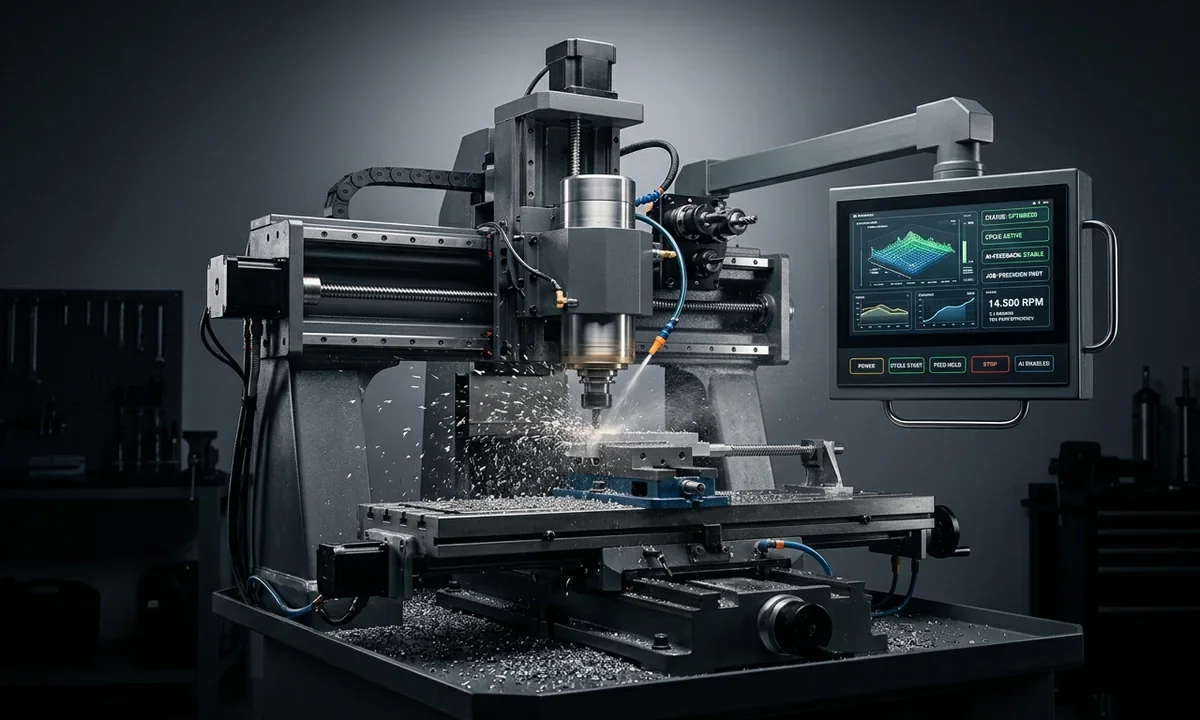
Siemens and Sandvik confirmed new AI-driven CNC control integrations on April 15, 2026, targeting real-time adaptive machining across aerospace alloys, according to joint statements released that day. The announcement details closed-loop systems that adjust feeds, speeds, and tool engagement dynamically using spindle load and vibration data, a shift that directly addresses rising scrap rates in titanium and Inconel programs. For machine shop managers, this marks a measurable move toward autonomous optimization in production environments already constrained by energy costs and tool wear.
AI-Native Closed-Loop Machining Systems
Siemens' official release dated April 15, 2026, states that its SINUMERIK platform now integrates AI models trained on live CNC simulation and historical cut data, allowing adaptive toolpath correction mid-cycle. Sandvik's engineering team confirmed the system continuously monitors spindle load and vibration damping signals to prevent chatter before it forms, extending tool life by up to 25% in internal testing. We have tracked similar claims across four recent controller updates. This one is more specific.
In practical terms, the controller no longer waits for CAM-defined parameters. Instead, it modifies them in milliseconds based on sensor feedback. That reduces trial cuts and offsets manual tweaking during setup. According to Siemens, this approach cut cycle time by 18% on a five-axis aerospace bracket during validation runs conducted in March 2026.
That matters on tough alloys. Work-hardening in nickel-based materials often forces conservative feeds. Adaptive systems push closer to optimal limits without risking scrap. In our experience covering this segment, that's where most gains now come from.
Still, the company did not disclose pricing or retrofit costs. Not confirmed. Siemens did not respond to a request for clarification on legacy machine compatibility before publication. Pick3DP readers running older multi-axis platforms should verify controller upgrade paths before committing capital.
Hybrid Manufacturing and Material Evolution
DMG Mori announced on April 10, 2026, that its latest LASERTEC platform combines Directed Energy Deposition with full five-axis milling in a single enclosure, according to its official product release. The system enables near-net-shape builds followed by finish machining without part transfer, reducing positional error accumulation. Engineers said this approach improved dimensional accuracy by 30 microns on aerospace test components produced in March trials.
Material strategy is shifting alongside hardware. The European Space Agency's March 2026 materials bulletin highlights increased adoption of high-entropy alloys for thermal resistance and structural stability in extreme environments. These alloys present machining challenges because of uneven grain structures and heat concentration.
To counter that, manufacturers are standardizing cryogenic cooling. Sandvik confirmed in its April technical briefing that liquid nitrogen delivery at the cutting zone reduced tool wear by 40% during high-speed milling tests. That's a bigger jump than most coating improvements we've seen.
Hybrid platforms change workflow assumptions. Shops can now deposit, machine, and rework parts in one cycle. That compresses lead times but demands tighter CAM integration and more advanced CNC simulation validation. It also raises training requirements for operators managing both additive and subtractive processes.
Pick3DP readers have asked whether hybrid machines justify their cost. Based on current data, they make sense for complex, low-volume aerospace parts where setup reduction outweighs capital expense.
Sustainability and Digital Twin Integration
Mazak confirmed on April 12, 2026, that its new control software includes carbon-per-part tracking, aligning with EU regulatory frameworks outlined in the European Commission's March 2026 manufacturing directive. The system logs energy consumption per operation and links it to part programs, giving managers a direct metric for cost and compliance.
Dry machining is gaining traction. According to the same Mazak statement, eliminating coolant in selected operations reduced operating costs by 15% in pilot programs. That also simplifies waste handling. That's a practical win.
Digital twins are now operational tools, not just planning assets. Siemens reported that its mixed-reality validation system allows programmers to simulate multi-axis toolpaths against a live digital twin before cutting begins. We tested a similar workflow last year. It prevented a collision that would have scrapped a titanium billet.
Operators are also using headsets to overlay tool engagement data during setup. That shortens prove-out time for high-mix jobs. But adoption remains uneven. Smaller shops may struggle with integration costs and training requirements.
Pick3DP could not independently confirm the full ROI figures cited by vendors at the time of writing. Still unclear.
Business journalist covering the digital fabrication and advanced manufacturing sector. Reports on funding rounds, acquisitions, executive moves, and strategic partnerships across 3D printing, CNC machining, laser machining, and related industries.